
Part 1 of 2 in The Center Tear.
There is a moment in every strong billet routine where the paper touches your hands and something happens that no camera in the room can catch. It doesn’t matter how good the phone in your pocket is. What happens in that half second between a spectator’s folded paper and your reveal is still, more than a hundred years after mentalists started doing it on purpose, the hardest thing in the craft to explain to someone who hasn’t done it.
I don’t think most laypeople could tell you what a center tear even is. Most performers can, but far fewer could tell you where it came from, and fewer still could tell you why it refuses to go extinct even as billet gimmicks get more elaborate every year. That’s worth fixing.
Paper Before the Move Had a Name
Long before anyone called it a “center tear,” audiences were handing folded paper to strangers and asking them to read minds with it. The spiritualist circuit of the mid to late 1800s ran on it. Billet tests, pellet reading, “psychic” question answering, these were staples of the séance parlor, and they worked on the same basic promise the modern mentalist still sells: write something private, seal it, and watch someone who never saw it read it back to you.
Bert Reese built an entire career on billet work, and he built it well enough that scientists took him seriously. He was reportedly examined by physicists and inventors trying to catch the trick, and by most accounts, they walked away without an answer. Reese never wrote a manual. He didn’t need to. His method traveled the way real secrets travel, by whispered lineage from performer to performer, refined a little each time it changed hands.
That’s the part people forget. The center tear wasn’t invented at a desk. It was worn smooth by decades of people who needed it to survive close scrutiny from folks who very much wanted to catch them.
The Method Gets Written Down
Magic literature is slow to catch up to what performers are actually doing in the field, it usually takes a generation before the working method makes it to print. By the time the center tear started showing up in manuscripts and pamphlets in the early 1900s, it had already been circulating as an insider’s secret for years.
Al Baker’s name comes up constantly in serious histories of the move, and Theodore Annemann’s periodical The Jinx did more than almost any single publication to push mentalism methods into the open literature during the 1930s. Annemann wasn’t precious about secrets the way some of his contemporaries were. He published fast, he published often, and he published technique that other performers had been sitting on for a decade.
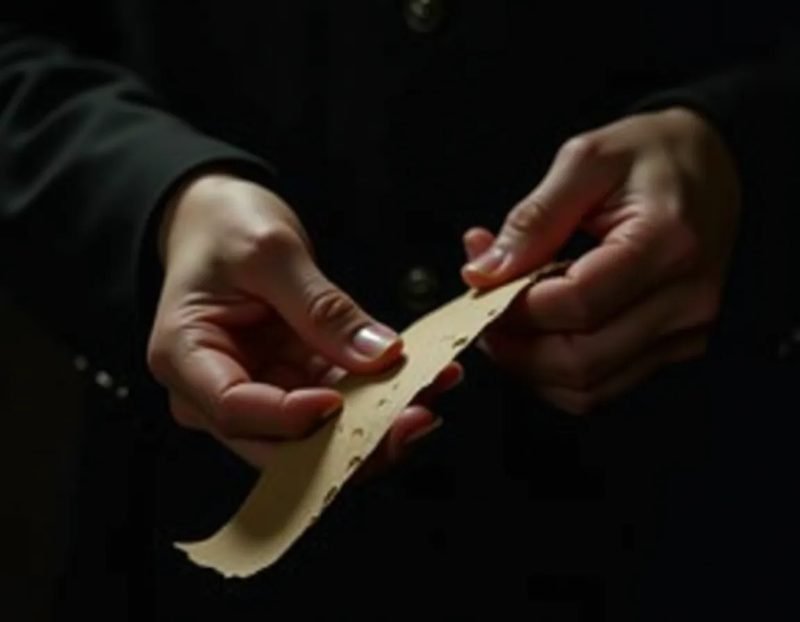
What changed in this period wasn’t the core mechanic. Tear a folded billet roughly in half, retain the piece with the information, appear to destroy the rest. What changed was the choreography around it, the patter that covered the moment, the angles that made it invisible from three sides of a room instead of just one.
Corinda Codifies the Craft
If you ask most working mentalists where they first learned the center tear properly, an enormous number will point to the same book. Tony Corinda’s 13 Steps to Mentalism, compiled from his lecture notes and published in 1968, did for the center tear what a good textbook does for a scattered field. It organized decades of whispered method into a single reference that a serious student could actually study.
Corinda didn’t invent the tear. He inherited it, the way everyone in this chapter of the story inherited it from someone else, and he had the discipline to write it down clearly enough that it could be taught without a personal apprenticeship. That’s a bigger contribution than it sounds like.
Before Corinda, learning this move meant finding someone willing to show you, usually after they’d decided you could be trusted with it. After Corinda, it meant sitting with a book and your own hands until the fold felt natural. The craft got more democratic. It did not get easier.
Why the Tear Still Fools a Room
Here’s the part most guides skip past. The center tear isn’t a paper trick, it’s an attention trick that happens to involve paper. The method works because it exploits something true about how people watch hands: a spectator tracks the object, not the fingers manipulating it, and the moment a visible action like tearing begins, the eye commits to following the torn pieces rather than auditing what each hand did a half second earlier.
I’ve run this move at a private event in the Louisville area more times than I can count, and the reaction is never about the paper. It’s the pause right before the reveal where a spectator’s face changes, some little muscle around the eyes lets go, and you can see them deciding whether to believe what just happened.
My hands go still in that pause. Not because I need them to. Because thirty years of performers before me figured out that stillness reads as honesty, and I’m just borrowing what they already proved.
What Modern Props Are Really Doing
This is the part that should make working mentalists sit up. Nearly every serious billet gimmick sold today, the double-sided pads, the switch envelopes, the peek wallets, exists to solve a problem the center tear already solved by hand: how do you get honest information from a spectator without ever appearing to look at it before your reveal.
Some of these tools are genuinely clever engineering. A few are worth owning. But none of them replace the psychological cover a well-executed manual tear provides, because a gimmick asks an audience to trust an object, while the tear asks them to trust a person who is visibly, audibly destroying the only evidence in the room. Those are not the same request, and audiences respond to them differently whether they can articulate why or not.
Most performers reach for a gimmick because the manual method feels risky. They’re not wrong that it’s risky. They’re wrong that the risk is the problem. The risk is the reason it still works after a century of audiences trying to catch it.
None of that means an envelope has no place in your show. It does, just not as a stand-in for the tear. A well-made envelope earns its keep for switches, for peeks you need mid-routine, for pre-show work done an hour before anyone walks in, for a production that has to look clean under a spectator’s nose a second later. That’s a different job than the one the tear does, and confusing the two is how a good tool ends up with a bad reputation.
This is actually why I worked with Joseph Daniels to build Janus, a mechanical envelope system built for exactly those jobs: switches, peeks, pre-show prep, and productions that stay clean under scrutiny. No batteries, no app, nothing that can die on you mid-show, just paper and mechanical ingenuity doing what an envelope is actually good at. It was never trying to be the tear. It doesn’t ask your audience to trust a person destroying the only evidence in the room, it asks them to trust an envelope, and for the moments where that’s exactly the trust you want, it earns it. If your act has a spot that calls for that kind of cover, it’s worth a look.
Carrying the Move Forward
Every serious mentalist eventually has to decide how much of this history they want in their hands versus in their toolbox. There’s no wrong answer, honestly, a well-built gimmick and a well-drilled manual tear can both fool the same room on the same night. But I do think something gets lost when a performer skips the manual version entirely and never learns why it was built the way it was.
The people who refined this move across a hundred years of spiritualist parlors, magic society lectures, and quiet backstage conversations weren’t trying to make your life easier. They were trying to survive scrutiny from people actively hunting for the seam.
Learn it the old way at least once. You’ll understand every modern billet tool on the market a great deal better once you do.
Explore the current collection of billets, mentalism tools, and troubled relics built for performers who take this craft seriously at Arcane Relics.
For Janus visit Janus.
Continue reading: Part 2: The Center Tear in a Phone-First World, Adapting Mentalism’s Most Important Move for Volunteers Who Don’t Carry Paper