
My father-in-law once handed me a talking board that had been in his family’s attic since the 1930s, wrapped in a pillowcase, “just in case.” He didn’t want it in the house. He didn’t want to throw it away either. That tension, half embarrassment and half genuine unease, is the entire collector’s market for Ouija boards in a single gesture.
Most people think of these as party store toys. Cardboard, plastic planchette, shrink wrapped next to the playing cards. That’s not wrong exactly, that’s what the modern object became. But the lineage runs through serious spiritualist history, patent offices, and some genuinely strange business partnerships. If you collect bizarre magic and mentalism artifacts and you don’t have a real one in the cabinet, you’re missing a piece of the story you’re supposedly telling.
The Board Was Never Supposed to Be a Toy
Talking boards predate the Ouija trademark by decades. Planchette writing, a small heart-shaped device on wheels with a pencil fixed to the point, was popular parlor spiritualism in the 1850s and 60s, well before anyone had printed a letter board to go with it. The alphabet board itself gets commercialized properly in 1890, when a Baltimore group including Elijah Bond files a patent for a device that lets a “spirit” spell out answers without a medium doing the interpreting.
The name comes next, and the story around it is one of the strangest origin tales in American commerce.
According to the accepted account, the board was asked what it wanted to be called, and it spelled out “Ouija.” Someone in the room claimed the word meant “good luck” in an old language. It didn’t. Nobody has ever been able to source that translation to anything real.
Charles Kennard trademarked the name in 1891. William Fuld took over the company a few years later and built it into the dominant manufacturer for the next half century, and Fuld boards are still the backbone of serious collecting today. Parker Brothers bought the rights in 1966. Hasbro owns it now, by way of acquiring Parker Brothers.
That’s four separate corporate eras stamped onto the back of a wooden board. Each one changed the printing, the materials, the box art. Each one is dateable if you know what to look for.
What Actually Moves the Price
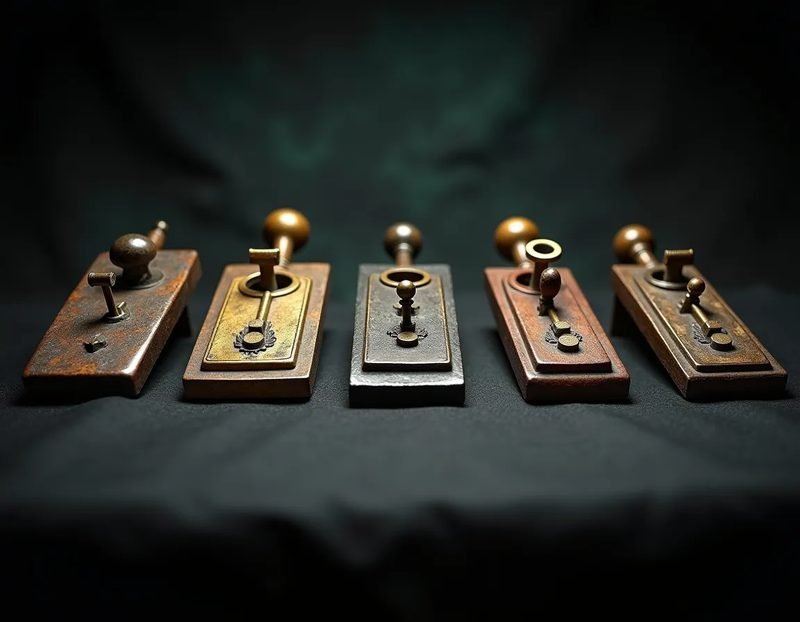
I’ve watched enough estate sales and online auctions to tell you the value swings aren’t subtle, and they aren’t about how “spooky” a board looks. They come down to four things.
- Maker and era. Early Kennard Novelty Company boards from the 1890s are the rarest and command real money when they surface with clean provenance. William Fuld boards from roughly 1901 through his death in 1927 are the meat of the serious market, wood construction, printed by lithography, often with a varnished finish that ages into a warm amber. Post 1930s Fuld production shifted and got more mass produced. Parker Brothers era boards, 1966 onward, are common and cheap, they’re collectible mostly for box art variation, not scarcity.
- Material. Wood before cardboard, always. The earliest boards were solid wood with painted or stenciled lettering. Cardboard construction crept in as a cost-saving measure and it shows in how the boards survived, or didn’t. A wood board that’s been kept dry for a century still feels substantial in your hands. Cardboard from the same era is usually gone, water damaged or crumbled at the corners.
- The planchette itself. A huge number of boards on the market today are missing their original planchette, which is a real problem for value, since the two were sold as a set and a mismatched replacement is obvious to anyone who’s handled a few dozen of these. Original planchettes are wood, often with a small glass or mica “window” set into the wide end for reading letters underneath the pointer.
- Condition of the printing, not the wood. Collectors obsess over surface scratches, but what actually kills value is faded or chipped lettering, since the board is functionally useless as a display piece if half the alphabet has worn away.
A board with strong maker attribution, matching planchette, and legible lettering will outsell a “prettier” board with none of those three every time.
Provenance Is the Whole Game
Here’s the part most casual buyers get wrong. They chase the board. Serious collectors chase the story attached to it.
A plain, unremarkable 1920s Fuld board with a documented chain of ownership, an estate letter, a dated photograph of it in use, a family account of who owned it and why, will sell for multiples of an identical board with no history at all. This isn’t superstition dressed up as connoisseurship. It’s the same logic that drives every category of collectible from military medals to movie props. The object is common. The story is not.
I’d go further, and this is where I depart from the pure antiques crowd. For a performer, provenance isn’t just about resale value. It’s material. A board with a real, verifiable, unsettling history behind it is a script you didn’t have to write. You can present the object honestly, name the decade, name what’s known about who owned it, and let the room fill in the rest.
You don’t need to claim anything supernatural to get that reaction. The history alone does the work.
Spotting a Fake or a Heavily “Improved” Board
The reproduction market for talking boards is enormous, because the aesthetic sells regardless of age. That’s fine for décor. It’s a problem when someone’s trying to pass a reproduction off as a genuine antique, which happens more than buyers expect.
A few tells I check every time:
- Screen printing versus lithography. Genuine early boards were lithographed, which leaves a particular texture and slight registration imperfection under magnification. Modern reproductions are almost always screen printed or digitally printed, and the lines are too clean, too uniform.
- Font accuracy. The Fuld company changed its lettering style across different production runs. If you know the era being claimed, you can check whether the font actually matches. Sellers who don’t know this history will happily pair a 1910s claim with 1940s lettering.
- Wear that doesn’t match handling. Real wear concentrates where hands and fingers actually travel, the “goodbye” corner, the numbers along the bottom, the edges gripped during use. Artificial aging, sanding, staining, tea washing, tends to be even and generalized across the whole surface. It looks old. It doesn’t look used.
- Hardware and construction. Old wood boards were often finished with hide glue and cut nails or period-correct screws. A board claiming an 1890s date with Phillips head screws has already told you everything.
None of this requires a lab. It requires slowing down and actually looking, which most buyers, dazzled by the object’s reputation, don’t bother doing.
Why This Belongs in a Working Performer’s Collection
Most mentalists own a talking board and never use it for anything beyond a shelf piece. That’s a mistake, and it’s the second thing most performers get wrong here.
The board is one of the only pieces of “occult” material culture that a general audience already has a relationship with. They’ve seen it in movies. Somebody’s cousin has a story about one. You don’t have to build belief from zero the way you do with an invented artifact. You’re building on top of something the room already half believes, or wants to believe, or is afraid to admit they believe.
I’ve used mine sparingly, once at a private event, and the reaction wasn’t to the mechanics of what moved. It was to the object itself, sitting there before I’d touched it. People leaned toward it and away from it in the same motion.
That’s a rare thing for a prop to do before you’ve done a single move.
A genuine antique board also gives you something a reproduction can’t fake, weight in conversation. When someone asks about it after the show, you’re not reciting a prop description. You’re talking about a real company, a real patent fight, a real family that owned this specific object before you did. That authority changes how the whole piece is received, and it changes how you’re received as the person who owns it.
If you’re going to add a talking board to your collection, add one worth talking about honestly.
Browse the current selection at arcanerelics.com/shop/.