

Ten years ago, if you wanted a gaffed coin that passed inspection under a loupe, you needed a machinist, a lathe, and a favor owed by someone in a tool and die shop. Today you need a résin printer that costs less than a decent deck of cards and an evening. That shift hasn’t just changed what’s possible on a workbench. It’s changed what a serious collector is willing to trust, and what they’re willing to pay for.
What Changed When the Printer Showed Up
I don’t necessarily believe additive manufacturing “democratized” magic, that word gets thrown around too easily. I do have a strong conviction that it collapsed a cost and time barrier that used to function as a quality filter, whether anyone intended it that way or not.
A magnetic thumb tip, a load-bearing false bottom, a shell that mates to a real coin within a thousandth of an inch, these used to take a craftsman days and a client’s patience. Now a maker with a decent SLA printer and some patience of their own can iterate a dozen versions in a weekend. The tolerances that once required a skilled hand on a lathe are now a slicer setting.
That’s genuinely useful. It’s also why the market got noisy fast.
The Tell Is in the Tolerance
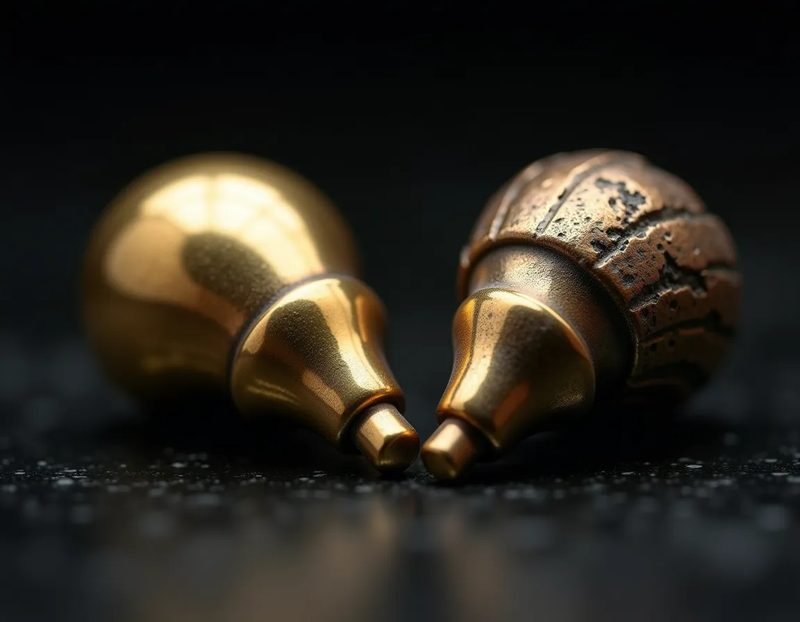
Here’s the thing most buyers still don’t check, and most sellers hope they won’t. Layer lines don’t lie. Hold a cheaply printed gaff at a raking angle under a single hard light source and you’ll see the truth of it, faint horizontal ridges climbing the surface like the topography of a coin nobody wants to look at twice.
Good printed work sands those lines out, primes, and finishes the piece so it reads as metal, wood, or bone under stage light and under a spectator’s hand. Bad printed work skips that last mile because sanding and finishing take almost as long as the print itself, and that’s exactly where the corners get cut.
A gaff has one job. It has to survive contact.
Cheap printed props survive a photograph. They don’t survive a spectator running a thumb across the seam, and any performer who’s had a prop exposed in someone’s hand knows that particular flavor of dread. My jaw tightens just thinking about it.
Why Hand-Made Still Commands the Premium
I collect. I also sell. Those two roles disagree with each other more often than you’d think, and this is one of those moments.
A hand-turned brass shell carries something a printer can’t replicate, and it isn’t nostalgia. It’s the accumulated judgment of a person who has made two hundred of these before and knows exactly how much material to leave at the lip so the shell doesn’t ring false when it’s set down on a table. A printer executes a file. A machinist corrects for the file’s mistakes in real time, feels when the cut is running hot, adjusts before the piece is ruined.
That’s not a small difference, my dear friend, that’s the entire difference.
Serious collectors pay for provenance as much as function. A piece with a known maker’s mark, a documented lineage, a story about who owned it before, that piece holds value the way a printed one-off from an anonymous file simply cannot. You’re not buying a mechanism. You’re buying a chain of trust.
Where Printing Actually Wins
None of this means printed gaffs are lesser by default. That’s too simple a take, and simple takes are usually wrong.
Printing is unbeatable for prototyping. A designer can test six variations of a switch mechanism’s internal geometry before committing brass to a lathe, catching a binding issue on iteration three instead of discovering it after forty dollars of raw material is already scrap. I’ve reworked utility devices this way myself, running a printed test piece through actual handling before ever touching metal.
Printing also wins for low-volume, high-complexity internals, things like nested compartments or organic curves that would take a machinist a full day to rough out and that a printer resolves overnight. And for props that live in a case and get handled by the performer only, never inspected by a spectator’s fingers, the surface-finish argument matters a lot less.
The honest answer is that the technology isn’t the problem. The discipline around finishing it is.
What Collectors Are Actually Paying For
I’ve watched this shift play out in real conversations with buyers, some of them at events around the Louisville area, some over email at odd hours from people who clearly couldn’t sleep until they’d asked their question. The pattern is consistent.
Buyers who understand the craft ask three things before they ask about price: who made it, what it’s finished in, and whether the maker stands behind the tolerance by hand or by machine alone. Buyers who don’t understand the craft ask what it looks like in the photo.
That gap is where trust gets built or lost.
A well-disclosed printed piece, sold honestly as printed, finished properly, and priced accordingly, has a real place in a working performer’s kit. What erodes the whole market is the piece sold as “hand-finished” that’s really just a print pulled straight off the bed with a coat of paint slapped over the layer lines. That’s not a shortcut. That’s a lie with a UV cure on it.
A Buyer’s Checklist Worth Keeping
If you’re building a serious collection, or building a serious act, here’s what I’d actually check before money changes hands.
- Ask for the process, not just the price. A maker who’s proud of their work will tell you exactly how a piece was produced. Hesitation is information.
- Check the seams under raking light. Tilt the piece so light skims across the surface rather than hitting it straight on. Layer lines and mold seams both show up this way.
- Weight matters more than people admit. A printed resin shell and a machined brass shell can look identical in a photo and feel completely different in the hand. If weight matters to the effect, ask what the piece is actually made of.
- Ask what happens under repeated handling. Some resins go brittle with UV exposure over months. Brass doesn’t care. Get a straight answer about longevity, not a marketing one.
- Provenance is not decoration. A maker’s mark, a signed certificate, a documented run number, these aren’t sentimental extras. They’re what keeps the piece’s value intact five years from now.
The Bottom Line for Working Performers
Additive manufacturing didn’t cheapen mentalism props. It exposed which parts of the craft were actually load-bearing all along, and which parts were just labor that happened to double as a quality guarantee.
The labor is no longer the guarantee. The judgment behind it still is.
So yes, buy the printed prototype when it does the job and it’s honestly sold. But when a piece is going to live in your hands for the next decade of your career, or in a case as part of a collection you actually care about, pay for the maker who still knows how to feel when the cut is running true. That knowledge doesn’t print. Not yet, and maybe not ever.
If you’re building a collection worth the name, or a working kit that needs to survive real hands under real light, browse what we’ve got at arcanerelics.com/shop/.