
Before the little wooden planchette ever slid across a board spelling out names of the dead, there was a table. A whole table, sometimes seating eight or ten people, lurching up on two legs in a lamplit parlor while everyone present swore they weren’t pushing. The Ouija board gets the pop culture immortality, the horror movie cameo, the flea market recognition. The talking table got there first, and did it with far less trickery than most performers assume.
Hydesville and the Birth of a Method
The story usually starts with the Fox sisters in 1848, rappings and knockings in a farmhouse in upstate New York, a whole religious movement built on the back of two teenage girls and their toe joints. But the table itself, tipping and tilting under a circle of hands, took a few more years to become the standard instrument of the séance room. By the mid 1850s it was everywhere, in Paris salons, in London drawing rooms, in American farmhouses where Spiritualism had taken hold like a fever.
The method was almost embarrassingly simple. A group sits, hands flat on the table, fingers just touching. Someone asks a question. One rap for yes, two for no, or a slow tip toward a letter as someone recites the alphabet. No board needed, no planchette, no props at all beyond furniture everyone already owned.
That’s the part worth sitting with.
A phenomenon requiring zero manufactured equipment became, within a decade, one of the most widely reported “supernatural” experiences of the century. I don’t think that’s an accident of history. I think it tells you something about how little apparatus real conviction actually needs.
The Mechanics Nobody Wanted to Hear About
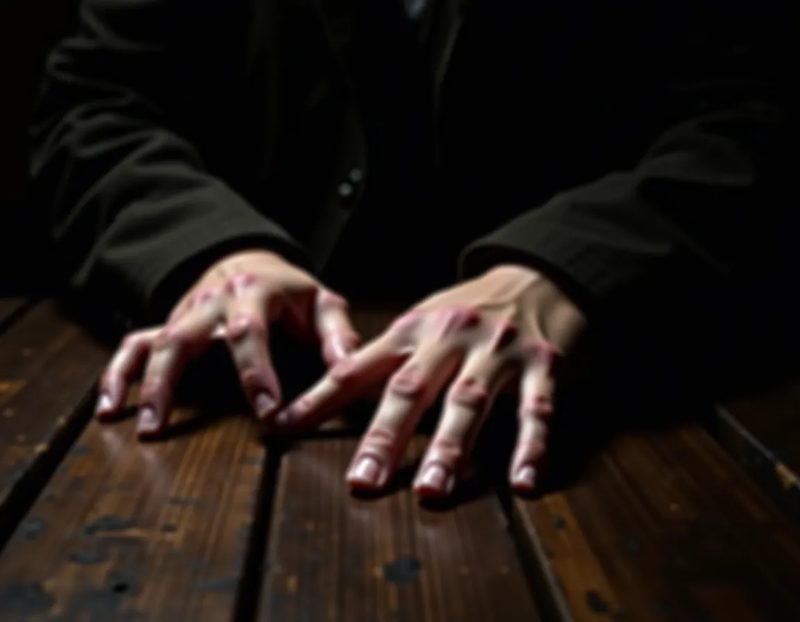
Michael Faraday, yes, that Faraday, ran the first serious experiment on table tipping in 1853. He built a stack of cardboard and glass sheets with a friction indicator between the sitters’ hands and the tabletop, designed to reveal which direction the pressure was actually moving. His finding was unglamorous and correct. The pressure moved outward, from the sitters toward the table, not the reverse. People were pushing. They simply weren’t aware they were doing it.
This is the ideomotor effect, and if you work in mentalism you already live inside it every night. Small, involuntary muscular movements driven by expectation and belief, invisible to the person producing them. Faraday didn’t discredit the sitters as liars, he discredited the idea that a lie was even required.
That distinction matters more than most books on the subject give it credit for.
A dowsing rod swings for the same reason a table tips and a pendulum answers a question it was never told. The believer’s hand does the work, the belief just hides the labor from the believer. I’ve built entire routines on that one fact, it’s the quietest engine in this business and also the most reliable one.
Why the Table Beat the Board to the Séance Room
Before William Fuld and the Kennard Novelty Company patented anything resembling the modern Ouija board in 1890, mediums needed something that scaled to a room. A table sat six people comfortably, sometimes more, and it required nothing you couldn’t find in your own dining room. That’s a business advantage as much as a spiritual one. Table tipping cost nothing to stage and traveled everywhere Spiritualism traveled, which by 1855 was most of the English speaking world.
It also produced something a board never quite manages, a physical event a whole circle experiences together. The table doesn’t just spell an answer to the person holding the planchette. It moves under everyone’s hands at once, it groans, it occasionally rises off the floor entirely in the more theatrical accounts. Group conviction builds differently when the “evidence” is shared weight and shared motion rather than one person’s hand on a small piece of wood.
The board, when it came along, offered something the table couldn’t: privacy, portability, and a manufactured mystique that a piece of furniture from your own kitchen could never carry. You can’t sell someone their own dining table back to them as a spirit communicator. You absolutely can sell them a board with strange symbols printed on it in a color no dining table has ever been.
The Slow Disappearance
Talking tables didn’t vanish because they stopped working, in the only sense that ever mattered, they never stopped producing the sensation people showed up for. They vanished because Spiritualism itself lost its cultural grip after the movement’s biggest names, the Fox sisters included, were caught, recanted, or simply aged out of relevance. Margaret Fox’s 1888 public confession that the rappings were manufactured by cracking her toe joints did real damage, and table tipping got dragged down with the rest of the movement’s credibility.
The Ouija board, arriving right as Spiritualism’s first wave was cresting, got rebranded fast enough to survive it. By the 1920s it was a parlor game, sold in toy stores, stripped of its churchy Spiritualist baggage and repackaged as an evening’s entertainment. Tables never got that rebrand. There was no company positioned to patent a dining table and sell it back to the public as a novelty item.
So the board got the movies. It got the demon possession plots and the summer camp ghost stories and the shelf space at every big box retailer in October. The table got a footnote in Spiritualism histories and a handful of paranormal investigation shows dragging out an old parlor set for a segment. That imbalance has nothing to do with which method is more convincing in a live room, my dear friend, and everything to do with which one a toy company could put a barcode on.
What the Table Still Teaches a Working Mentalist
I don’t necessarily believe a table wants to answer anyone’s questions. I do believe the table tipping era mapped out, decades before anyone had a name for it, the exact physiology that modern muscle reading and billet work still depend on. Every technique built on reading unconscious tension, a hand tensing over the right card, a pendulum favoring the correct answer, a subject’s arm resisting slightly before a fold, traces its lineage straight back to that Victorian parlor and Faraday’s cardboard stack.
I tested a stripped down version of table tipping at a private event near Louisville a few years back, no board, just four chairs and a small round table with everyone’s fingertips barely touching the rim. The table began drifting toward one guest’s side of the circle before I’d asked a single real question.
Nobody in that room touched it on purpose.
That’s the whole demonstration, honestly, and it lands harder than most billet reveals I’ve run because the audience did the work themselves. They just don’t know it yet when the table starts to move.
Reviving a Phenomenon Without Reviving the Furniture
Most performers reach for a Ouija board when they want a séance beat in a show, because it’s the recognizable object, the audience already knows the shape of the mystery before you’ve said a word. That familiarity is also the problem. Everyone has a theory about how a planchette moves before you’ve even set your hands on it.
A talking table carries no such baggage. Most modern audiences have never seen one, never read a headline debunking one, never watched a movie villain use one. You get to build the mystery from nothing, which is a rarer gift in this business than it sounds.
Working versions exist, gimmicked and ungimmicked both, some relying on nothing but the ideomotor effect and a well managed group dynamic, others built with genuine mechanical assistance for a performer who wants the movement guaranteed rather than hoped for. Either approach earns its place in a bizarre magic set precisely because the method is old enough to be historically true and unfamiliar enough to feel new again.
The dead haven’t answered a single question through a piece of furniture, as far as I can prove. But the room full of living people, hands trembling slightly on the wood, absolutely will.
Bring the Séance Room Back Into Your Act
If you’re building a bizarre magic set and want a séance beat with real historical weight behind it rather than a rented prop from a Halloween catalog, the talking table deserves a second look. It predates the board, it demonstrates a genuine and well documented phenomenon, and it hasn’t been strip mined by a century of pop culture the way the Ouija board has.
We carry pieces built for exactly this kind of work.
Visit the Arcane Relics shop and see what’s waiting on the table.