Part 2: The Hidden Object Hunt, Building a Contact Mind Reading Routine That Plays to a Full Theatre

In Part 1: Hellstromism: The Lost Art of Contact Mind Reading and the Performers Who Nearly Buried It, we covered where this craft came from and why it nearly vanished. Now the harder question. How do you make a form built for a drawing room read clearly to four hundred people, some of them forty rows back?
I don’t think contact mind reading is telepathy. I never have. But I’ve watched a blindfolded performer walk a stranger’s thoughts across a stage in near silence, and the room behaved as though something impossible had happened.
That reaction is the product. Your job is to protect it.
Why the Parlor Version Dies on a Big Stage
The classic hunt was built around intimacy. A dozen guests, a hidden pin or a ring, and a performer moving through furniture with a spectator’s hand clamped to his wrist. Everyone could see everything, so nobody needed help understanding what they were watching.
On a stage, the same effect fails for three boring reasons. The walk is slow. The action is small. And the back row can’t tell whether the performer is searching, guessing or succeeding.
Slow is fatal in a big room. Small is invisible. Confusing is worse than both, because a confused audience decides the volunteer is a plant before you’ve found anything.
So you don’t shrink the parlor version onto a stage. You rebuild it around what a large audience needs to see, hear and believe. That’s a different piece.
Staging the Hide So Everyone Owns It
The hide is where the audience decides whether the piece is fair. Get it wrong and nothing you do afterward can repair it.
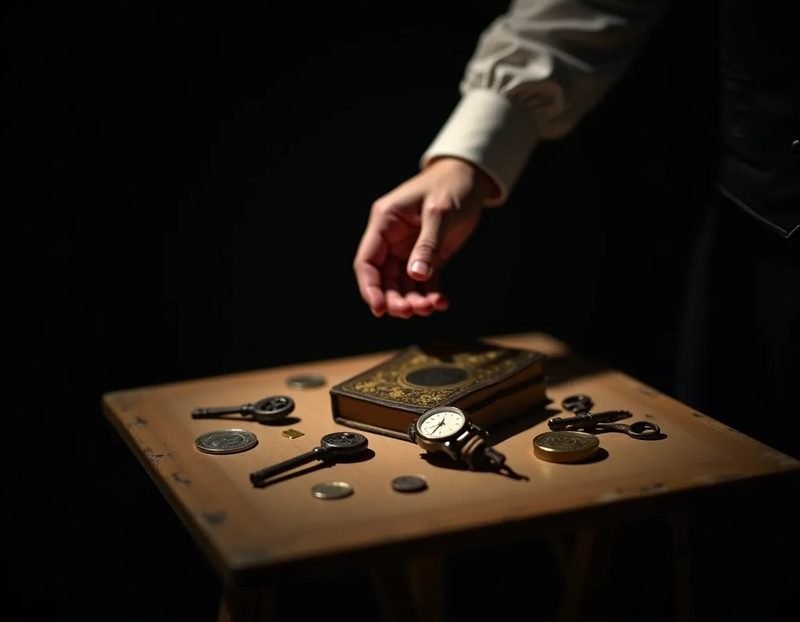
Don’t ask the group to hide something while you wait in the wings. That’s a parlor habit, and it turns your absence into a question mark. Instead, keep the process public and fast. Put a small pool of borrowed objects on a table downstage, let the audience call out which one, and have a second volunteer choose the location while you stand with your back to the house, hands visible, blindfold still in your pocket.
Then the key move. The hider whispers the location to the subject, and only the subject. The room never learns it either. That matters more than it sounds like it should, because a large audience that doesn’t know the answer can’t watch you fumble toward it. They can only watch you arrive.
Keep the hiding places physical and distinct. A jacket pocket in row three. Under a specific chair is too vague. Try inside the closed lid of the grand piano, taped beneath the edge of the lectern, or in the hand of a volunteer seated at the aisle. Places the back row can picture the moment you name them.
Choosing the Subject Who Will Carry the Piece
Nothing in this routine matters as much as your subject. The reading depends on tiny, involuntary pressure changes, and a nervous person is a noisy person. A jittery volunteer gives you static. A calm one gives you a signal.
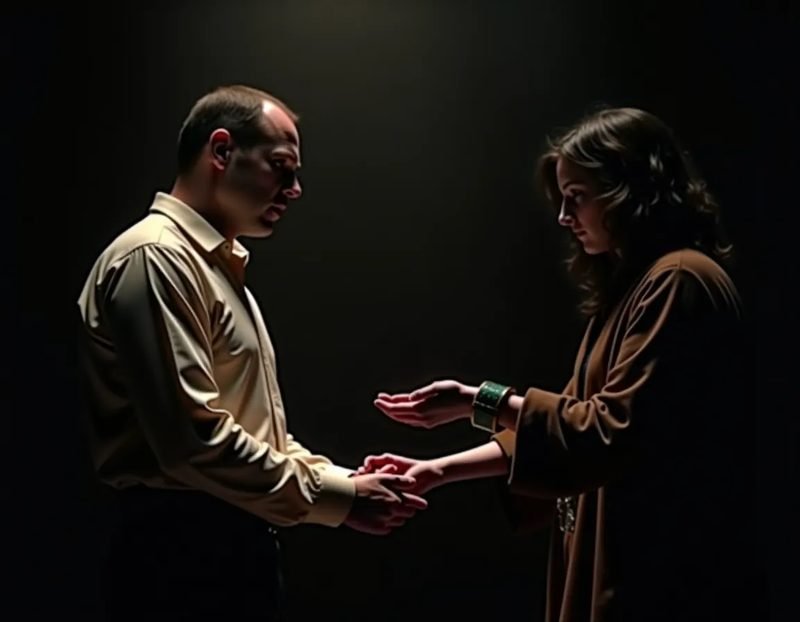
Spend thirty seconds finding out which you’ve got. Before you ever mention the hunt, take the volunteer’s hand, ask them to press gently against yours while you shift your weight left, then right. You’re not testing them for the audience. You’re testing the channel. If the pressure is soft and consistent, proceed. If they grip like they’re dangling off a cliff, thank them warmly and choose again.
I’ve had better luck with people who are a little bored than with the eager ones. Eager volunteers push. They try to help, and helping is the enemy of good contact work.
Give them one instruction, and give it in plain words. Think of the place. Don’t steer me. That’s the whole briefing.
Making the Walk Readable From the Back Row
Now the visual problem. A two-person walk across an empty stage looks like a slow dance unless you give the eye something to track.
First, light it. A tight follow spot on the pair, with the house dimmed low, turns them into a moving picture frame. Without that, the back row loses the contact point, the actual hand on the wrist, and that hand is the whole story.
Second, use a lavalier on you and a handheld or a second lav on the subject. When they breathe and you hesitate, the room should hear it! A hush with a live microphone in it is one of the most tense sounds in theatre, and most performers never give it to their audience.
Third, and this is the piece people skip, build stops into the walk. Twenty steps of continuous motion tells the audience nothing. Stop dead, pivot, back up, correct. A hunt with visible hesitation reads as genuine effort, and genuine effort is what sells contact reading in a hall. If you’ve been following the pressure honestly, you’ll do this naturally anyway.
If the venue has a camera feed to a screen, put it on the joined hands during the stops. A close shot of a wrist gripped by a stranger says more than any patter line.
The Blindfold Question and the Talking Question
Do you blindfold? I lean yes for a stage. It removes the objection that you spotted the subject’s glance, and it makes the audience lean forward. But use a proper one. Something padded, dark and slightly theatrical, not a scrap of cloth that leaves the volunteer wondering what they signed up for.
Whatever you choose, let a spectator tie it, and let the front row see the knot. That’s thirty seconds well spent.
Then decide how much you’ll talk. Most performers over-narrate. They describe every step, every flicker of feeling, every supposed impression, and the nuance drains out of it. I keep my patter thin during the walk. A few words at a turn, a sentence at a stop. When I tested this shape at a private event in Clarksville, Indiana, the quietest stretch got the loudest silence, and I felt the whole room lean with me. My hands went still. So did theirs.
Silence is a prop. Treat it like one.
Scripting the Moment the Object Turns Up
Here’s the part that separates a competent hunt from a memorable one. The last three steps.
Don’t rush toward the location. Slow down as you approach, let the pressure guide you into a near stop, and make the final move look like something the subject did, not something you did. Have them lift the piano lid. Have them reach into the pocket. Let the discovery pass through their hands, not yours.
Why? Because a mind reader who grabs the object looks like he knew all along. A mind reader who stands back while a stranger finds the object looks like he was led there. That difference is the entire illusion.
Then script the aftermath, and keep it short. Remove the blindfold slowly. Thank your subject by name. Ask them one question: Were you thinking of anything besides that place? If they say no, leave it alone. If they say something odd, keep it for the second show.
Never explain how it worked. Not even in a joking way.
Then walk off. That’s the whole game, honestly.
Rehearsing It Until It Stops Feeling Like a Trick
You cannot learn this from a description. You learn it by practicing with real people, in real rooms, until you can feel the difference between confident pressure and hopeful pressure in your own wrist.
Run the walk with ten different volunteers before you put it on a bill. Friends, relatives, the neighbor who owes you a favor. Note who gives you a clean signal and who doesn’t, and what you said to each before starting. Record two of the sessions on video so you can watch your own hesitation and see how it reads from a distance.
Watch for the moments you look like you’re guessing. Cut them, or restage them, or turn them into deliberate stops.
Contact mind reading isn’t dead. It was set down by people who stopped asking what a bigger room needs, and that’s a solvable problem, if you’re willing to be a little more theatrical than the old parlor men ever needed to be.
If you’re building a stage piece like this, you’ll want the right supporting cast of props, blindfolds and borrowed-object presentations. You’ll find the pieces we stand behind at arcanerelics.com/shop.