The Body in the Dark: Physical Phenomena and the Case for Bringing Manifestations Back to the Modern Seance

I’ve sat in rooms where a table moved and nobody wanted to leave. Not because the show was especially polished. Because something had changed in the air, and walking out meant deciding what to call it.
Physical phenomena do that. Mental work, even brilliant mental work, lives in the head. A table that rises belongs to the body. And the body is harder to argue with.
This isn’t an argument for cheap theatrics. It’s an argument for craft.
How We Got Here
The retreat from physical phenomena wasn’t random. By the mid-twentieth century, Spiritualism had been embarrassed by its own history too many times. Investigators had exposed too many mediums with telescoping rods and painted muslin, and performers who wanted to be taken seriously moved hard into the psychological. Mentalism was cleaner. It required no rigging, left no physical evidence, and it invited scrutiny without collapsing under it.
That instinct made sense. I’ve built shows around it.
But somewhere along the way “psychological” became a ceiling instead of a floor. The retreat from physical work stopped being a tactical choice and became received doctrine. Bring up table tipping at a serious bizarre magic gathering and watch the room get very polite, very quickly.
Most performers learned the wrong lesson. The lesson wasn’t “physical phenomena are finished.” The lesson was “obvious fraud is finished,” those aren’t the same thing at all.
What the Body Believes
There’s a difference, a fundamental one, between a spectator who is convinced and a spectator who is shaken.
Convince someone mentally and they’ll remember the performance. Shake them physically and they’ll remember the room. The chair they sat in. Whether the air felt cold. The exact quality of the silence just before something happened.
Mental work reaches the audience through inference. You reveal a thought and they conclude, however unwillingly, that something extraordinary occurred. The conclusion travels through logic. They were fooled, or there’s something they can’t explain. Either way, the processing happens upstairs.
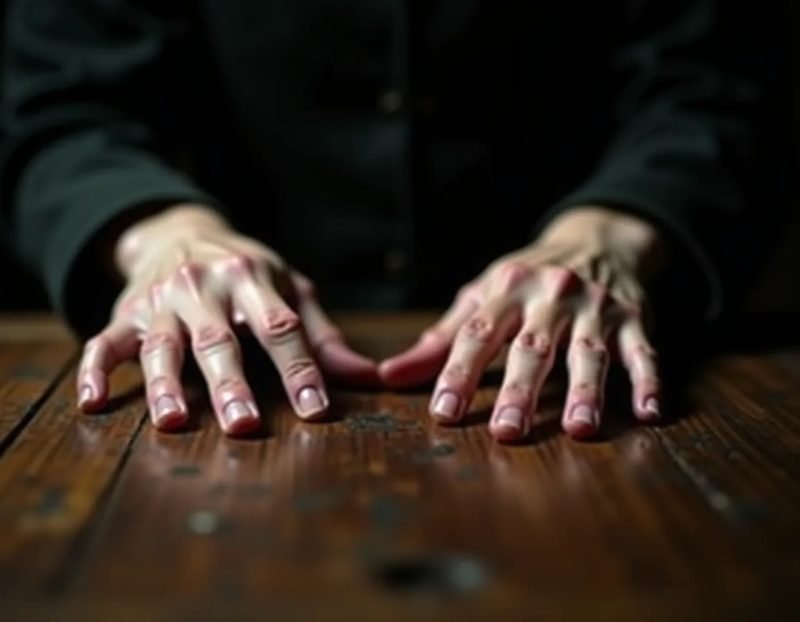
Physical phenomena bypass that route entirely. When a table tilts and you felt the vibration travel through the surface and into your hands at the same moment, your body registered it before your brain formed an opinion, there was no inference step. There was only the sensation, and then the scramble to account for it.
That scramble is the most valuable space in the seance room.
I don’t claim table tipping is supernatural. I don’t claim that about anything. But I’ve watched hands go flat and still on a table surface at first contact, that breath-held pause where the body is already responding to something the intellect hasn’t yet categorized. That moment is real. It’s earnable. And it justifies building an entire show around it.
Table Tipping Is Not a Novelty Act
Let me be clear about something. Table tipping done poorly is a genuine catastrophe. It looks precisely like what it is: a group of self-conscious adults waiting for something that may or may not happen, performing sincerity for each other. If you’ve witnessed bad table work, I understand completely why you filed it away.
Good table work is something else.
The technique has a serious history. Eusapia Palladino, whatever conclusions you draw about her, held sitters in states of real bewilderment for decades. Contact maintained, phenomena produced in adequate lighting in some demonstrations, investigators including Hereward Carrington came away unable to account for everything they’d seen. William Crookes sat with D.D. Home under conditions he designed himself and wrote accounts that troubled him for the rest of his life. These weren’t suggestible people. Crookes was a Fellow of the Royal Society. He understood exactly what he was claiming when he published those reports.
You don’t need to believe any of it was genuine. What that history gives you is something more useful: a century and a half of testimony, a documented language for physical seance phenomena, and an audience that carries some buried cultural memory of what a seance table is supposed to feel like.
Work with that inheritance.
The practical method is learnable. Table tipping, properly staged, operates through a combination of ideomotor response, deliberate pacing, and the performer’s ability to read and redirect the energy of a group in real time. There are sequences that build from barely perceptible tremors to undeniable movement. There are specific contact points and hand positions that allow the performer to work without the sitters consciously registering direction. The mechanics are teachable, what most guides never say plainly is that your sitters need to feel like participants, not audience members.
That distinction is the whole game.
The Risk Objection, Addressed Directly
I know the concern. Physical phenomena can be exposed. A skeptic in the room will wreck it. You lose the narrative the moment something goes wrong.
Let me address this honestly.
The same skeptic who has a ready explanation for every mental revelation, who’s already built his theory while you’re still performing, struggles considerably harder with something his hands just felt. The exposure dynamic is different. You’re no longer asking him to disbelieve a conclusion. You’re asking him to disbelieve a sensation. That’s a harder argument to make, and most people won’t make it in front of the group.
Bad physical work will be called out. So will bad mental work. The answer in both cases is identical: your presentation needs to be stronger than your method.
Context changes everything here. Physical phenomena that arrive inside a genuine narrative, in a room already charged with atmosphere and suggestion, sit in a completely different category than a table tilting under fluorescent lighting for a skeptical crowd. Your sitters aren’t evaluating a magic trick. They’re inside a story. Inside a story, the table moving doesn’t invite rational analysis.
It invites dread.
Dread is more durable than wonder. Wonder fades in a week. Dread comes back at three in the morning, months later, when the house is quiet and something creaks in the hall and the memory surfaces before you’re ready for it…
That’s what you’re building toward. Not applause. That.
How to Build Physical Work Into a Seance Show
A few things I’ve learned running physical phenomena in live seance contexts, most of them learned wrong before I learned them right.
Sequence matters more than almost anything else. Don’t open with your biggest physical moment. Let the room heat through atmosphere, through narrative, through mental effects that establish genuine uncertainty. Physical phenomena that arrive late in a show carry the accumulated weight of everything before them. The same table movement that reads like a party trick in the first ten minutes reads as deeply troubling at the forty-minute mark, when the room is already somewhere it didn’t expect to be.
Contact is a prerequisite. Physical phenomena without shared physical contact between sitters lose most of their force. When the table moves and every hand in the room is resting on it, nobody is watching it happen. Everyone is feeling it happen, together, in the dark. That’s a different thing entirely.
Don’t explain it afterward. The performer’s instinct is to give the room an exit at the close, something wry or clinical to step back behind. Resist that. A seance that ends with a debriefing was never a seance, it was a demonstration. Leave them with the sensation and no comfortable accounting for it.
That’s the work.
Where to Start
If you’re serious about adding physical work to your show, begin with the historical record, not the method books. Read the Proceedings of the Society for Psychical Research. Read Carrington. Read Dingwall, who brought genuine skepticism into those rooms and still came away with reports he couldn’t cleanly dismiss. Don’t read them looking for proof of anything. Read them to understand how sitters described what they experienced, the specific language they reached for, the sensations they reported, and what conditions produced the strongest responses.
That vocabulary is yours to use.
For working methods, the tradition of bizarre magic as it developed through practitioners like Tony Andruzzi was never interested in separating the physical from the psychological. The two were always designed to work together. That integration is the correct model. One without the other is either a demonstration or a mood piece. Together, they’re a seance.
And look seriously at what’s available now for seance physical work. There are props built with genuine performance life, pieces that carry weight and atmosphere and hold their own in the kind of close, intimate lighting this work demands. They’re not novelties. They’re tools for performers who take this seriously, and if you take it seriously, they’re worth your investment.
The seance room is the oldest performance space in the mentalist’s repertoire. Before there were stages, there were dark parlors and small groups and things that moved in the night. The psychological sophistication we’ve built since then is real and worth keeping.
But the body hasn’t changed. It still responds to something moving when it shouldn’t be moving, it still knows wrongness before the mind catches up. That response is available to you.
It’s been available all along.
Browse the Arcane Relics shop for seance props and bizarre magic tools built for working performers.