
The Silent Retrieval: Pocket Indexes, Organization, and the Discipline Behind a Clean Produce

I used to think the pocket index was a crutch. I was wrong. A man in Lyndon stood eighteen inches from my right side for most of a forty-minute private show, and he never once looked at my jacket. He watched my face and my left hand. By the end he was certain I’d done it all with nothing on me but a pen.
I carried nineteen items that night.
This isn’t a beginner’s primer. It’s about what separates a working index from a jacket full of paper you’re afraid to touch, and about why Pathfinder Billet Index is the first design I’ve looked at that treats that problem seriously.
Why the Crutch Label Sticks
Performers call the pocket index a crutch because most of them use it like one. They learn the information first, panic, and then paw through their jacket hoping their fingers remember what their brain didn’t rehearse. The audience reads that hunt as effort. Effort kills the effect.
The pocket index also has a long history of doing one small job. One playing card. One zodiac sign. One choice. Plenty of fine routines were built on that single piece of information, but the limit shaped the way we think. If you wanted to predict more than one thing, you carried more gear and took more risk.
Pathfinder is built to break that limit. Christopher Taylor designed it so you can predict up to four pieces of information on a single billet, in real time, in any setting, even completely surrounded. Neal Scryer calls it the most advanced billet index system in the world today. I’m cautious about superlatives, but the idea behind it is the right answer to the crutch problem: carry less, and ask each item to do more.
Build the system like an engineer. Perform it like you’ve never heard of it.
Index Architecture: Decide Before You Sew
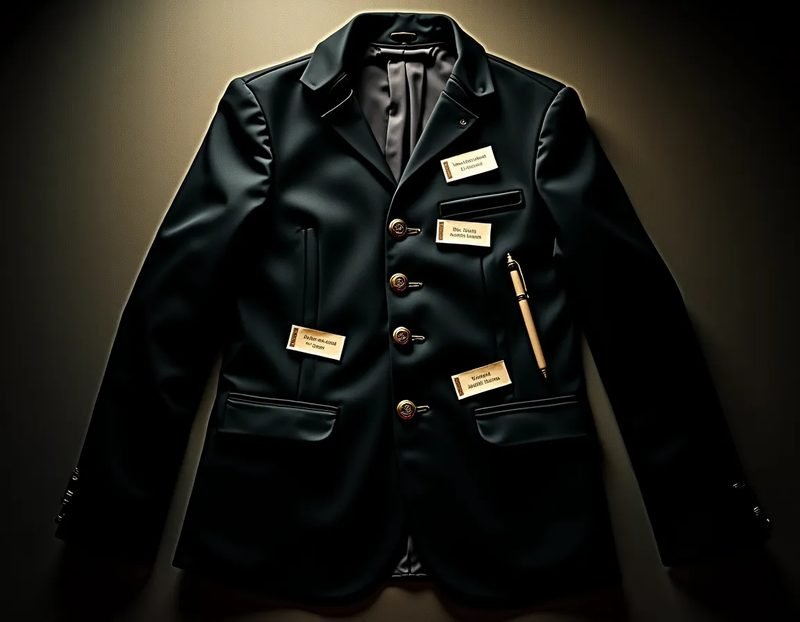
Most bad indexes grow by accident. A performer adds a pocket here, a slot there, a new billet whenever a routine calls for one, and eighteen months later nobody, including the performer, can say what lives where. Start with a map instead.
Your jacket gives you a fixed number of usable locations. Pick the ones you can reach without a visible shoulder shift. Reject the rest, even if they look convenient on paper. Then assign by logic, not by whim, and write the map down. If you can’t recite it from memory in the dark, it isn’t finished.
This is where a purpose-built index earns its place. Pathfinder is a custom-made index, built for one job, so you aren’t improvising a filing system out of whatever your tailor happened to sew in. The store describes it as giving you the ease and confidence to deliver your best performance every time. I’d phrase it more modestly: it takes a whole layer of guesswork off your plate before you ever walk on.
The size is adjustable, too. The author’s direction is that it runs from two to 52 outs if you’re using two. As one example, one can hold all the black cards while the other holds all the red. That kind of flexibility matters at the planning stage, because you decide how big the system needs to be for the show in front of you, not for every show you might ever do.
Fewer Doors, Cleaner Reach

Here’s the counterintuitive part. A bigger index makes you look less impressive, not more. Every additional billet means more sorting, more fumbling risk, and more time your hand spends in a pocket while the room is watching you think.
That’s the strongest argument for the Pathfinder approach. Four separate choices used to mean four separate billets, four separate retrievals, and four chances to hesitate. One billet that carries up to four predictions cuts the number of doors you have to open. The store’s examples show the range: the time of death assigned to each of four victims, how a spectator colours a simple drawing, which pockets four borrowed items end up in.
Ask what the effect requires, then carry exactly that. Nothing decorative.
I once carried a “just in case” billet for eight months. I used it twice. It cost me a clean reach at least a dozen times, because my fingers kept finding it first.
Delete the just-in-case items.
Build It Into Your Fingers
You can’t look down. That’s the whole discipline. Your hands have to know the index without your eyes, and that means the thing you’re holding has to be pleasant and predictable to handle.
This is the area where the newer Pathfinder Clear version looks most useful on paper. It uses an easier to use and more durable material, sturdier construction, and clear pages so you can count billets at a glance. Counting is a small job, but it’s the sort of small job that eats confidence. If you’ve ever stood on a stage wondering whether you reloaded everything, you know the feeling.
Rehearse the reach with your eyes closed. Then rehearse it while you’re talking, because that’s where it breaks. Your hand goes soft and slow when your mouth is busy, so drill both together. Read a paragraph aloud and finish the handling on the last word, ten times in a row, with no misses.
My hand goes still the instant I’m unsure. That stillness is the tell, and it’s the thing I train hardest against.
Muscle memory isn’t glamorous. It’s repetition. The store says Pathfinder Clear ships with new handlings that grew out of years of practice with the original, so you aren’t starting from a blank page. You’re starting from someone else’s hours.
Choosing Your Moment
The reach is never the problem. The moment is. Beginners act at the peak of tension, right after the volunteer speaks, because that feels dramatic. It’s exactly when every eye in the room is locked on you, waiting.
Move your action to the valleys. Attention falls the second an audience believes the important thing has already happened. The laughter settles, you look away as if you’re thinking, and that’s your window. It belongs in the exhale, not the held breath.
Give your hand a reason to move. A performer who sweeps into a pocket for no reason is announcing something. A performer who checks a pen pocket, adjusts a lapel, or pats down for a lost marker is simply a person. Motivate the action with something the audience already accepts.
And plant the innocent dips early. Go into that same pocket twice before the effect, once for a pen, once for a handkerchief, and leave with something ordinary both times. By the time the real moment arrives, the pocket has a history of boring behavior. Nobody reads a habit as a secret.
The store also mentions a new use I find interesting: using an index proactively to force a choice from a list, and using new handlings for multi-stage reveals. A multi-stage reveal gives you more than one valley to work with, which is a real timing gift. A simple paper list is all it takes to force a word or object, with no apps or phones needed.
The Volunteer at Your Elbow
Close-up work puts a stranger inches from your jacket, and everything above gets tested by that proximity. I’ve had volunteers lean in, glance down, and make small talk about my sleeve. They aren’t suspicious, they’re just human, and humans look at whatever moves.
Manage the geometry first. Stand so the pocket you’re using sits on the far side from your volunteer, and let your body make a soft angle so your torso shields your hand without looking blocked. Turn slightly to the audience, gesture with your free hand, and let the near-side hand drop naturally.
Then give the volunteer something to do. A small task, a signature, a sealed envelope to hold, a pen to cap. A person with a job doesn’t watch your jacket.
The best routines hand the job over entirely. One idea in the store copy has the spectator choose the only clue from a list that applies to an unseen object, so the spectator becomes the performer. Another takes them on a journey to a movie, concert or event, only for their matching ticket to appear. Both keep the volunteer busy and curious, and a busy, curious volunteer is the best cover you can have.
Keep your eyes off the pocket, always. Look at the volunteer, or at the object you’re about to reveal. Your gaze tells the room where the action is, so send it somewhere harmless.
The best moment I ever had happened while a man stared at my face and asked me a question about my grandmother. I answered him warmly, and by the time he finished listening, the work was already done.
He never knew a thing had moved.
Practice Like the Room Is Watching
I don’t claim the pocket index is glamorous. I claim it works, and it works best in the hands of a performer who treats it as a discipline instead of a shortcut.
Run the full sequence in front of a mirror, then in front of a camera, then in front of one patient friend who’s been told to watch your jacket and nothing else. If they catch something, you have your answer, and it’s a useful one. Fix the angle, fix the timing. Then run it again.
Keep a log for the first month. Note every miss, every hesitation, every time your fingers found the wrong thing. You’ll see patterns quickly, and most of them trace back to assignments that made sense on paper and felt wrong in motion. Change the map. The map serves you, not the reverse.
Pathfinder also comes with online downloadable templates to customize its routines to fit you, and the store frames the whole thing as a tool for building a routine as unique as you are. That’s the right attitude. Use the supplied routines to learn the system, then make something that sounds like you.
And when it finally goes quiet, when the reach becomes something you forget you’re doing, you’ll understand why the serious performers never talk about it. Silence is the proof.
If you want to see what the system offers, the full details are on the Pathfinder Billet Index page, and the rest of the shelf is at Arcane Relics.