
The Performer’s Guide to Pendulum Divination: History, Science, and the Art of the Swing Revisited

The Performer's Guide to Pendulum Divination: History, Science, and the Art of the Swing

A woman in the third row stopped breathing. I know because I was watching for it. The pendulum, a vintage brass bob on a twelve-inch chain, had swung three times toward her left hand, the hand resting over the sealed envelope on the table between us. She hadn’t told me which hand held the card. Nobody had.

I don’t claim pendulum divination is supernatural. I don’t claim anything about it, actually. But I’ve sat in a hundred rooms where a small weighted chain made a crowd go genuinely, uncomfortably quiet, and that quality of silence is worth understanding, worth earning, and worth building a full working around.

This guide isn’t for the curious. It’s for the performer who wants a sustained atmospheric piece that can run five minutes or forty-five, depending on what the room needs and what you’re willing to carry into it.

Choosing Your Performance Pendulum

Visual Impact: Stage vs. Close-Up

At close range, almost anything works if you handle it with intention. A faceted crystal point, a sphere of polished jet, a Victorian brass plumb bob pulled from an architectural salvage bin: all of them read as deliberate when you’re moving with deliberateness. Stage is a different problem entirely. The pendulum needs to carry from the back row without becoming a cartoon prop, which means size, reflectivity, and contrast against your clothing all matter in ways they simply don’t at a parlor table. A heavy faceted crystal on a twenty-inch silver chain catches light in ways a small brass bob can’t match from fifteen feet. Think about that contrast before you commit. White crystal on black. Aged brass on cream linen. You’re composing a visual before you say a word, and first impressions in this kind of work are hard to walk back.

Materials and What They Communicate

Crystal says spiritualist. It drops the audience squarely into the Victorian parlor tradition, the medium’s cabinet, the table-tipper’s circle. That’s not a criticism; it’s narrative shorthand that does real work before you explain anything. Brass lands older, more occult-adjacent, suggesting the alchemist’s workbench rather than the seance room. Glass, particularly hand-blown or period-looking, reads as scientific instrument: the apothecary’s counterweight, the clockmaker’s tool. Each material positions you differently in the audience’s imagination, and those positions aren’t neutral.

Does the material change how the pendulum actually responds? No. Does it change how the audience receives everything you do with it? Completely. Know which character you’re performing, then pick accordingly.

One physical note worth carrying: hold a brass bob in your palm for two minutes before performance. It takes body heat and holds it. That warmth transfers to a spectator’s hand when you pass it over, and they’ll register it as something even if they can’t name what. Small details like that compound.

Chain Length and Weight

Twelve to sixteen inches for close-up, sixteen to twenty-two for parlor and small stage. The bob should be heavy enough to resist minor air currents but not so heavy that genuine micro-movement gets suppressed. Eight to fourteen grams is the practical range for most performers. Lighter pendulums are more expressive. They’re also more susceptible to environmental drift. Know what you’re holding before you’re holding it in front of people who are watching for something to happen.

Calibrating Your Pendulum: The Ideomotor Effect and the Scripted Programming Moment
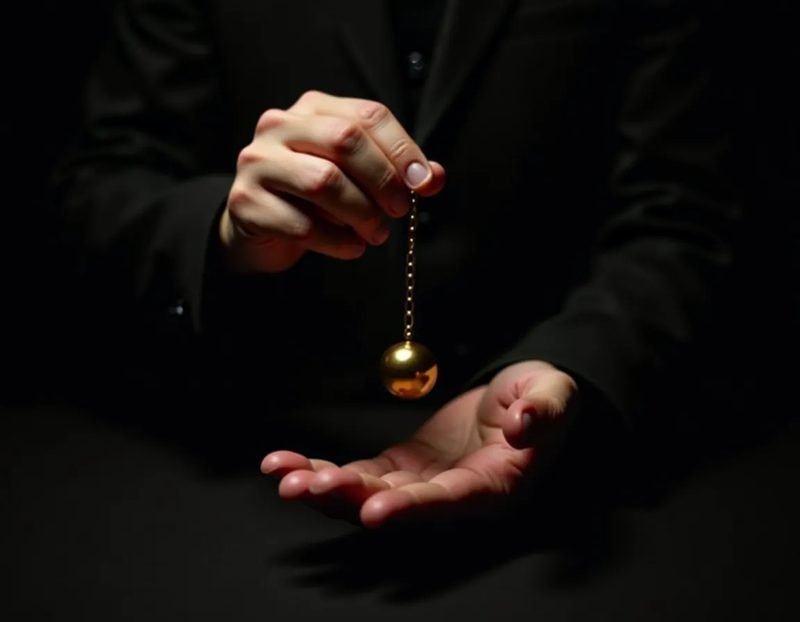
performer's relaxed hand holding pendulum chain pinched between thumb and index finger, pendulum suspended in air above

The Ideomotor Response

I was skeptical of this mechanism for years. Still skeptical of certain claims made around it. But the ideomotor effect is not mysticism; it’s textbook kinesiology, documented and named by William Carpenter in 1852, observed by Chevreul before him, replicated in laboratory settings ever since. When you concentrate on a direction or a charged concept, your neuromuscular system generates micro-contractions in the hand, wrist, and fingers that produce motion you don’t consciously direct. The pendulum amplifies and externalizes those contractions into visible movement. That’s the mechanism. The body thinks, and the pendulum surfaces what the body is thinking.

Which means a performer who understands this can work with it deliberately, scripting the moment when signals get established, and a skilled reader can sometimes detect genuine ideomotor activity in a spectator’s hand before the spectator is aware of it themselves.

That second part is where it gets useful.

Establishing Your Signals

Before any public working, calibrate. Hold the pendulum over your extended palm, chain still. Think about “yes,” a clear affirmative, your own name spoken silently, something you know with absolute certainty. Let movement emerge without forcing it. Note which axis it favors. For most practitioners, yes runs on a forward-back line relative to the body; no tends to cross perpendicular; “I don’t know” rotates in a slow, undecided circle. These aren’t universal; your signals belong to your nervous system specifically, and consistent daily practice of three to five weeks will settle them into something you can trust under the specific pressure of a working audience.

Scripting the Programming Moment for an Audience

Most performers skip the calibration ritual entirely. This is wrong, and it shows in the working. The calibration itself, performed openly in front of the audience before you approach the charged material, is where the piece earns its credibility. You introduce the pendulum, explain that it responds to unconscious nervous system signals, demonstrate yes and no against low-stakes verifiable statements: your own name, a true date, a color you’re holding in mind. Then you bring the spectator into that same framework before asking them anything that matters. The moment lands as mysterious because it is genuinely slightly mysterious, even when you understand the mechanism completely. That’s honest theater. And honest theater holds longer than manufactured mysticism tends to.

The Performance: Presenting Pendulum Divination for an Audience

Setting the Scene

The pendulum needs a surface. Not always a table, but usually something to anchor the visual frame: a printed chart, a spread cloth, an aged map, something with texture that tells the audience they’re in a specific kind of room. Dead silence is preferable to ambient music for this work. Music gives an audience something to do with their ears; silence forces them to watch the swing, and watching the swing creates exactly the kind of sustained, slightly uncomfortable attention you’re after. If you can burn something beforehand, do it. Not for effect. For encoding. Smell binds memory more aggressively than any other sense, and people remember the room where they witnessed something they couldn’t quite explain.

Structuring the Presentation

Three-phase structure works reliably. First, explain the mechanism honestly, or honestly enough, so the audience understands what kind of experience they’re in. Second, demonstrate with low-stakes questions they can verify in real time. Third, apply to the charged working. That escalation from transparent to opaque is what builds the dread. By the time you’re asking the question that actually matters, the audience has watched the pendulum respond. They believe it works. The question of how becomes secondary to what it’s about to reveal.

Questions That Work

Binary questions are your foundation. “Is this the card?” “Did she choose the left hand or the right?” But don’t dismiss the open question directed at a chart. “Which direction points toward the thing she hasn’t said aloud?” is a different kind of theater than a forced-choice reveal, and it plays longer. Avoid questions the audience finds trivial, because if the answer doesn’t matter to the room, the swing doesn’t matter. Something should feel genuinely at stake when the pendulum moves, or you’re doing a demonstration, not a performance.

Advanced Techniques: Maps, Charts, and the Pendulum as Truth Detector

Pendulum Charts

A pendulum chart is a printed or hand-drawn semicircle divided into labeled sections, each marking a possible answer or category. Hold the pendulum above the center point, ask the question, and read the swing direction against the labels. The chart converts a binary tool into something capable of multi-answer responses without gimmickry. Most performers reach for sectored charts in emotional or thematic workings: life areas, unnamed fears, things a spectator is carrying but won’t say out loud. Print yours on aged stock, something with weight and texture. A sloppy chart tells the audience you haven’t committed, and they’ll follow that lack of commitment straight out of the moment.

Map Dowsing on Stage

This is one of the strongest visual formats in pendulum work, and it’s underused by a wide margin. Spread a map on a table or on the floor of the performance space. Have a spectator think of a location, a country, a city, a street they know well. Walk the pendulum slowly over the surface, watching for micro-responses in your hand and secondary signals in the spectator’s posture and face as you pass over different regions. The image of a performer moving a small weight over a large surface while a room holds its breath is genuinely strange in a way that most contemporary mentalism doesn’t manage anymore. You don’t need the exact street. A correct country lands hard. A correct city lands harder. Structure the working to the accuracy threshold you can actually deliver, not the one that would impress you in the planning stage.

The Pendulum as Truth Detector

This gets misused. Often badly. The principle isn’t unsound: when a person suppresses a true response, neuromuscular tension distributes into the periphery in ways a trained observer can sometimes detect. A pendulum held over a spectator’s extended hand can register this, but only when the performer is watching closely for secondary signals rather than exclusively reading the swing. Don’t present this working as infallible. Present it as sensitive. That framing is more accurate, and it’s counterintuitively more unsettling for an audience to sit with than a confident false claim of certainty.

Combining with Book Tests

The cleanest combination I’ve built: the spectator selects a word from a book test and holds it in mind without speaking it, the pendulum traces over a printed alphabet chart while you read the direction of swing, and the book test confirms at the close. Two independent mechanisms arriving at the same answer. The audience doesn’t know what to do with that. Or, more precisely, they know what they saw but they don’t know what to make of it, which is exactly where you want them standing when you stop.

Troubleshooting: When the Swing Doesn’t Cooperate

The pendulum stops responding when you stop trusting it. That’s the cause nine times in ten. Anxiety constricts micro-movement, the chain goes dead, and you’re standing in front of a patient room holding a lifeless weight. Know this going in so it doesn’t catch you.

Other causes: air conditioning drafts (always check the room before you commit to a staging position), a spectator whose skepticism has gone physically rigid in a way that inhibits their own ideomotor response, and simple fatigue. Don’t schedule this kind of working at the end of a long set if you have any choice in the matter. It’s front-loaded. It needs presence, not endurance.

If the swing dies mid-working, don’t fill the silence with words. Let it be still. Then reset publicly, re-establish your signals in view of the audience, and re-approach the working from the beginning of that beat. The reset reads as ritual. It buys credibility back, not time. Most performers skip this step and reach for patter instead, and it shows immediately.

And this, which doesn’t feel like practice but is: five minutes every morning, pendulum over a blank page, no question attached, just watching what the chain does. It tells you more about your current state than any amount of pre-show preparation could. The pendulum isn’t a prop you pick up on show night. It’s a practice that earns show night.

That’s the whole thing, really.

Find the Right Tools at Arcane Relics

The prop matters. Not as a fetish object. As a communication tool that tells the audience what kind of experience they’re in before you’ve spoken a sentence, and that has to be right before anything else can be.

Arcane Relics carries performance pendulums, pendulum charts, and related bizarre magic props selected for working performers who think carefully about this kind of material. If you’re serious about building a pendulum working that holds, take a look at what’s currently in stock. Browse the full inventory at arcanerelics.com/shop/.

The Performer’s Guide to Pendulum Divination: History, Science, and the Art of the Swing

The Performer's Guide to Pendulum Divination: History, Science, and the Art of the Swing

No card trick does this.

A small weight hangs from a chain between your fingers. Cold brass, maybe, or polished crystal. Dead still. Then, without any visible movement from your hand, it begins to turn. The audience tilts forward as one body, and for a moment nobody breathes. That’s the pendulum. It’s been pulling exactly that reaction for centuries, and it hasn’t gotten tired of it yet.

Pendulum divination sits at one of the strangest crossroads available to a performer: genuine folk practice, documented psychological phenomenon, and theatrical ritual, all converging in one object small enough to fit in a coat pocket. Dowsing and pendulum use appear in texts from the 16th century, but the roots go deeper. Rural Europe’s water-finders worked by touch and instinct, not theory. Cultures that left no written record built complete divination systems around suspended weight and the body’s barely perceptible, involuntary motion, passing the practice from hand to hand across generations with no agreed name for what they were measuring. By the 19th century, French physicians were using pendulums to diagnose illness, and spiritualists had made them the primary instrument for contact with the dead. So who was right about what they were doing? Houdini debunked the seance. Dunninger exposed the mediums. But neither of them could kill the pendulum, because the pendulum was never only a trick.

Why does that matter? Because for the mentalist and bizarre magic worker, the fact that nobody fully agrees on what the pendulum is doing, not even researchers with grant money and controlled conditions, is not a problem to explain away. It’s the whole performance. This guide covers the genuine practice, the psychology behind it, and how to build a pendulum presentation your audience won’t shake off on the drive home.


Choosing Your Performance Pendulum

The pendulum you use in private practice and the one you bring on stage aren’t always the same tool. That’s a distinction most performers underestimate. Get it wrong and you’re fighting your own props before the effect even starts, and the audience picks up on the friction even when they can’t name what feels off.

Visual Impact: Stage vs. Close-Up

At stage distance, ten feet or more, a pendulum has to read. A small crystal point on a fine silver chain simply vanishes. What survives at range is weight and contrast: a heavier bob in brass, iron, or deep-colored glass, suspended from a chain with enough mass to catch the light and hold the eye of someone sitting in the third row with no particular reason to believe in what they’re watching.

Close-up work is a different problem. Not just a smaller version of the same one. Here, delicacy wins. A slender crystal point, a Victorian fob weight, an antique brass plumb bob, these pull in the kind of close-hand scrutiny that rewards the prepared performer. Your spectator is near enough to examine the chain, near enough to cup their hand under yours. And that’s exactly when it lands, when they’ve been that close from the start and still can’t explain what just happened or where the movement came from.

Materials and What They Communicate

Material is character. Does the audience consciously analyze it? They don’t. But they absorb it. Every prop is making an argument before you open your mouth, and a pendulum makes it louder than most because the spectator is already staring at the thing.

  • Crystal (quartz, amethyst, obsidian): Signals tradition, spirituality, roots in older practice. The natural fit for seance-adjacent work or any presentation built around genuine divination history. A faceted crystal point catches light in a way brass simply can’t match, something almost restless in the way it behaves at the end of its chain.
  • Brass or bronze: Signals age, precision, the faintly scientific. Ideal for a mentalist framing, “instruments used by 19th-century researchers to measure the body’s unconscious signals.” Heavier and more reliable in its swing arc than crystal, though less atmospheric in close work.
  • Glass or resin: Versatile. Dark glass reads as opaque and strange; clear resin can be shown hollow, which matters in any presentation where the absence of a hidden mechanism is the point you’re making.
  • Found objects: Some of the most effective pendulums in bizarre work aren’t pendulums at all. A ring on thread. A pocket watch on its chain. A borrowed key. These moments carry a weight that purpose-built bobs rarely touch, and they cost nothing but the ask.

Chain Length and Weight

The physics aren’t complicated. A longer chain gives you a slow, deliberate arc. A shorter one produces faster, jumpier movement that’ll read as nervous rather than controlled. For most stage and parlor contexts, four to six inches is your range. But what do most performers get wrong here? They choose for appearance and ignore response. You want the lightest possible touch from your fingertips to start the swing without visible push or drag, because a pendulum that requires a deliberate nudge before it answers is working against you at the worst possible moment.

Arcane Relics carries a chosen selection of performance-grade pendulums, weighted and balanced for stage and parlor use, including antique-style brass bobs that have become quiet fixtures in bizarre magic circles. Hold one and you’ll understand right away what separates an instrument from a novelty.


Calibrating Your Pendulum: The Ideomotor Effect and the Scripted “Programming” Moment

Calibrating Your Pendulum: The Ideomotor Effect and the Scripted "Programming" Moment

Before you perform with a pendulum, you need to know what’s actually happening when it moves. Once you do, you’ll know how to talk about it in a way that works for your performance, no matter what your audience believes walking in.

The Ideomotor Response

In 1852, physiologist William Carpenter coined the term ideomotor to describe something specific: the body produces movement in response to thought or imagination, without conscious will. You think about a direction. Tiny, involuntary contractions in your fingers and wrist move the pendulum that way. You didn’t choose to move it. You weren’t aware of moving it.

And yet it moves.

This isn’t supernatural. It’s also not fraud. It’s a documented, measurable physiological response, the same mechanism behind the Ouija board, water dowsing, and muscle testing. When you tell an audience the pendulum “reads” something from the unconscious mind, you’re on solid ground. The unconscious does hold information the conscious mind doesn’t readily reach. Whether the swing reflects that information accurately is a separate question, but the mechanism is real. That matters more than most performers realize.

Establishing Your Signals

Before any performance, work out what signal system the pendulum will use. In private practice, this means sitting quietly, holding the cord between two fingers, and putting simple questions with known answers to it. Watch what happens. Most practitioners find a consistent pattern surfaces on its own: forward-and-back for yes, side-to-side for no, or a circular rotation for each. Your pattern may differ. What counts is consistency, not convention.

Why do so many performers skip this step? Most don’t treat it as training. They should.

Practice until the responses are reliable before you commit to any performance context. This isn’t superstition. It’s neuromuscular conditioning. You’re training your involuntary responses until they’re consistent enough to trust under pressure, in front of strangers, with a show riding on them.

Scripting the “Programming” Moment for an Audience

The calibration ritual is also a performance opportunity, and a good one. In genuine divination practice, “programming” the pendulum, that is, establishing its signal conventions, is done privately, before use. In performance, you can bring this ritual into the open. Done right, it deepens engagement and gives you cover for the calibration work you’ve already completed at home.

A sample script approach: “Before I use this, I want you to understand what you’re watching. The pendulum doesn’t know anything I don’t know. It responds to what I know but haven’t yet consciously examined. So first, let’s establish a language. I’m going to think of something true, something I’m certain of, and we’ll watch what happens…”

You hold the pendulum. You think of something certain, something with the weight of bedrock behind it. The pendulum swings into its yes pattern. You repeat for no. You’ve just performed the calibration ritual in full view of the audience, explained the mechanism honestly, established your signals, and appeared to share the process rather than direct it. That’s the trick inside the trick.


The Performance: Presenting Pendulum Divination for an Audience

The pendulum works best when you treat it as a process, not a trick. You’re not doing something to it. You’re doing something with it, and the audience is in on it too. That shared claim on the outcome is what separates pendulum work that actually connects from work that looks polished but leaves the room cold.

Setting the Scene

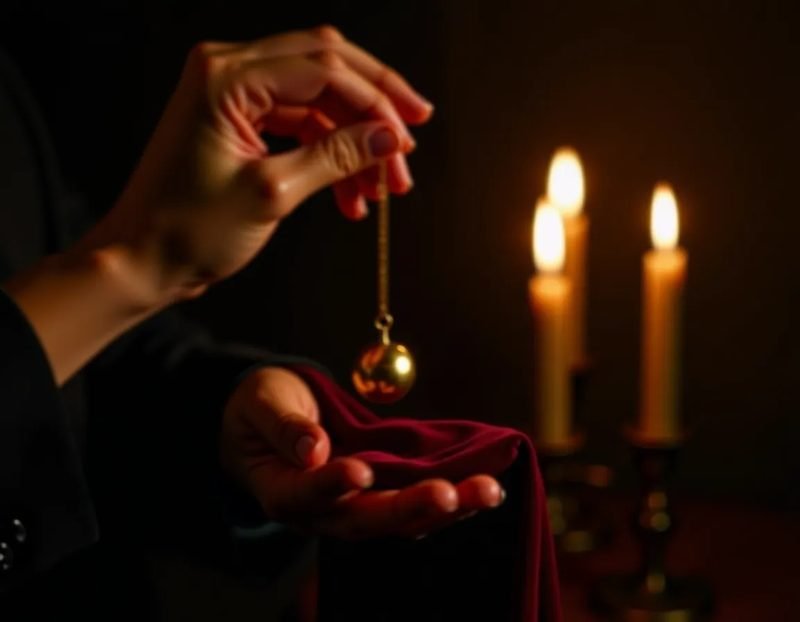
Context does heavy lifting. A pendulum pulled from a jacket pocket under house lights is a curiosity, at most. But what changes when you move it to a candlelit table, draw it from a velvet pouch, and ground it in the documented history of ideomotor research? It becomes an instrument with real weight behind it. The difference isn’t the object. It’s the room. Invest in it. A seance cloth, a few worn period objects, the waxy smell and amber throw of good candles, these aren’t decoration. They’re the first page your audience reads, the one that tells them whether you’re a performer with a prop or someone who takes these things seriously.

Structuring the Presentation

  1. Frame the history. Establish briefly that pendulum use has a documented record across medical, military, and folk contexts. You’re not running a parlor stunt. You’re showing something that serious researchers spent real time with, and that distinction registers for your audience even when they can’t put their finger on why.
  2. Demonstrate calibration. Show the signals clearly, using the scripted moment described above. Making the mechanism visible up front is, paradoxically, what gives the later responses their charge, because nothing feels stranger than a process that’s been explained and still doesn’t cooperate.
  3. Invite participation. Ask the spectator to hold a question, either spoken or private, depending on whether you’re working in a mentalism context or something closer to a table seance. The private version runs stronger as mentalism. Spoken works better inside seance framing.
  4. Work the questions. The pendulum grips hardest when it answers things no one in the room can easily account for. “Are you thinking of a living person?” hits differently than “Is your card the seven of spades?”
  5. Interpret aloud. Don’t just read the swing. Talk through it. “It’s moving, but catching. As if the answer is yes, and something complicated is attached to that yes.”

Questions That Work

Yes/no questions with real emotional stakes produce the sharpest reactions. That’s the short version. What separates a useful question from a dead one? The pendulum should feel like it’s reaching into something that actually matters. The categories that hold up are questions about people (living or dead, present or absent), questions about decisions the spectator is actively sitting with, and questions about the past they know the answer to but haven’t spoken aloud. Don’t waste the moment on party games.


Advanced Techniques: Maps, Charts, and the Pendulum as Truth Detector

Advanced Techniques: Maps, Charts, and the Pendulum as Truth Detector

Pendulum Charts

A pendulum chart is a printed arc or circle divided into labeled sections. That’s all it is. But it gives the pendulum a working vocabulary beyond yes or no. Letters. Numbers. Time periods. Why stop there? Any category you can name and print becomes a valid answer. In performance, a well-made chart on genuinely aged paper does double work: it’s a functional tool and a visual object the audience can’t stop reading. The slight roughness of old stock paper unfolding flat on the table, combined with the ink-darkened edges, anchors the whole premise with a physicality no digital prop can replicate.

Map Dowsing on Stage

This is the most theatrically complete pendulum presentation you can build. Hold it over a spread map, let it drift and circle, and watch the room go quiet while everyone waits for the swing that finally stops on a specific location. That silence is the whole show. A large physical map, the kind with visible texture and slight buckling in the paper, spread flat under a warm lamp, gives the audience something to physically lean into. Build it as a feature. It’s not a closer. It deserves a central slot in your set where the tension has room to develop, not shoved at the end when people are already reaching for their coats.

The Pendulum as Truth Detector

Here’s the frame that converts skeptics. Not a supernatural claim. Not mind reading. The premise is simpler: the body knows the truth even when the mouth doesn’t volunteer it, and the pendulum reads the involuntary physical response to deception. That’s it. No mysticism required. This plays especially well with audiences who’d fold their arms through a straight cold reading, because you’ve handed them a rational explanation to hold while the effect does its actual work underneath. Watch the room when you introduce this frame: shoulders drop, people uncross their arms. You’re not asking them to believe anything. Just asking them to watch their own hands.

Combining with Book Tests

The pendulum fits cleanly alongside a book test. Spectator selects a word. You work the pendulum over an alphabet chart and arrive at it one letter at a time. Slower than a direct reveal? Yes. But that accumulated weight is something a flash reveal can’t build. Each confirmed letter is another small commitment from the audience, another beat of held breath before the pendulum swings to the next. By the time the final letter settles into place, the room has been sitting with it for two solid minutes, everyone quietly counting along, the silence pressing in tighter with each pass. That kind of grip, built letter by letter until the audience is almost willing it to land, doesn’t fade the way a quick reveal does.


Troubleshooting: When the Swing Doesn’t Cooperate

Every working pendulum performer has been there. The thing goes muddy in front of an audience, and you’re standing with a string and a weight and a room full of people watching your hand. How you handle that moment matters more than every clean read you’ve ever done.

Inconsistent swings usually trace back to divided attention, tension sitting in the wrist, or genuine conflict in what the spectator believes versus what they’re hoping to hear, and any of those causes produces the same visible muddle. What do you do? Don’t force it. Name it. “It’s not committing. That happens when the question itself holds a contradiction, when what someone hopes for and what they actually believe are pulling against each other.” That line does real work. It explains what the room just saw, drops the ambiguity onto the spectator rather than your instrument, and usually shakes something true out of them. They’ll say more than they planned to.

Between shows, hold the pendulum while doing something else entirely. Read. Have a conversation. Listen to music with the volume turned low. Let the hand sit completely slack. A tightened grip is the enemy, and most performers don’t figure that out until the pendulum starts lying to them at the one moment it shouldn’t. But it does take time. There’s no shortcut.


The Arcane Work Continues

Centuries of debunking. Centuries of appropriation. The pendulum outlasted all of it, and it’s still here, still doing something real. Whether you call it ideomotor response, unconscious information processing, or genuine divination, watch a still weight begin to move and something specific happens to the room. That quality of attention, that collective held breath where no one wants to be the first to blink, is almost impossible to manufacture any other way.

Why does it still work? Because it doesn’t ask the audience to believe anything. It just moves. And the room reacts before the brain has time to build a defense. That’s the mechanism, and it’s available to any performer willing to take the object seriously.

That’s what you’re chasing in every performance. Not the swing. The stillness just before it. The pendulum produces that reliably, given the right context, the right script, and an instrument that visually belongs in the scene, one that earns the weight of what you’re about to say before you’ve said it. It’s one of the oldest tools in the bizarre repertoire. There’s a reason it hasn’t been replaced.

If you’re building a pendulum presentation for the first time, or reworking one you’ve been refining for years, the object in your hand matters more than most performers admit. How many performances have you seen quietly ruined by a cheap chain and a plated bob that looked like costume jewelry? A pendulum that’s correctly weighted, balanced, and visually right for your aesthetic is a working tool. Not decoration. At Arcane Relics, we carry pendulums, seance props, and performance accessories chosen for working performers, pieces with presence, with actual history, and with the kind of weight that tells an audience something is happening before you say a word.

Browse the collection. Something will find you.