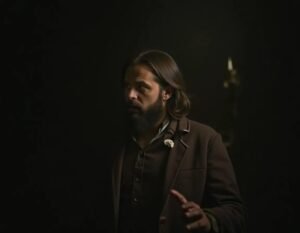

There’s a man in the third row. He arrived with his wife, who looks genuinely curious. He looks like he’s waiting for something to go wrong. His arms aren’t crossed, he’s too smart for that, but his face has the particular stillness of someone who has already written a review in his head. You’re seven minutes in. The effect you just performed landed cleanly for everyone on his left and right. He didn’t react. And you noticed, maybe two seconds too long, that his wife glanced at him before she let herself smile.
That glance is what should concern you. Not him. Her.
What most performers call “the skeptic problem” is really a problem of group dynamics, and it operates almost nothing like we assume. We spend enormous energy preparing for the hostile volunteer or the drunken interrupter. Those are problems with clear shapes and clear responses. This is subtler and more dangerous: the quiet resistant node who never does anything wrong, and yet slowly drains the room around them.
This is about finding that person early, understanding how they operate, and routing around them without making anyone feel martyred. Because martyring them is just as bad as losing the room.
Worse, by a long measure.
The Node You Haven’t Found Yet
In social psychology, the term “social proof” usually gets applied in a positive direction: when one person laughs, others laugh; when one person leans forward, others follow. But social proof runs both ways, and its negative current is just as strong. When someone in a room performs visible detachment, that detachment radiates. Not because your audience is unsophisticated, because humans calibrate their emotional responses to each other in real time. It’s one of the oldest social mechanisms we carry.
I prefer the term “resistant node” to “skeptic” because genuine skepticism is something you earn through investigation. This person has generally committed to a position before your show started. They brought their conclusion with them. What you’re managing isn’t their opinion. You’re managing their broadcast.
The tell reveals itself early. Crossed arms alone mean nothing, lots of people cross their arms when they’re concentrating. What you’re watching for is the combination: a guarded posture, a face turned toward you but with attention clearly elsewhere, and, most critically, a tendency to glance sideways at others’ reactions rather than watching the effect itself.
That sideways glance. That’s the tell. They’re monitoring the room, not watching the show.
Spot this in your first two minutes. If you catch it at minute ten, you’re already downstream.
Why This Isn’t a Heckler Problem
A heckler creates a discrete event. There’s a moment, a source, a response required. The room knows what happened. Most performers, even nervous ones, have a framework: acknowledge, redirect, move on. The resistant node doesn’t give you any of that. There’s no event. Just a quiet signal running outward through your audience like a low-frequency hum, and by the time most performers feel it, they can’t locate the source.
The heckler is a surgical problem. The node is atmospheric.
Here’s what makes it harder: the resistant node is usually perfectly well-behaved. They’re not doing anything wrong, they’re just sitting there with a particular quality of attention that communicates detachment to everyone nearby. You can’t call them out without looking unreasonable. You can’t redirect them without creating exactly the martyrdom situation you’re trying to avoid. They haven’t given you an opening, that’s not an accident. People who carry this kind of resistance often have enough social intelligence to keep it below the surface. They don’t need to say anything. The room can feel them anyway.
This is why so many performers instinctively try to convert them. It feels like the right move. Win them over and the whole room follows. In practice, it rarely works. And attempting it usually costs you the room you already had.
How Skepticism Spreads, and How It Stalls
Think about the physical geometry of where people are sitting. The resistant node has neighbors. Those neighbors arrived open to the experience, and for the first few minutes they were with you. But humans are deeply social animals, and prolonged emotional divergence from someone nearby creates a subtle pressure. If my seatmate is unmoved, and I’m moved, I begin quietly questioning my own reaction. Am I being credulous? Am I the naive one here? That doubt doesn’t announce itself. It just tightens the room.
The spread follows physical proximity rather than sight lines. The node doesn’t need to be visible from the front of the room. Two or three people nearby begin to self-correct, and those people’s changed energy touches the people next to them. Within a few minutes, a pocket of the room has gone flat, the rest of the audience starts to feel it without knowing why.
Here’s the counterintuitive part: the node’s influence stalls at natural social boundaries. Strangers who didn’t arrive together have weaker calibration bonds. Guests who came with the host often carry a stronger loyalty to the experience than to the resistant stranger beside them. And a room that has already shared one strong collective moment, something that made everyone go quiet at exactly the same instant, has built emotional infrastructure that’s much harder to disrupt.
This is why your early minutes matter so much. You’re not just warming up. You’re building the room’s immune system.
Routing Around Resistance
The first principle: don’t route through the node. Don’t avoid them conspicuously either, that draws attention. What you’re doing is managing the flow of attention, directing the room’s emotional gaze toward the people who are already with you.
Use your believers as mirrors. When something lands, let your focus drift toward the reactions you want more of. Hold eye contact a half-beat longer with the person who’s genuinely lit up. Ask your follow-up question to someone three seats from the node, not the node themselves. You’re not ignoring the resistant person, you’re teaching the room where to look for its own emotional cues.
Physically, close the distance with the warm pocket. In parlor or close-up settings, where you move matters as much as what you say. Two minutes working near the people who are genuinely present will pull that energy forward. The room follows your body.
In some situations, a small, non-confrontational moment of inclusion can neutralize a resistant node entirely. Not a trick, not a test. Something minor: a direct question requiring only a yes or no, a brief moment where they feel seen without being put on the spot. Sometimes the resistance is protective rather than hostile. They’re waiting to be made to look foolish. If you demonstrate early that you’re not that kind of performer, the guard can drop. Not always. But often enough that it’s worth one gentle attempt before you write them off.
And if none of that lands, that’s fine too. You don’t need to convert them. You need to contain the signal. Keep the warm pocket warm, keep the believers believing, and let the node be the one person in twenty who had a different night. So yes, that counts as a win.
What You Must Not Do
Don’t call attention to the resistance. Not directly, not obliquely, not with a joke everyone in the room knows is aimed at one person. The moment you do that, you’ve made them the center of the show and created a victim narrative. The room’s sympathies will split in ways that are very hard to recover from. Even if they were being subtly disruptive, martyring them costs you far more goodwill than their quiet skepticism ever would have.
Don’t try to convert them. This is the one that trips up the most working performers. The instinct is almost universal and it’s almost always wrong. Think about what conversion requires: you have to spend substantial time and attention on the one person in the room least interested in what you’re doing. While that’s happening, the people who came to have a real experience are being neglected. You’re optimizing for resistance and starving belief.
My jaw tightens when I watch another performer make this choice, and I feel it in my stomach a second later, because I know exactly what’s about to happen to the audience they’re walking away from.
And don’t let the node see that you’ve noticed. You have noticed, of course. Reading the room is the job. But if your attention keeps returning to them, if your energy visibly dips in their corner, they’ll know you’ve clocked them, and so will the people nearby. Hold your composure, it matters more than almost any other skill in this specific situation.
The Room You Want to Leave Them With
I did a private event in Louisville a few years back where a man near the back spent most of the first half with a very clear expression of amused tolerance. He wasn’t disruptive. He was just present in a way that announced his position. By the third effect, I had stopped trying to reach him and focused everything on the twelve people in front of him who were having a real experience.
He came up at the end. Not converted, not a believer. But troubled in a way he couldn’t comfortably name. That’s exactly what he said: “I don’t know what that was.” He didn’t mean it as a compliment and it wasn’t intended as one. He meant it as a problem he was taking home with him.
That’s more interesting to me than a convert.
You’re not trying to force a conclusion. You’re trying to create an experience that resists easy dismissal. If your show is built on things that can’t be neatly explained, on moments that happened in the room in real time without obvious methodology, then the resistant node has to do more work on the drive home than they expected. That unresolved, peculiar feeling at midnight is your win. Not applause. Not conversion.
The believers in your room are your responsibility. Protect them first. The resistant nodes are a variable you manage, not a problem you solve.
Some rooms have one. Some rooms have three. Build a show strong enough to hold the room regardless.
At Arcane Relics, the props and effects we carry are selected for working performers in real rooms, where psychology matters more than catalog appeal. If you’re building a show designed to hold a room, that’s where to start.