Reading the Room in Real Time, Adjusting a Bizarre Magic Set Without Breaking the Frame

Reading the Room in Real Time, Adjusting a Bizarre Magic Set Without Breaking the Frame

A room lies to you before the show even starts. The promoter tells you the crowd skews older, reflective, ready for slow reveals. Then forty minutes in you’re standing in front of twenty-five-year-olds who came from an open bar downstairs, restless, phones half out, and your carefully sequenced hour of quiet dread is built for people who aren’t in the seats. This happens more than performers admit. The gap between the room you prepared for and the room you got is where careers get made or quietly stall.

The Room Tells You Everything in the First Ninety Seconds

Most performers read the room during their opening line. That’s too late. The room starts talking the moment you walk toward the space, before you’ve said a word. Watch how people are already sitting. Are they leaning toward each other, still finishing conversations, or are they turned toward the stage waiting? Are drinks half full or nearly gone? A crowd two rounds deep responds to different rhythms than a crowd that just sat down.

I read three things before I open my mouth: posture, noise floor, and eye contact density. Posture tells you energy. Noise floor tells you attention span. Eye contact density, how many people are actually looking at the space where the show will happen versus looking at their table, tells you how much work your opening needs to do to earn focus.

None of this requires magic. It requires paying attention like your set depends on it, because it does.

Build Your Set in Modules, Not a Script

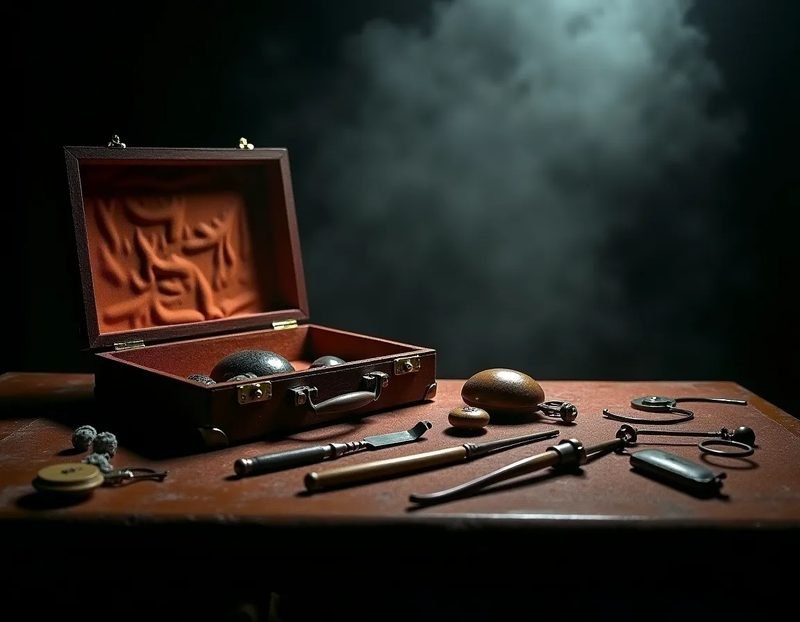
a performer's prop case open on a table, several distinct effects laid out and organized

Here’s the part most guides get wrong. They tell you to memorize a running order and stick to it, because consistency equals professionalism. That’s true for a magician doing card tricks at a corporate happy hour. It’s false for a bizarrist working a room that might swing between reverent silence and restless energy inside the same hour.

Your set should exist as interchangeable modules, not a fixed script. Think of each piece as carrying its own emotional signature, a slow burn, a jolt, a quiet unsettling, a comic release, and know which signature each one delivers before you ever walk in. Then you can reorder them live without anyone noticing the seams, because the transitions were built to work in more than one sequence.

I keep four or five pieces in rotation for any given evening, each rated on two axes: how much silence it demands and how much energy it needs from the room to land. A piece that needs the room quiet and attentive doesn’t go first in a loud room. It waits. You open with something that can survive noise, something visual or startling enough to cut through chatter, and you earn the silence before you spend it on your best material.

Pacing Is a Conversation, Not a Countdown

New performers treat their set like a train schedule. Effect one at minute three, effect two at minute eight, reveal at minute twelve. The room doesn’t run on your watch. It runs on its own nervous system, and if you ignore that, you’ll deliver a technically flawless show to an audience that checked out four minutes ago.

Watch for the tell that a room needs a breath: shifting in seats, side conversations creeping back in, someone glancing at a phone screen that just lit up. When you see two or three of these at once, that’s not a signal to push harder into your next big reveal. That’s a signal to shorten your setup, cut a beat you’d normally savor, and get to payoff faster than planned.

The opposite tell matters too, and it’s rarer. When a room goes still in a way that feels earned rather than polite, when you can hear the ice not moving in anyone’s glass, don’t rush past it to keep pace with your rehearsed timing. Let it sit. That stillness is the whole reason you do this work. Spending it too fast is the mistake of someone still counting minutes instead of reading faces.

Adjusting Without Breaking the Frame

This is where bizarre magic asks more of you than mainstream conjuring does. A card magician can drop a trick and grab another deck without much cost to the illusion. You can’t. If your persona is a man who reads objects for their history, or a woman who claims uneasy contact with things left behind, every adjustment has to happen inside that frame or the whole evening collapses into a guy doing tricks.

So the skips and substitutions need built-in cover. I never say “let’s try something else” or anything that admits a change of plan. Instead the persona makes the call. A brief pause, a line about needing a moment, a redirection toward an object already on the table, these all read as choices the character is making in real time, not corrections to a broken show. If you write your patter with even a little flexibility baked in, phrases that work whether the next beat is effect A or effect C, the audience never sees the seam.

I’ve cut a planned centerpiece mid-set at a private event because the energy in the room had gone quiet in the wrong way, tired rather than transfixed, and I needed something shorter and stranger instead. Nobody in that room knew a piece got dropped. They just experienced a show that felt inevitable, because the persona never broke character to manage logistics.

Know Your Silence Tolerance Before You Need It

Every performer has a personal threshold for how long they can hold silence before their nerves make them fill it. Most people’s threshold is too short, and they don’t know it until they’re in front of a crowd that’s gone quiet for reasons they can’t read. Is the silence engagement or discomfort? If you can’t tell the difference under pressure, you’ll rush the reveal that needed three more seconds to land, or worse, you’ll crack a joke that shatters a mood you spent ten minutes building.

Practice sitting in silence deliberately, outside of any show. Time yourself. Notice the exact second your body wants to talk. That’s data, not a character flaw, and once you know your number you can push past it on purpose when the room’s silence reads as held breath rather than confusion.

I’ve found that most rooms can hold far more silence than performers give them credit for. The audience isn’t waiting for you to rescue them from the quiet. They’re waiting to see what you do with it.

Recovery Is a Skill, Not an Accident

Something will go wrong in every extended run of shows. A prop misbehaves, a spectator gives an answer that derails your setup, a heckler decides tonight’s the night. Amateur performers treat these moments as emergencies to survive. Professionals treat them as material, because the persona you’ve built should have a plausible reaction to almost anything, if you’ve thought it through in advance.

Write yourself two or three all-purpose lines that fit your character and can absorb a derailment without acknowledging failure. Not jokes about technical difficulty, those break the frame instantly, but lines that reframe the interruption as part of the phenomenon itself. A misbehaving object becomes evidence something doesn’t want to be touched tonight. A skeptical spectator becomes exactly the kind of resistance your character claims to expect and even prefer.

The performers who unnerve a room most convincingly aren’t the ones with the most polished routines. They’re the ones who never once look like anything could throw them off. That composure isn’t personality, it’s rehearsal, applied to the moments you can’t script.

Reading a room and adjusting inside your persona is a discipline, and like any discipline it improves with the right tools built for exactly this kind of flexible, atmospheric work. If you want pieces engineered to bend without breaking, built for performers who need material that survives an unpredictable room, take a look through what we carry at Arcane Relics.

The Skeptic at Table Three: Managing Disbelief Without Breaking the Room

The Skeptic at Table Three: Managing Disbelief Without Breaking the Room

There’s a man in the third row. He arrived with his wife, who looks genuinely curious. He looks like he’s waiting for something to go wrong. His arms aren’t crossed, he’s too smart for that, but his face has the particular stillness of someone who has already written a review in his head. You’re seven minutes in. The effect you just performed landed cleanly for everyone on his left and right. He didn’t react. And you noticed, maybe two seconds too long, that his wife glanced at him before she let herself smile.

That glance is what should concern you. Not him. Her.

What most performers call “the skeptic problem” is really a problem of group dynamics, and it operates almost nothing like we assume. We spend enormous energy preparing for the hostile volunteer or the drunken interrupter. Those are problems with clear shapes and clear responses. This is subtler and more dangerous: the quiet resistant node who never does anything wrong, and yet slowly drains the room around them.

This is about finding that person early, understanding how they operate, and routing around them without making anyone feel martyred. Because martyring them is just as bad as losing the room.

Worse, by a long measure.

The Node You Haven’t Found Yet

In social psychology, the term “social proof” usually gets applied in a positive direction: when one person laughs, others laugh; when one person leans forward, others follow. But social proof runs both ways, and its negative current is just as strong. When someone in a room performs visible detachment, that detachment radiates. Not because your audience is unsophisticated, because humans calibrate their emotional responses to each other in real time. It’s one of the oldest social mechanisms we carry.

I prefer the term “resistant node” to “skeptic” because genuine skepticism is something you earn through investigation. This person has generally committed to a position before your show started. They brought their conclusion with them. What you’re managing isn’t their opinion. You’re managing their broadcast.

The tell reveals itself early. Crossed arms alone mean nothing, lots of people cross their arms when they’re concentrating. What you’re watching for is the combination: a guarded posture, a face turned toward you but with attention clearly elsewhere, and, most critically, a tendency to glance sideways at others’ reactions rather than watching the effect itself.

That sideways glance. That’s the tell. They’re monitoring the room, not watching the show.

Spot this in your first two minutes. If you catch it at minute ten, you’re already downstream.

Why This Isn’t a Heckler Problem

A heckler creates a discrete event. There’s a moment, a source, a response required. The room knows what happened. Most performers, even nervous ones, have a framework: acknowledge, redirect, move on. The resistant node doesn’t give you any of that. There’s no event. Just a quiet signal running outward through your audience like a low-frequency hum, and by the time most performers feel it, they can’t locate the source.

The heckler is a surgical problem. The node is atmospheric.

Here’s what makes it harder: the resistant node is usually perfectly well-behaved. They’re not doing anything wrong, they’re just sitting there with a particular quality of attention that communicates detachment to everyone nearby. You can’t call them out without looking unreasonable. You can’t redirect them without creating exactly the martyrdom situation you’re trying to avoid. They haven’t given you an opening, that’s not an accident. People who carry this kind of resistance often have enough social intelligence to keep it below the surface. They don’t need to say anything. The room can feel them anyway.

This is why so many performers instinctively try to convert them. It feels like the right move. Win them over and the whole room follows. In practice, it rarely works. And attempting it usually costs you the room you already had.

How Skepticism Spreads, and How It Stalls

Think about the physical geometry of where people are sitting. The resistant node has neighbors. Those neighbors arrived open to the experience, and for the first few minutes they were with you. But humans are deeply social animals, and prolonged emotional divergence from someone nearby creates a subtle pressure. If my seatmate is unmoved, and I’m moved, I begin quietly questioning my own reaction. Am I being credulous? Am I the naive one here? That doubt doesn’t announce itself. It just tightens the room.

The spread follows physical proximity rather than sight lines. The node doesn’t need to be visible from the front of the room. Two or three people nearby begin to self-correct, and those people’s changed energy touches the people next to them. Within a few minutes, a pocket of the room has gone flat, the rest of the audience starts to feel it without knowing why.

Here’s the counterintuitive part: the node’s influence stalls at natural social boundaries. Strangers who didn’t arrive together have weaker calibration bonds. Guests who came with the host often carry a stronger loyalty to the experience than to the resistant stranger beside them. And a room that has already shared one strong collective moment, something that made everyone go quiet at exactly the same instant, has built emotional infrastructure that’s much harder to disrupt.

This is why your early minutes matter so much. You’re not just warming up. You’re building the room’s immune system.

Routing Around Resistance

The first principle: don’t route through the node. Don’t avoid them conspicuously either, that draws attention. What you’re doing is managing the flow of attention, directing the room’s emotional gaze toward the people who are already with you.

Use your believers as mirrors. When something lands, let your focus drift toward the reactions you want more of. Hold eye contact a half-beat longer with the person who’s genuinely lit up. Ask your follow-up question to someone three seats from the node, not the node themselves. You’re not ignoring the resistant person, you’re teaching the room where to look for its own emotional cues.

Physically, close the distance with the warm pocket. In parlor or close-up settings, where you move matters as much as what you say. Two minutes working near the people who are genuinely present will pull that energy forward. The room follows your body.

In some situations, a small, non-confrontational moment of inclusion can neutralize a resistant node entirely. Not a trick, not a test. Something minor: a direct question requiring only a yes or no, a brief moment where they feel seen without being put on the spot. Sometimes the resistance is protective rather than hostile. They’re waiting to be made to look foolish. If you demonstrate early that you’re not that kind of performer, the guard can drop. Not always. But often enough that it’s worth one gentle attempt before you write them off.

And if none of that lands, that’s fine too. You don’t need to convert them. You need to contain the signal. Keep the warm pocket warm, keep the believers believing, and let the node be the one person in twenty who had a different night. So yes, that counts as a win.

What You Must Not Do

Don’t call attention to the resistance. Not directly, not obliquely, not with a joke everyone in the room knows is aimed at one person. The moment you do that, you’ve made them the center of the show and created a victim narrative. The room’s sympathies will split in ways that are very hard to recover from. Even if they were being subtly disruptive, martyring them costs you far more goodwill than their quiet skepticism ever would have.

Don’t try to convert them. This is the one that trips up the most working performers. The instinct is almost universal and it’s almost always wrong. Think about what conversion requires: you have to spend substantial time and attention on the one person in the room least interested in what you’re doing. While that’s happening, the people who came to have a real experience are being neglected. You’re optimizing for resistance and starving belief.

My jaw tightens when I watch another performer make this choice, and I feel it in my stomach a second later, because I know exactly what’s about to happen to the audience they’re walking away from.

And don’t let the node see that you’ve noticed. You have noticed, of course. Reading the room is the job. But if your attention keeps returning to them, if your energy visibly dips in their corner, they’ll know you’ve clocked them, and so will the people nearby. Hold your composure, it matters more than almost any other skill in this specific situation.

The Room You Want to Leave Them With

I did a private event in Louisville a few years back where a man near the back spent most of the first half with a very clear expression of amused tolerance. He wasn’t disruptive. He was just present in a way that announced his position. By the third effect, I had stopped trying to reach him and focused everything on the twelve people in front of him who were having a real experience.

He came up at the end. Not converted, not a believer. But troubled in a way he couldn’t comfortably name. That’s exactly what he said: “I don’t know what that was.” He didn’t mean it as a compliment and it wasn’t intended as one. He meant it as a problem he was taking home with him.

That’s more interesting to me than a convert.

You’re not trying to force a conclusion. You’re trying to create an experience that resists easy dismissal. If your show is built on things that can’t be neatly explained, on moments that happened in the room in real time without obvious methodology, then the resistant node has to do more work on the drive home than they expected. That unresolved, peculiar feeling at midnight is your win. Not applause. Not conversion.

The believers in your room are your responsibility. Protect them first. The resistant nodes are a variable you manage, not a problem you solve.

Some rooms have one. Some rooms have three. Build a show strong enough to hold the room regardless.

At Arcane Relics, the props and effects we carry are selected for working performers in real rooms, where psychology matters more than catalog appeal. If you’re building a show designed to hold a room, that’s where to start.

The Séance Table as Mise-en-Scène: Designing Environments That Break Skeptics

A dark wood séance table lit by beeswax candles, set with a leather journal, a wax-sealed envelope, and an antique framed photograph

By the time your first participant sits down, the séance has already been running for twenty minutes. The work happened while they were in the hallway, at the dinner table, or standing in the cold outside the door. The environment was speaking. The question is whether you designed what it said.

Most performers think about effects. Better performers think about atmosphere. The best performers understand that atmosphere is an effect, and it should be engineered with the same precision you’d apply to a centre tear or a book test. This is not about candles and mood. It’s about ratios, angles, and the specific psychological pressure that well-chosen objects exert on an unprepared mind.

Why the Room Does Half the Work

Dariel Fitzkee wrote at length about the staging of mystery. The core idea is not complicated: what surrounds an effect changes how it lands. A sponge ball vanish in a fluorescent-lit kitchen is a trick. The same vanish in a room that smells of old paper and looks like a 19th-century parlor is something else entirely.

Skeptics are not broken by argument. They are softened by atmosphere. The rational mind has defenses, but those defenses were built for verbal debate, not for a well-staged room. When someone walks into a space that activates their nervous system’s ancient threat-assessment circuits, logic does not disappear. It slows. It gives ground.

Your job, before you utter a single word or touch a single prop, is to build a room that puts the skeptic in a slightly off-balance state. Not afraid. Not resistant. Just leaning slightly forward. That’s the condition you’re after. Everything you’ve planned to perform will land harder in that state than it would in any other.

Lighting: Ratios, Not Ambience

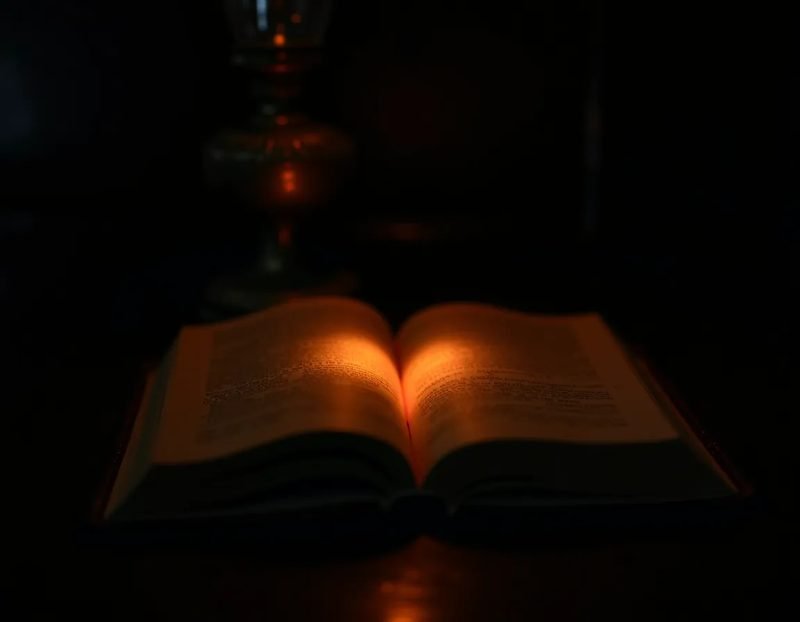
close-up of antique oil lamp casting warm amber pool of light on open leather-bound journal, dark wood surface, surround

Amateurs say “low light.” Professionals think in ratios.

The goal is not darkness for its own sake. It’s contrast. A single light source at roughly 40% of what you’d consider comfortable reading light creates shadows. Shadows create depth. Depth creates uncertainty. When a participant cannot fully read the room, they fill the gaps with imagination, and imagination is your most reliable collaborator.

Placement matters more than intensity. Light coming from below the table surface, or from a lamp at seated eye level, distorts familiar faces and objects in ways the unconscious registers before the conscious mind can explain it. A lamp positioned to backlight your silhouette slightly adds authority. It’s the same principle that makes a judge’s bench feel different from a dinner chair.

Color temperature is underused. Warm amber light, around 2700K if you’re working with adjustable LEDs, creates an older, slower feeling in the room. Cooler light reads as institutional and modern. You want warm. You want the room to feel like it belongs to a different century, or at least to a part of this century that most people don’t visit.

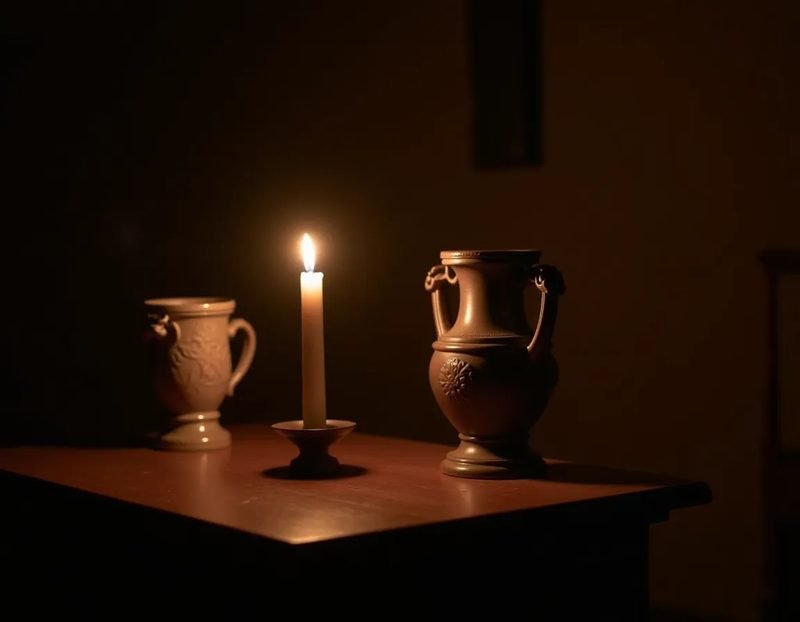
One candle is theater. Two is decoration. Five is ritual. If you use candles, commit. Arrange them in a pattern with internal logic, even if you never explain that logic. Participants will assume meaning. Let them.

The Table as the First Argument

Round tables are not a cliche. They are a functional choice based on sightlines, energy management, and group psychology.

A rectangular table creates a head. Someone sits at the head. That person leads. In a séance, you don’t want that dynamic visible. You want the appearance of an absence of hierarchy, the condition under which participants are most likely to surrender individual skepticism to the group. A round table says “we are all equal here.” That equality is what you’ll work against quietly, and precisely because it seems true, it will hold.

Surface texture and color matter. Dark wood, or a dark cloth over whatever you actually have, reduces contrast between objects placed on the table. This makes it harder to track exactly what’s there, in what position, and in what state. This is not deception. It’s environmental information management.

Table height matters. A surface that sits slightly lower than standard dining height makes participants lean forward. Leaning forward is an engaged, slightly vulnerable body posture. You want that posture before the first word.

Old tables work best, but it’s the character of oldness you’re after, not the antique price tag. A scratched, solid, dark wood table says “this has been used for things.” That suggestion costs nothing and gives you a great deal.

Prop Placement and Unconscious Reading

Every object in the room will be read. That is not an exaggeration. Participants scan unfamiliar environments compulsively, and they assign meaning to what they find. You are the author of that environment. Write carefully.

Props that suggest history are more valuable than props that suggest function. A sealed envelope on the table says “something is about to happen.” A leather journal, half-open, with handwritten notes visible from across the room, says “someone has been here before and left a record.” A small framed photograph of an unidentified person says “this concerns specific people.” These props don’t explain themselves. That’s the point. Explanation is the enemy of suggestion.

Placement should appear accidental. Objects arranged with obvious geometric precision look staged. Objects that look as though they were set down and not moved look inhabited. The technique: arrange with precision first, then displace each piece slightly. Two inches left. Three inches forward. Tilt one at an angle. Now it looks real.

Keep the center of the table clear. The center is where things will happen. If it’s cluttered before you begin, you’ve spent your budget early. Keep it open and let participants project into that empty space. Empty space in a charged environment is not nothing. It’s pressure.

The floor is part of your staging. A faded rug, a single book face-down near a leg of the table, something partially obscured by the tablecloth: these are not props for effects. They are texture. They say the room has a life beyond this evening.

Sound, Scent, and the Attending Senses

Performers forget two senses consistently. Don’t.

Sound: a completely silent room is not atmospheric. It’s oppressive. Oppression creates resistance. What you want is near-silence with occasional intrusion. A building settling. Distant traffic muffled by heavy curtains. If you can arrange it, a clock somewhere in the room, ticking, is extraordinary. Participants become aware of time passing. Time is what séances are about. The past intruding on the present. A clock makes that abstract idea concrete and audible, without you saying a word about it.

Avoid music at the table unless it’s barely audible and purely textural. Recognizable music pulls participants out of the room and into their own memory. You don’t want them in memory. You want them present, in this room, with you.

Scent: old books, cedar, very faint wood smoke if the space allows it. These are olfactory signals for “old,” “stored,” “still.” Avoid floral scents, which read as domestic. Avoid synthetic fragrances, which read as contemporary. What you want is the smell of things that have been in a room for a long time.

Beeswax candles do double work: light and a specific smell that reads as old-world and ceremonial. Worth the cost over paraffin, every time.

The Entry Protocol

The environment starts working before the door opens.

Where do participants wait before entering? What do they see, hear, and smell in that space? If you have any control over the pre-room, use it. A narrow hallway is better than a wide one. Something on the wall that doesn’t fully explain itself. A quiet exchange between you and someone else that stops when they approach. These are not tricks. They are environmental priming, and they work.

The moment of entry should be controlled. One person at a time, when possible. A participant who enters alone into a room they’ve never seen has a distinct experience from one who files in as part of a group still laughing from dinner. The entry is a threshold, and thresholds are psychologically loaded. Walk through a doorway and your brain categorizes the new room. You can guide what category it chooses.

Seat participants with direction. Don’t let them choose their own seats unless seating is genuinely arbitrary. Tell them where to sit with quiet authority. “Please, sit here” is sufficient. In complying, they’ve already yielded something. That’s the first act of the evening, and it happens before you’ve performed anything.

The Pause Before the First Word

Once everyone is seated and the room is set: wait. Not with a showman’s dramatic pause. Just wait. Ten seconds. Fifteen. Let the room fill itself. Participants will look at the table, at each other, at you. Their attention will have no anchor, so it floats. Floating attention is suggestible attention.

Then speak. Your first words should be plain and quiet. Not a preamble about the history of spiritualism. Not a disclaimer. Something simple and present: “Thank you for being here.” Or nothing at all. A look at each participant in turn, and then a small, deliberate gesture toward the table.

By now, the room has been working for twenty minutes. You haven’t performed anything yet. But you have already changed the people sitting in front of you. That’s what staging is for. The effects you run will land harder, read deeper, and stay longer in memory because of everything you built before this moment.

Annemann knew it. Corinda knew it. Hades knew it. The staging is not support for the magic. It is the first act of the magic. Design it accordingly.

The props, instruments, and atmospheric tools used by working bizarre magic performers are waiting at Arcane Relics. Browse the shop for séance staging props, spirit slates, mentalism instruments, and the complete library of bizarre magic texts that belong on a serious performer’s shelf.

The Architecture of Dread: Building Atmospheric Tension Before a Single Word Is Spoken

The Architecture of Dread: Building Atmospheric Tension Before a Single Word Is Spoken

Why the Room Does Half the Work

Most performers walk into a venue and start thinking about their opening line. The serious ones arrive two hours early and start thinking about the air.

Atmospheric work is not decoration. It is not mood-setting in the theatrical sense, where lighting and set dressing support a story already written. In bizarre magic and mentalism, the atmosphere is the first act. By the time you speak your opening sentence, the audience should already be unsettled. They should not be able to explain why.

This is a learnable skill, repeatable, and entirely separate from your scripted material. What follows is a working framework for building genuine psychological tension before a single word of performance has been delivered.

Light as an Instrument, Not a Fixture

Light as an Instrument, Not a Fixture

Stage lighting is designed to make performers visible. Séance lighting is designed to make everything else uncertain.

The distinction matters. If your venue has a dimmer board, resist the temptation to simply lower the house lights to “atmospheric.” That produces darkness, not dread. Dread comes from selectivity: what is lit, what is shadowed, and where the eye keeps returning without finding resolution.

Practical light sources do this better than theatrical instruments in most intimate settings. A single oil lamp on a side table. A pair of candles at the far end of the room, positioned just beyond comfortable focus. One directional source that illuminates a prop without fully explaining it. The audience brain fills gaps. You want it busy filling gaps before you have said anything.

Color temperature matters more than most performers account for. Warm amber sources, around 2000-2200K, consistent with candlelight, read as old. They pull the room out of the present tense. Cool sources feel clinical; they work against you in a séance context unless you are deliberately building a paranormal investigation aesthetic. Know which world you are constructing before you choose your sources.

One practical note: never let all sources sit at eye level or below. A small upward-facing light placed behind an object casts its shadow onto the ceiling and walls. Shadows that move upward register as wrong. Use that.

Ambient Sound and the Grammar of Silence

Sound design for bizarre magic divides into two categories: what you play, and what you do not.

On the ambient side, the common mistake is choosing tracks that read as obviously “spooky.” Drone music, minor-key string clusters, anything that signals horror film. Genre signals safety. Safety is the opposite of what you want.

The more effective approach uses sound that is almost right. A field recording with one element that does not belong. A piece of early 20th-century phonograph music played slightly below normal speed. The sound of a building at night, with one creak that does not repeat on a predictable interval. The brain cannot habituate to irregular stimuli. It stays alert.

Volume is critical. The level should sit just below conversational speech. Guests will unconsciously lower their own voices to match. Quieter voices produce quieter bodies. Quieter bodies are more receptive, more focused, and significantly easier to direct.

On silence: learn to use it before you enter the room. If you have any control over the pre-show environment, build in a period of complete quiet before your arrival. Two minutes of ambient sound, then it stops. Then you enter. The contrast between ambient noise and silence reads as the approach of something. You become the thing that arrives after the sound stops.

The Grammar of Objects: Prop Placement Before the Show

The Grammar of Objects: Prop Placement Before the Show

Every object visible in your performance space before the show starts is making an argument. The argument is: something is going to happen here.

Prop placement is not prop display. Display arranges things to look good. Placement arranges things to create questions. There is a significant difference.

Consider the single, face-down playing card on an otherwise clear table. No deck in sight. No explanation. It was there when guests arrived. The card may mean nothing in the performance, and it does not matter. Its job was to put the question in the room.

Objects work best when placed at the edges of comfortable attention. Not centerpiece placement, not hidden; somewhere between. A pocket watch beside a chair nobody sits in. A closed book spine-out on a shelf, with a slip of paper protruding from its pages. A single glove. These items function as visual subordinate clauses. They suggest that a sentence is coming.

Avoid clutter. Three or four deliberate objects accomplish more than a full table of props. The brain treats abundance as decoration. Scarcity creates attention.

Asymmetry is your ally. Symmetrical arrangements read as controlled and designed, which is comforting. Slight asymmetry, the object that is almost but not quite aligned with its neighbors, reads as something interrupted. Something arranged by someone who was then called away.

The Pre-Show Encounter: Misdirection Before You Begin

If you have access to your audience before the formal performance begins, you have the most powerful pre-show tool available: live contact.

This does not mean performing. It does not mean doing effects in the lobby. It means controlled encounter design that plants material and primes psychology without being identifiable as performance.

The simplest version: you are present in the space as guests arrive, apparently occupied with something else. Examining an object, making a note, consulting a document. You do not immediately acknowledge the room. When you do make contact, it is brief. You learn one thing about one person, a name, a detail they volunteer, and you move on. That detail may or may not reappear in the performance. It does not matter either way. What matters is that every person in the room now holds a small, private uncertainty about what you know and when you learned it.

For seated séance work: the waiting period before guests are invited into the performance space is not dead time. If you can pipe your ambient sound into the waiting area at lower volume, do it. If your materials reference an absent third party, a medium, a deceased subject, a previous participant, refer to that person casually in pre-show conversation. “She left a note about this evening.” Do not explain it. Move on.

Annemann understood the value of the pre-show period and addressed it directly in Practical Mental Effects. Banachek’s Psychosomatic Mentalism contains sharp observations on managing the room before formal performance begins. The literature on this specific area is not extensive, but it exists. Read it carefully.

Pacing, Arrival, and the Productive Use of Waiting

The moment you enter the performance space is the first moment of the show. Most performers waste it by entering normally.

“Normally” means: the performer walks in, perhaps says hello, moves to their position, and begins. The audience has been given no reason to shift attention modes. They are still in receiving-information mode. That is not where you want them.

The alternative is to treat your entrance as a cue that something has changed. The change can be very small. You enter and do not immediately acknowledge the room. You stand at a position for a count of three before turning. You sit without speaking and adjust one object on the table before you look up. These behaviors are not theatrical in the dramatic sense. They are simply not normal. “Not normal” is the perceptual key you are looking for.

Pacing throughout the pre-show should be slower than feels comfortable. Silence should last longer than feels comfortable. The audience’s discomfort with silence is yours to use. When nobody speaks and nothing happens, attention increases. Expectation builds. When you break that silence, you arrive into a room that is listening very hard.

One technique worth considering: set a practical sound, a clock, a distant phone, a record player winding down, to trigger at a specific moment just before you speak. The transition from one sound state to another functions as a non-verbal announcement. It tells the room that something is about to begin without you having to say so. Your opening line drops into a space already prepared to receive it.

All of this is work that happens before your first effect. None of it requires new apparatus. It requires planning, early arrival, and a willingness to treat the room itself as part of your method.

The audience will not know why they felt it. They rarely do. That is the point.

Build the Room. Then Build the Show.

If you are working seriously in bizarre magic, the architecture of the experience is as important as the method behind any individual effect. A strong piece performed in a neutral room will land. The same piece performed in a room that has spent forty-five minutes building pressure will be remembered differently. It will feel like something actually happened.

That difference is not accidental. It is built.

At Arcane Relics, we stock props, atmospheric tools, and performance materials for practitioners who work at this level. Candle systems, antique staging pieces, and resources designed specifically for intimate and séance-style environments.

Browse the Arcane Relics Shop

“`

Continue reading: Sound Design for the Séance: How Audio Architecture Shapes Belief and Sustains Atmosphere