
Sound Design for the Séance: How Audio Architecture Shapes Belief and Sustains Atmosphere

In Part 1: The Architecture of Dread: Building Atmospheric Tension Before a Single Word Is Spoken, the focus was physical: room arrangement, sightlines, the deliberate placement of objects to shape expectation before anyone sits down. If you have not read it, start there. This post assumes the room is sorted. What it does not assume is that you have given any serious thought to what the room sounds like. Most performers have not. That is the gap we are filling here.
Why Performers Ignore Audio (And Why That Is a Mistake)
The auditory system processes threat faster than the visual system does. This is not theory; it is evolutionary biology. Your audience is already forming emotional responses to what they hear before they consciously register what they see. A room that looks right but sounds wrong creates low-level friction that stops people from fully committing to the experience. They cannot name the problem. They just feel slightly outside it.
Most performers spend hours on visual staging and almost nothing on audio. They queue up a “dark ambient” playlist on a phone, set the volume somewhere in the middle, and call it done. The result is not atmosphere. It is wallpaper.
Sound design, done properly, is not background. It is infrastructure. It holds the emotional temperature of the room while you work.
Music Selection: What Works and What Kills the Room
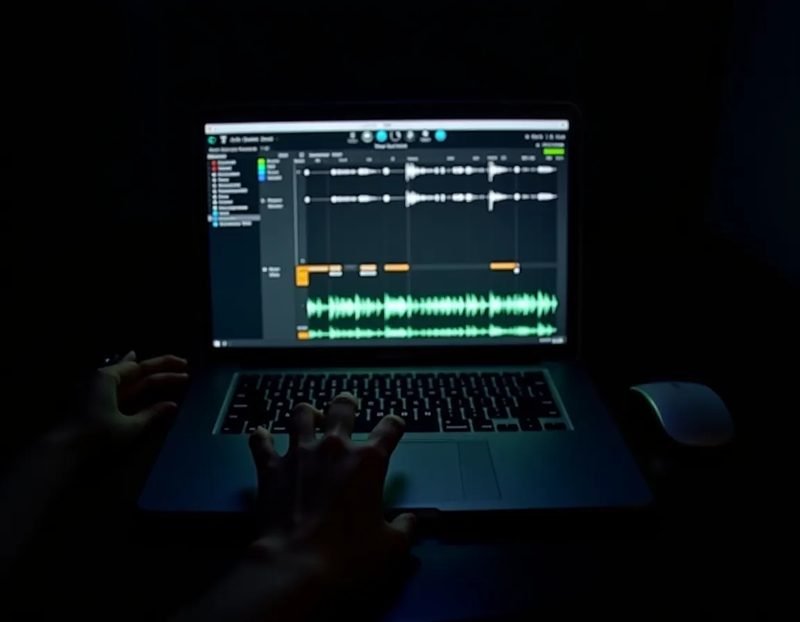
The wrong music choice can undo careful staging in under thirty seconds. Here is what you need to understand about selection.
Avoid anything with a recognizable melody. The moment an audience member thinks “I know this song,” they are no longer in your room. They are in a film they saw, a playlist they know, a memory that has nothing to do with you. Recognizable melody is an exit door. Keep it shut.
Avoid horror film clichés. Jump-scare stingers, standard minor-key orchestral swells, anything that sounds like a genre film trailer. These trigger a media-literate response in most audiences. They know they are being manipulated by a familiar technique, and that awareness is the opposite of belief.
What works: drone-based compositions and slowly evolving textures with no clear beginning or end. Microtonality, where instruments are tuned slightly off-standard, creates persistent low-grade unease without announcing itself. Study composers like Thomas Koner or early Robert Rich and understand why their work functions the way it does before using it. If you cannot articulate what the music is doing to the room, you are not controlling it.
Tempo matters more than most performers realize. Music in the 50 to 70 BPM range sits just below average resting heart rate. It creates a pull toward stillness and receptivity. Significantly slower than that and the effect becomes funereal in the wrong register. Faster and it elevates anxiety past the useful range. Know where you want the room emotionally, then choose tempo to put it there.
Volume is the other variable that rarely gets the attention it deserves. The piece should be audible without being noticeable. If anyone in your audience is consciously aware of the music, it is too loud. The goal is subliminal presence, not soundtrack.
Silence Is an Active Choice, Not an Absence
Silence is pressure. Used correctly, it is the most powerful audio tool in the room.
Corinda understood pacing. Annemann wrote about timing in ways that still hold up. But silence as a deliberately planned and executed technique rarely gets discussed in technical terms. It should.
A pause of four to six seconds after a significant moment feels, to an audience, like a much longer interval. During that silence, the audience fills the void. They generate their own explanation, their own emotional weight. They do the work for you. Your job in those seconds is to hold the stillness without breaking it through unnecessary movement or sound. That is harder than it sounds in practice.
Plan your silences the way you plan your words. Know exactly where you are dropping to nothing, how long you are holding it, and what you are doing physically during that time. Unplanned silence reads as hesitation. Planned silence reads as control. The difference is everything.
One practical note: if you are running background music, you need the ability to cut it instantly and completely. A fade is a signal, not a silence. It tells the audience something is transitioning. Sometimes that is useful. A hard cut to nothing, in the right moment, stops the room cold. These are different tools. Know which one you need and have the ability to execute it.
Layering: Building a Sonic Environment With Architecture
Think in three layers. Work from the bottom up.
The foundation layer is a continuous low-frequency tone or ambient room noise. This should be nearly inaudible. Its function is to fill the acoustic quality that empty rooms have, that particular dead-air quality that tells a nervous system something is absent. The foundation layer removes that absence and replaces it with something neutral. If your audience can identify it consciously, it is too present. This layer operates below perception.
The mid-layer is your primary music or soundscape. This is the drone composition, the textural piece, the slowly evolving ambient work. This layer carries the emotional temperature of the room. It changes when that temperature needs to change.
The surface layer is where specific, deliberate sounds appear and recede. A single bell tone. A particular frequency at a particular moment. A barely audible breath. These elements are your detail work. They are not decoration. They are punctuation.
Running all three layers requires technical setup and rehearsal time with your audio system before any performance. Arcane Audio was built with exactly this kind of work in mind: a performer-specific system designed to handle the precision cueing and multi-track management that a serious séance or theatrical mentalism set actually demands. If you are currently running audio from a phone or a basic playlist app, you are working with the wrong tools for this level of control. The system matters because the timing matters, and timing at this level is measured in single seconds.
Cue Points: Mapping Audio to Your Emotional Arc
Every performance has moments where the emotional temperature shifts. The first name. The reveal. The moment of apparent contact. These are your cue points, and each one deserves a deliberate audio decision made in advance.
Map your performance on paper. Write out the arc: where it builds, where it peaks, where it releases. Overlay audio changes onto that arc. Not every cue point requires a dramatic shift. Some moments are better served by the music dropping slightly in volume. Some want a surface-layer element introduced briefly. Some want silence. Some want no change at all. Know which is which before you walk into the room.
The mistake most performers make is treating audio as something that happens to their performance rather than something designed into it. The performers who get this right treat their audio script with the same seriousness as their spoken script. In practice, they are the same document.
Your Voice Is the Final Instrument
Everything covered so far is the environment. Your voice is the instrument working inside that environment, and it is the most precise audio tool you have access to.
Pitch variation is where most performers are weakest. A monotone delivery, even a dramatically intense one, stops working after about ninety seconds. The audience stops tracking it. Deliberate pitch movement, dropping at the end of a significant statement, rising slightly before a pause, keeps the auditory system engaged and the audience locked in.
Breathiness is a specific, deployable quality. A slight increase in breath in the voice, not gasping, just a loosening of the production, reads as intimacy and vulnerability. It signals that something real is happening. It is extraordinarily effective in close-up mentalism and séance settings where proximity amplifies everything.
The whisper is not simply reduced volume. A whisper delivered with intention is a concentration of attention. The room goes quiet to hear it. This is a physical response. The audience leans in. That lean is one of the most useful states you can produce.
Intonation was developed specifically for performers who want to work this level with precision. It addresses vocal delivery from the technical side: where to place pitch changes, how to build and release tension through breath control, how to use silence within your spoken delivery rather than simply around it. If you have been performing for more than a year and have never formally studied your own voice as an instrument, that is where to begin. Most of the work happens before the words.
A Working Process Before You Walk In
None of this functions if it is designed the night before. Audio architecture requires the same lead time as physical staging.
- Map your performance arc on paper. Identify five to eight key emotional moments.
- Assign an audio decision to each: volume shift, layer addition, hard cut, silence, or no change.
- Build your three-layer setup and rehearse the transitions until they are automatic and require no conscious attention during performance.
- Record a full rehearsal run and listen back through headphones. You will catch things you cannot hear while performing.
- Adjust. Rehearse again. Do this at least twice before any live performance.
The performers working at the highest level in bizarre magic and theatrical mentalism treat sound design as a craft with the same rigor they bring to technique. Audiences cannot name why the performance felt different. They will say things like “the room just had something to it” or “I felt like something was actually there.” That is not luck or talent. It is architecture, and it is learnable.
Browse the Arcane Relics shop for Arcane Audio, Intonation, and the full range of tools we stock for performers who take atmospheric work seriously.