Light as Language: A Working Performer’s Guide to Atmospheric Illumination

Light as Language: A Working Performer's Guide to Atmospheric Illumination

Most performers think about lighting the way they think about tablecloths. Something to have, not something to use. They dim the overheads, put a candle on the table, and call it atmosphere. They’re not wrong that the room feels different. They are wrong about why, and that misunderstanding costs them more than they realize. Light isn’t decoration. It’s a priming mechanism. And most performers are leaving it to chance.

What Light Temperature Actually Does

Light temperature is measured in Kelvin. Daylight runs around 5000 to 6500K, clean and clinical. A candle burns at roughly 1800 to 2000K, amber and thick. Standard household incandescents sit at around 2700K. Most venues default to something between 3000 and 4000K, warm enough to feel comfortable but not warm enough to do any real psychological work.

Here’s what that means for your show. Cool light, anything above 4000K, activates alertness. It mimics midday sun. The nervous system reads it as daytime, as scrutiny, as the kind of environment where you check your phone and notice details. Warm light does the opposite. Below 2700K, something quieter happens in the room. People lean back. Their breathing slows. They stop scanning and start watching.

This isn’t opinion. It’s circadian biology. And it’s the single most under-exploited tool in a performing mentalist’s arsenal.

If your venue has overhead fluorescents, you’ve already lost before you’ve said a word, bring your own sources. A pair of amber-gelled practical lamps on dimmers costs less than most decks and does more for your opening than any scripted patter ever could.

Directionality: Where the Light Comes From

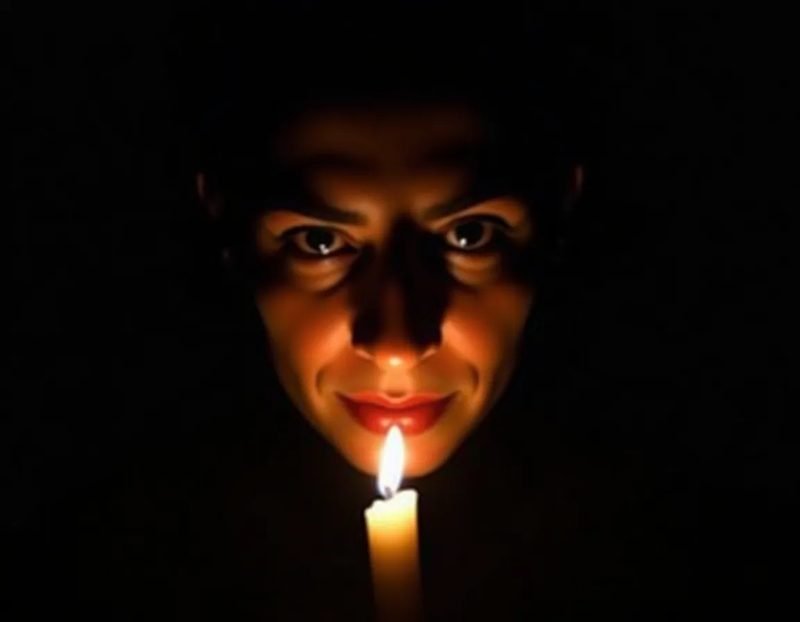
a performer's face lit from slightly below and to the side by a single candle flame, dramatic shadow rising across the u

Most stages and performance spaces are lit from above. It’s practical for the performers and comfortable for audiences. It’s also completely wrong for mentalism, bizarre magic, or any work that benefits from unease.

Overhead light flattens faces. It removes shadow from the eye sockets, the cheekbones, the jaw. The human brain reads a fully lit face as open, readable, safe. That’s the opposite of what you want when you’re asking an audience to believe you can read them.

Side lighting, at roughly eye level or slightly below, does something different. It throws one half of the face into partial shadow. It creates planes. It makes a familiar face look slightly unknowable, and that’s the register you’re trying to occupy before the first effect begins.

Light from below is gothic for a reason. We evolved reading danger in faces lit by firelight, which rises from the ground. A source below eye level, even a subtle one, triggers a low-level recognition of something old. You don’t need to be theatrical about it. A single flame on a low surface, casting upward light against your hands during a reading, does quiet, serious work on your audience’s nervous system without them knowing why.

The question worth asking: where does light come from in nature when something bad is about to happen? Not from above. Bring your sources down.

Contrast Ratio Is the Real Variable

Performers obsess over how dark to make a room. That’s almost always the wrong question.

What matters is the contrast ratio, the difference in brightness between the lightest and darkest areas in the space. A room that’s merely dim is just a dark room. A room with a single bright point and genuine shadow on everything else creates the conditions for suggestion and unease. The eye is drawn to the light, the imagination fills the dark.

In practice, this means you want almost nothing competing with your primary source. Exit signs, prop table work lights, phone screens glowing through pockets, they all bleed into the dark and flatten your contrast. Before you perform, walk the room and kill every ambient light source you can reach. That crack of light under the door matters more than you’d think. It anchors people to the ordinary world outside, which is exactly where you don’t want their attention.

A high contrast ratio makes small movements read large. A hand shifting position near a candle flame, a face turning slightly from the light, these register as significant in high-contrast environments in ways they simply don’t in a softly lit room. You’re not just managing atmosphere. You’re calibrating your audience’s sensitivity to your physical instrument.

Candlelight Is Not Decoration

I’ve watched performers use candles the way they use tablecloths. For aesthetic. One candle, centered, lit five minutes before showtime, burned for the duration.

That’s a waste of a tool that took our ancestors forty thousand years to associate with darkness, danger, and the boundary between the known and unknown.

Candlelight flickers. That’s the crucial thing. A static light source is background. A moving one keeps the eye tracking, keeps the brain slightly unsettled, unable to fully habituate to the environment. The slight, irregular movement of flame is enough to prevent the brain from fully relaxing its threat-monitoring. Not in a way that causes anxiety. In a way that keeps the room alive.

Multiple candles of different heights create overlapping shadow patterns that shift independently. The geometry of the room changes as flames move. This isn’t dramatic. It’s barely perceptible. That’s exactly why it works. Audiences don’t notice it consciously, they just feel that the room is different from ordinary rooms, which makes them different from ordinary audiences.

The container matters too. An amber glass holder reduces the color temperature further and softens the spread. A plain white candle in a clear holder throws cooler, harder light. Know which effect you’re building before you set the table.

The Pre-Show Window

The room is doing work before you walk in. That’s either working for you or against you.

If your audience assembles in full light and then you dim when you’re ready to begin, you’ve just made a dramatic gesture. That’s theater. What you actually want is for them to have arrived into atmosphere, to have sat down already inside the environment you’ve built. By the time you walk in, the room has been quietly working on them for ten minutes.

This means your lighting has to be set before the first person enters. Not just your primary performance sources, but the full environment. What do they see when they come through the door? What’s the first thing their eyes adjust to? That adjustment period, those first thirty seconds in a room, is when the framing happens. Make it count.

Don’t greet audiences in the full light of a normal room and then expect them to step into something stranger when you decide it’s time. Let them arrive already somewhere else.

The Mistakes That Undermine Everything Else

Blue-tinted LED candles. I understand the appeal. They’re safe, no fire marshal conversations, consistent burn. They’re also completely wrong in color temperature and their light doesn’t move. The flicker mode on most battery candles is a regular pulse, not the chaotic, living movement of real flame. Audiences don’t consciously know the difference. Their nervous systems do.

Overhead dimmed to thirty percent. This is the most common mistake in mentalism staging. Dimming overhead fixtures reduces intensity but doesn’t change directionality. You still have top-lit faces. You still have flat shadows. You’ve made the room darker, not stranger. Stranger requires a different source, not less of the same one.

Mixing color temperatures. If you bring warm practical lamps and leave the venue’s cool overheads on at low level, you get a muddy visual environment where nothing reads clearly. Cool and warm fight each other. Commit to one register and eliminate the other. This means being willing to ask the venue to kill circuits entirely, not just dim them.

Treating the light as static. Even with fixed sources, building in a moment of change, a second candle lit during a piece, a lamp extinguished at a specific beat, gives you timing control over the room’s emotional state. Light cues don’t need to be dramatic to be effective. The quietest changes read the deepest when the contrast ratio is doing its job. And that’s the whole game, honestly.

The performers who understand this aren’t working in darkness for mood. They’re working in precisely calibrated darkness because they know exactly what it does to a room of human nervous systems before a single effect begins. Your props can only work on an audience that’s already somewhere.

Your lighting decides where that somewhere is.

If you’re building a performance environment and want props and artifacts built to occupy that kind of space, you can see what we carry at Arcane Relics.

Sound Design for the Séance: How Audio Architecture Shapes Belief and Sustains Atmosphere

A vintage spirit trumpet on a dark wood table lit by candlelight, with old sheet music in the background

In Part 1: The Architecture of Dread: Building Atmospheric Tension Before a Single Word Is Spoken, the focus was physical: room arrangement, sightlines, the deliberate placement of objects to shape expectation before anyone sits down. If you have not read it, start there. This post assumes the room is sorted. What it does not assume is that you have given any serious thought to what the room sounds like. Most performers have not. That is the gap we are filling here.

Why Performers Ignore Audio (And Why That Is a Mistake)

The auditory system processes threat faster than the visual system does. This is not theory; it is evolutionary biology. Your audience is already forming emotional responses to what they hear before they consciously register what they see. A room that looks right but sounds wrong creates low-level friction that stops people from fully committing to the experience. They cannot name the problem. They just feel slightly outside it.

Most performers spend hours on visual staging and almost nothing on audio. They queue up a “dark ambient” playlist on a phone, set the volume somewhere in the middle, and call it done. The result is not atmosphere. It is wallpaper.

Sound design, done properly, is not background. It is infrastructure. It holds the emotional temperature of the room while you work.

Music Selection: What Works and What Kills the Room

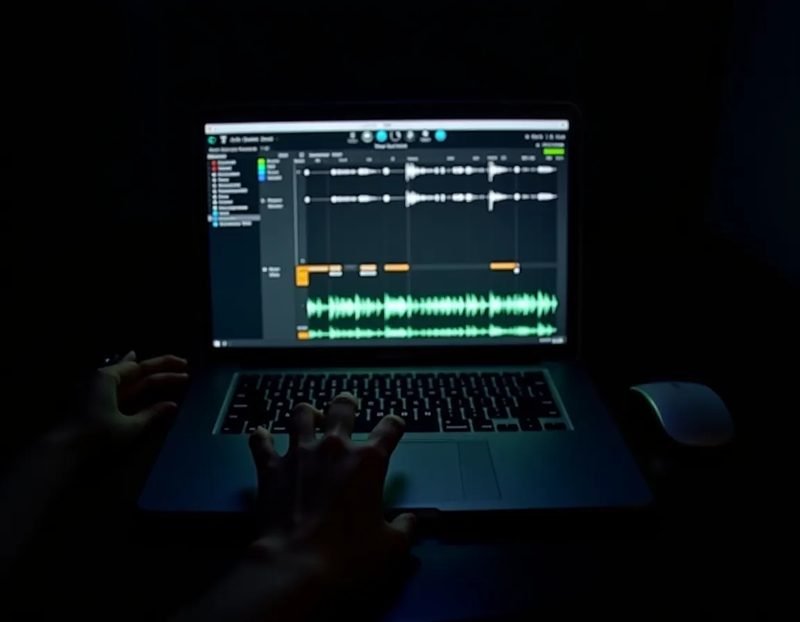
close-up of laptop screen displaying a multi-track audio session, waveform layers labeled, performer's hand resting on t

The wrong music choice can undo careful staging in under thirty seconds. Here is what you need to understand about selection.

Avoid anything with a recognizable melody. The moment an audience member thinks “I know this song,” they are no longer in your room. They are in a film they saw, a playlist they know, a memory that has nothing to do with you. Recognizable melody is an exit door. Keep it shut.

Avoid horror film clichés. Jump-scare stingers, standard minor-key orchestral swells, anything that sounds like a genre film trailer. These trigger a media-literate response in most audiences. They know they are being manipulated by a familiar technique, and that awareness is the opposite of belief.

What works: drone-based compositions and slowly evolving textures with no clear beginning or end. Microtonality, where instruments are tuned slightly off-standard, creates persistent low-grade unease without announcing itself. Study composers like Thomas Koner or early Robert Rich and understand why their work functions the way it does before using it. If you cannot articulate what the music is doing to the room, you are not controlling it.

Tempo matters more than most performers realize. Music in the 50 to 70 BPM range sits just below average resting heart rate. It creates a pull toward stillness and receptivity. Significantly slower than that and the effect becomes funereal in the wrong register. Faster and it elevates anxiety past the useful range. Know where you want the room emotionally, then choose tempo to put it there.

Volume is the other variable that rarely gets the attention it deserves. The piece should be audible without being noticeable. If anyone in your audience is consciously aware of the music, it is too loud. The goal is subliminal presence, not soundtrack.

Silence Is an Active Choice, Not an Absence

Silence is pressure. Used correctly, it is the most powerful audio tool in the room.

Corinda understood pacing. Annemann wrote about timing in ways that still hold up. But silence as a deliberately planned and executed technique rarely gets discussed in technical terms. It should.

A pause of four to six seconds after a significant moment feels, to an audience, like a much longer interval. During that silence, the audience fills the void. They generate their own explanation, their own emotional weight. They do the work for you. Your job in those seconds is to hold the stillness without breaking it through unnecessary movement or sound. That is harder than it sounds in practice.

Plan your silences the way you plan your words. Know exactly where you are dropping to nothing, how long you are holding it, and what you are doing physically during that time. Unplanned silence reads as hesitation. Planned silence reads as control. The difference is everything.

One practical note: if you are running background music, you need the ability to cut it instantly and completely. A fade is a signal, not a silence. It tells the audience something is transitioning. Sometimes that is useful. A hard cut to nothing, in the right moment, stops the room cold. These are different tools. Know which one you need and have the ability to execute it.

Layering: Building a Sonic Environment With Architecture

Think in three layers. Work from the bottom up.

The foundation layer is a continuous low-frequency tone or ambient room noise. This should be nearly inaudible. Its function is to fill the acoustic quality that empty rooms have, that particular dead-air quality that tells a nervous system something is absent. The foundation layer removes that absence and replaces it with something neutral. If your audience can identify it consciously, it is too present. This layer operates below perception.

The mid-layer is your primary music or soundscape. This is the drone composition, the textural piece, the slowly evolving ambient work. This layer carries the emotional temperature of the room. It changes when that temperature needs to change.

The surface layer is where specific, deliberate sounds appear and recede. A single bell tone. A particular frequency at a particular moment. A barely audible breath. These elements are your detail work. They are not decoration. They are punctuation.

Running all three layers requires technical setup and rehearsal time with your audio system before any performance. Arcane Audio was built with exactly this kind of work in mind: a performer-specific system designed to handle the precision cueing and multi-track management that a serious séance or theatrical mentalism set actually demands. If you are currently running audio from a phone or a basic playlist app, you are working with the wrong tools for this level of control. The system matters because the timing matters, and timing at this level is measured in single seconds.

Cue Points: Mapping Audio to Your Emotional Arc

Every performance has moments where the emotional temperature shifts. The first name. The reveal. The moment of apparent contact. These are your cue points, and each one deserves a deliberate audio decision made in advance.

Map your performance on paper. Write out the arc: where it builds, where it peaks, where it releases. Overlay audio changes onto that arc. Not every cue point requires a dramatic shift. Some moments are better served by the music dropping slightly in volume. Some want a surface-layer element introduced briefly. Some want silence. Some want no change at all. Know which is which before you walk into the room.

The mistake most performers make is treating audio as something that happens to their performance rather than something designed into it. The performers who get this right treat their audio script with the same seriousness as their spoken script. In practice, they are the same document.

Your Voice Is the Final Instrument

Everything covered so far is the environment. Your voice is the instrument working inside that environment, and it is the most precise audio tool you have access to.

Pitch variation is where most performers are weakest. A monotone delivery, even a dramatically intense one, stops working after about ninety seconds. The audience stops tracking it. Deliberate pitch movement, dropping at the end of a significant statement, rising slightly before a pause, keeps the auditory system engaged and the audience locked in.

Breathiness is a specific, deployable quality. A slight increase in breath in the voice, not gasping, just a loosening of the production, reads as intimacy and vulnerability. It signals that something real is happening. It is extraordinarily effective in close-up mentalism and séance settings where proximity amplifies everything.

The whisper is not simply reduced volume. A whisper delivered with intention is a concentration of attention. The room goes quiet to hear it. This is a physical response. The audience leans in. That lean is one of the most useful states you can produce.

Intonation was developed specifically for performers who want to work this level with precision. It addresses vocal delivery from the technical side: where to place pitch changes, how to build and release tension through breath control, how to use silence within your spoken delivery rather than simply around it. If you have been performing for more than a year and have never formally studied your own voice as an instrument, that is where to begin. Most of the work happens before the words.

A Working Process Before You Walk In

None of this functions if it is designed the night before. Audio architecture requires the same lead time as physical staging.

  1. Map your performance arc on paper. Identify five to eight key emotional moments.
  2. Assign an audio decision to each: volume shift, layer addition, hard cut, silence, or no change.
  3. Build your three-layer setup and rehearse the transitions until they are automatic and require no conscious attention during performance.
  4. Record a full rehearsal run and listen back through headphones. You will catch things you cannot hear while performing.
  5. Adjust. Rehearse again. Do this at least twice before any live performance.

The performers working at the highest level in bizarre magic and theatrical mentalism treat sound design as a craft with the same rigor they bring to technique. Audiences cannot name why the performance felt different. They will say things like “the room just had something to it” or “I felt like something was actually there.” That is not luck or talent. It is architecture, and it is learnable.

Browse the Arcane Relics shop for Arcane Audio, Intonation, and the full range of tools we stock for performers who take atmospheric work seriously.

Pre-Show as Performance: The Art of Intelligence Gathering Before the First Effect Begins

Pre-Show as Performance: Intelligence Gathering Before the First Effect Begins

The show doesn’t begin when you ask for silence. For a working mentalist, the show begins when the first guest arrives, or in some cases when the person who greets you at a venue mentions that the guest of honor has a mother who passed away recently. That piece of information correctly filed away becomes the key upon which the entire evening will hang. Pre-show isn’t preparation.

The Pre-Show Window Is Finite and Unforgiving

Pre-show is the opening act to a performance you probably won’t even realize is happening. The Pre-Show Window Is Finite and Unforgiving There is a pre-show window that opens as soon as guests begin to arrive for your performance and closes as soon as you take your stage. Experienced performers know this window is rarely open for longer than 20 minutes in close-up, 30 minutes in stage settings. Every minute that you’re socializing rather than working during this window is a minute of information you’ll never get back.

While most mentalists struggle to keep the performance concept in mind at all during this time, failing to transition seamlessly from a preparatory state to performance mode, they often fall into one of the common pitfalls of this time frame: setting up props, mentally rehearsing routines, and standing by waiting for the act to begin. In the mean time, the guests are socializing. They’re introducing each other and explaining their relationship to each other. They’re mentioning names, dates, and preferences.

The entire time they’re completely unaware that there is a working mentalist in their midst listening for important information. Working the Pre-Show Window Effectively Strategic conversation during this time isn’t small talk. In fact finding isn’t casual. It isn’t natural.

Engineering Useful Conversations

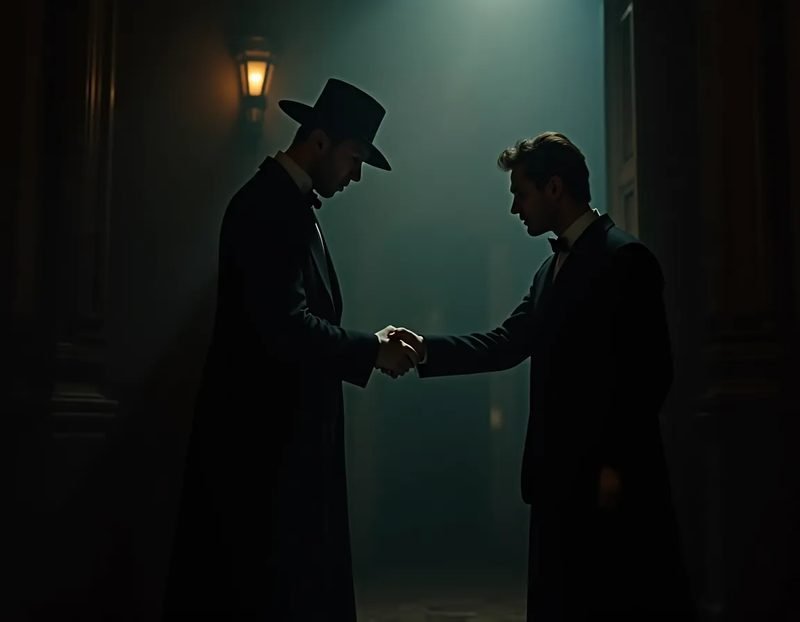
performer in dark suit shaking hands with a guest at a venue entrance, leaning slightly forward in attentive posture

It takes work and an understanding of the psychology of what’s happening and what’s necessary in order to elicit the information that you’ll need during the act. There are three principles you should keep in mind when trying to collect information during this period: Ask open-ended questions that yield proper nouns “What brings you here tonight?” doesn’t yield as much useful information as “How do you know the host?” Proper nouns give the mentalist context that they can later use in the performance and they serve to anchor specific details to time and place. The first sentence of a reply will always include the wording that you asked for, but it’s the second sentence of the reply that yields the most useful information. Ask for additional information after they’ve told you what they think you want to hear: “She mentioned her friend David” and “She mentioned a friend” are not quite the same to a working mentalist.

Ask for additional information after they’ve told you what they think you want to hear and you’ll find that they’re happy to share as much information as you’ll allow them to. Be receptive to topics that they bring up. The most useful information will always arise organically and will be related to topics that they want to discuss. Be receptive and you’ll get more than you would if you were to steer the conversation in a specific direction.

  • Ask open questions that return proper nouns. “What brings you here tonight?” nets you little. “How do you know the host?” gives you a name, a context, and a relationship to map. Proper nouns anchor specificity in a show. “She mentioned her friend David” lands differently than “she mentioned a friend.”
  • Listen for the second sentence. The first sentence is usually managed. The second sentence is where people tell you what they actually think. Give people room to keep talking after their initial answer and you will collect something useful roughly sixty percent of the time.
  • Let the topic land on you, not the other way around. The best pre-show intelligence comes from subjects the guest raises voluntarily. A comment about a long drive from the coast gives you geography. A mention of a recent health scare gives you something more. You do not steer toward these things. You create the conditions for them to surface.

Working the Room Before Anybody Takes a Seat A working mentalist has complete control of the venue before an audience member ever sits down or even takes notice of their presence. Having control of the environment before a performance is the key to seamlessly integrating it into the show itself. All of the information contained in this section is in addition to your natural working knowledge of a venue and everything you’ve learned up to this point about a performance. Some of the information contained here will be entirely new to you while other parts will be reinforced from your experience with magic and mentalism.

Reading the Room Before Anyone Sits Down

It is all important. Begin by learning the space without any people in it. Pay particular attention to the entry and exit points and the path that guests will follow as they move into the performance area. Take a look at the bar and try to get an idea of who will be standing there during the performance, and where they’ll be relative to the other audience members.

As guests begin to arrive, pay particular attention to their clusters and movement patterns. Remember that extroverted guests will tend to seek out and take up space nearest to entrances and exits. Guests who are shy or wish to avoid social interaction during the performance will hug the walls and seek to put as much distance between themselves and the rest of the audience as possible. Couples will often sit apart during the performance if they’re not speaking to one another.

These patterns should be studied and taken into consideration when crafting your act. A bizarre magic performer should also be aware of the ambient props in a space that will be available to them to set up and use during the act. Having a sealed envelope sitting on a table and a covered object on a pedestal before an audience takes notice of them is very different from doing so after the audience has taken their seats and is focused upon the performance. Having an open book face down on a chair before an audience takes notice of it is very different from doing so after the audience has taken their seats and is focused upon the performance.

Engineering Useful Conversations During this time, there is no distinction between socializing and performing. Strategic conversation is not about being friendly to an audience and working them for information during the pre-show period. It is about about using the format of social conversations to collect the information you’ll need to perform during the main portion of your act. A working mentalist will have to be able to craft conversations that feel like social gatherings to the other participants, yet yield a high degree of useful information about the guests and relationships between the guests.

Scribe: Building a Pre-Show System That Holds

As such, pre-show conversation engineering is quite different from both magic and mentalism in a traditional sense and also quite different from most people’s everyday social interactions. Scribe: Building a Pre-Show System That Holds A working mentalist can collect a tremendous amount of information from their guests. The problem isn’t collecting it. It’s organizing it so that they can access it properly when it’s needed during the performance.

A good system for pre-show intelligence is like a scribe that serves the mentalist by allowing them to quickly and easily access the information that they’ve collected, while hiding the process from the audience’s view. Mental notes aren’t reliable and they tend to break down long before the pressure of the stage performance begins to mount. A detail that seemed very important as it was collected will begin to fade by the time you’re three effects into the main portion of the act. You’ll start to notice the faces of the people in the third row staring up at you as the mental notes you’ve collected up to this point begin to fall apart under the pressure of the stage.

Scribe serves to help fill this gap between collecting the information and having it available for you to use during the main portion of the act. It’s a tool that has been designed from the ground up to serve the needs of the working mentalist. It’s something that you can naturally use during your pre-show conversations with the guests, without drawing any suspicion to yourself, yet it serves to organize all of the important details that you’ve collected in a way that’s useful to you during your performance. The practical benefits of using Scribe as a tool to organize your pre-show intelligence are easy to see.

It enables you to cruise through a room of guests, collecting whatever information you can find along the way, while at the same time using that information to create a structured performance that will allow you to create the illusions and impressions that you’re looking to create. You can use it to build a basic intelligence picture prior to the arrival of your guests, so that you have a good idea of what they’ll be like before they start to arrive. You can then use this information to help build your set list and guide your decisions regarding the main portion of your act. Collecting Intelligence and Depoying It Without Warning There’s an art to using the information you’ve collected during the pre-show period, and presenting it to the right people at the right time in such a way that it always feels right and never like magic or trickery.

The timing of when you deploy the information you’ve collected will be critical. There’s an art to presenting the information in such a way that it never feels like you’re using it. When you present correct information at the wrong time, it always comes across as luck. Present it at the right time, and in the right context, and it will always feel like more than luck.

Deploying Intelligence Without Telegraphing the Work

Again, it’s a matter of presenting it in such a way that it feels right rather than like it’s part of a trick. The timing of when you use the information you’ve collected is important but it’s not the only thing. It’s also important that you follow a few guidelines for presenting this information so that it’s always felt organically and never as part of the performance itself. The principles to keep in mind are as follows: Never lead with specific information; Build up to it; Make the audience feel the performance of the magic as you lead them to the punch line so that they have time to fully buy into it before it’s revealed.

By presenting your information in a broad way that leads up to a specific punch line you’ll create a completely different impression than if you were to just state the information outright. Use the information to ask questions; Rather than to state information; The punch line to a question will always feel different than a statement would. Not all of the information you’ve collected during the pre-show period will necessarily be used during your performance. In fact, it’s always better to have more information than you’ll be able to use, because having more than you need adds to the impression that you could have done more if you had chosen to.

The pre-show period isn’t preparation for a performance. It’s the performance itself. The performance of magic isn’t something that you do on stage in front of the audience. It’s something you do every minute of every performance.

  1. Never lead with the specific. Build toward it. Let the audience feel the approach before the arrival. A broad statement narrowing toward a precise detail creates a different psychological experience than going straight for the name.
  2. Use the information to ask a question, not make a statement. “Is the person you’re thinking of someone who recently moved?” lands with more apparent impossibility than “You’re thinking of someone who recently moved.” The question format requires the subject to confirm, which creates a visible moment of astonishment rather than a statement they simply receive.
  3. Let some of it go unused. Not every piece of pre-show intelligence needs to be spent. If you have six strong details and you use three, the audience assumes you could have gone further and chose not to. Restraint implies depth.

Pre-Show as a Performance Philosophy

If you can keep this in mind and remember that every minute is part of your performance, then you’ll be able to create the most amazing and memorable effects possible for your audience. A mentalist who creates truly amazing performances for his audiences doesn’t think of the time before the act in terms of preparation or even in terms of working for the act. It’s more than that. The time before the act is part of the act itself.

The time before the act is the performance. The entire time before an audience takes their seats for a performance is, in effect, a continuous performance of its own. The curtain never rises because the curtain never falls. The act never begins and ends because the act never ends or begins.

If you can remember this fact and learn to see everything that you’re doing as part of this performance, you’ll be able to create an experience that’s far more mysterious and compelling than anything else that you’ve ever done before. The preparation for a stage performance is never preparation for the stage performance itself. The preparation for a stage performance is always part of the stage performance. Working a room before an audience arrives is part of the performance of magic and mystery that you do for the guests before they take their seats.

Working a bar before the audience arrives is part of the performance of magic and mystery that you do for the guests before they take their seats. In fact, the preparation for a stage performance is merely a subset of this larger act of magic and mystery that working mentalists perform for an audience on a daily basis. You’re not preparing for an act when you’re working a room or the bar prior to a performance of magic. You’re already performing.

In fact, you’re already performing at its most intimate and essential level, because the performances you give the guests while preparing for the stage show is the most important aspect of any stage show, because it provides the time spent preparing for the stage performance is always the audience’s most intimate experience with the performer during the entire performance. It’s also one of the few periods during which the audience feels free to express themselves and behave in ways that they might not feel free to do when they’re sitting in the seats and fully focused upon the stage performance. If you can perform during this time in a way that adds to the overall magic and mystery of your stage performance, you’ll create an experience for your audience members that will be far more memorable and unique than anything else that you could do. Corinda touched on this idea in The Thirteen Steps To Mentalism but to fully grasp the concept it’s up to you to apply it. The pre-show period is treated far too often as if it were a sub-set of technique, a grab-bag of things to use in an emergency. If you treat pre-show intelligence as a philosophy of performance that underpins everything you do in a show rather than as an afterthought, you’ll find that you’re able to perform at an entirely different level. The pre-show period is the period of time that begins when the guests for your show start to arrive and continue on until you take your stage. This period of time has nothing in common with what most people consider to be a performance of magic. Browse the Arcane Relics shop for tools built for performers who work at this level, including Scribe and the full range of mentalism and bizarre magic resources.