
Part 2: The Nose Remembers, Scent as the Séance’s Overlooked Instrument

In Part 1: Lighting Design for the Séance Room: A Working Framework for Every Effect, I laid out how light shapes belief before a single word is spoken. Sound gets its due too, most working mentalists have some opinion about creaking floorboards or a low drone under the table. But scent, the sense most wired into memory and dread, sits almost untouched. Ask ten performers what their séance room smells like and eight will shrug. That gap is the subject of this piece.
Why the Nose Gets There First
Here’s the part most performers skip past. Your olfactory bulb sits a few synapses from the amygdala and the hippocampus, the brain’s fear switch and its memory library. Sight and sound route through the thalamus first, a kind of security checkpoint that filters and labels before the feeling arrives. Smell doesn’t wait in that line. It hits the emotional centers almost raw.
That’s why a smell can drop you back into a specific afternoon of your childhood with no warning at all, while a photograph from the same day leaves you cold. Marcel Proust built a whole novel out of this exact mechanism, a piece of madeleine dipped in tea. Psychologists now just call it the Proust effect, and it’s real, it’s measurable, and it’s sitting unused in most séance rooms.
A sitter who smells something faintly wrong, wrong in a way they can’t name, starts distrusting their own certainty within seconds. That’s the doorway. Everything else you do in the room walks through it.
Candle Wax and the Grammar of Old Fire
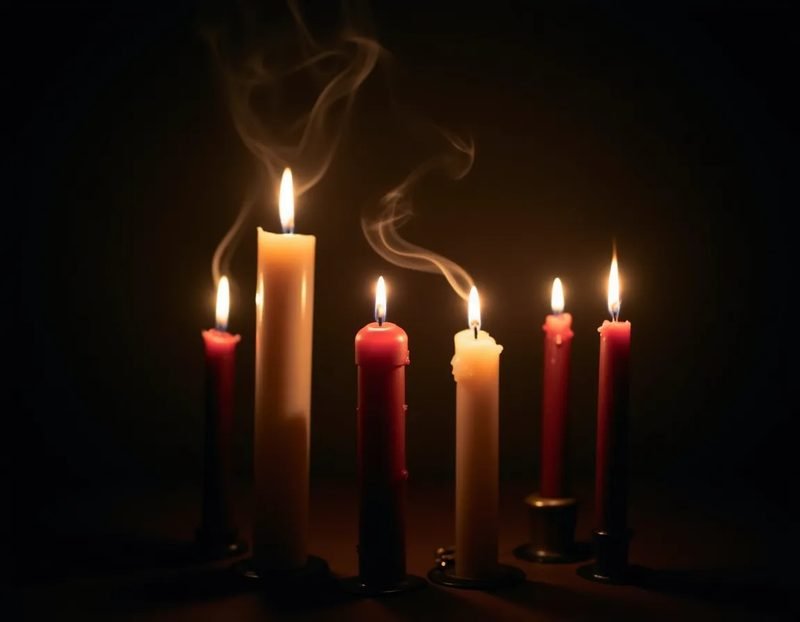
Most performers grab whatever candle is on the shelf and call the mood handled. That’s a mistake, and it’s an easy one to fix.
Paraffin, the wax in most cheap tapers, throws a thin petroleum note when it burns, faint but there. It reads as modern. Your sitters won’t consciously register “petroleum,” but some part of them files the smell under hardware store, not haunted parlor. Beeswax burns honeyed and warm, closer to what a room lit only by candlelight would have smelled like for the four hundred years before electricity existed. Tallow, rendered animal fat, is harder to source and messier to burn, but it carries a smoky, almost meaty undertone that nothing else replicates. Some of the darkest Victorian séance accounts describe exactly that smell without ever naming it.
The snuffed wick matters more than the burning one. That thread of smoke right after you pinch a flame out, the sitters catch it. Time it. A candle extinguished at the moment of a “contact” moment does something a candle burning steadily through the whole sitting can’t.
Paper, Dust, and the Smell of Time
Old paper doesn’t smell old by accident. Lignin, a compound in wood pulp, breaks down as paper ages and releases vanillin, the same aromatic compound in actual vanilla, along with faint notes of almond and grass. That’s the real chemistry behind what people call the “old book smell.” You can buy synthetic versions of it. Don’t. Once you know what to look for, a real aged document, foxed with those small rust colored spots from trace iron and mold spores, holds its scent in a way no spray bottle matches.
I keep a handful of period correspondence and ledger pages in a sealed box specifically so I can bring one out mid effect. The moment a sitter leans in to read something and gets that particular dry, sweet, mineral smell before they’ve read a single word, something shifts in how they hold the object. They’ve already decided it’s real. The reading just confirms it.
Dust itself is worth staging too. A light layer, undisturbed on a specific shelf or box lid, tells a story your dialogue doesn’t have to.
Incense as Punctuation, Not Wallpaper
This is where most performers who do think about scent get it wrong. They burn incense continuously through the whole sitting, and the room adapts within four or five minutes. Your nose fatigues to a constant stimulus fast, it’s a documented sensory mechanism called olfactory adaptation, and once it happens the incense becomes furniture. Expensive, fragrant furniture, but furniture.
Use incense like you’d use a music cue. Frankincense and myrrh together carry centuries of ecclesiastical weight, they smell like consecration, like something being marked as sacred or dangerous. Dragon’s blood resin burns sharper, resinous and a little bitter, useful right before a moment you want to feel like a threshold being crossed. Benzoin is warmer, almost vanilla adjacent, good for closing a sitting gently rather than opening one.
Light it, let it build for under a minute, then let it fade rather than replenishing it. The rise and fall does more work than a steady cloud ever will.
Copal is worth mentioning on its own. Used across Mesoamerican ritual practice for centuries, it has a bright, almost citrus sharpness under the resin that most sitters have never smelled before and can’t place. Unfamiliar scent reads as unfamiliar event. That’s the whole trick.
Controlled Staleness
Here’s the technique nobody talks about, and it’s the one I’d argue matters most.
A room that’s been closed up, low airflow, slightly higher humidity than comfortable, develops its own smell within an hour or two. Not mold, you’re not trying to make anyone sick, just a faint mineral closeness, the smell of air that hasn’t moved. Close the vents an hour before sitters arrive. Skip the air freshener entirely, that’s the opposite instinct from what you want. A slightly damp cloth left folded in a drawer, removed just before the room is used, will do more for atmosphere than any diffuser on the market.
Your instinct as a business owner is to make the room smell clean and welcoming.
Resist it.
A séance room that smells too clean reads as staged, because in daily life almost nothing does. The rooms we associate with the uncanny, attics, cellars, houses left standing after someone died in them, all share that faint closeness. You’re not decorating a room. You’re aging one, in real time, for the ninety minutes your sitters are inside it.
Building the Cue Into the Effect Itself
Scent works best when it’s not ambient at all, when it’s tied directly to a specific beat. I’ve built pieces where a sealed object, opened only at the reveal, releases a scent the sitter didn’t expect and can’t source. The gap between “I smell something” and “I can name it” is where belief lives. Keep sitters in that gap as long as you honestly can.
I tested an early version of this at a private event in the Louisville area, a small reading where the reveal involved an old tin the sitter hadn’t touched yet. The tin had spent two weeks with a folded scrap of aged paper and a pinch of dried myrrh sealed inside it. When she opened it, her breath caught before she’d even processed what was on the paper. That reaction, the body responding before the mind catches up, is the entire argument for taking scent as seriously as light and sound. It got there first.
Don’t announce the scent. Never say “do you smell that.” The moment you name it, you’ve handed the sitter permission to rationalize it. Let it work in silence. Let them wonder later whether they imagined it.
Where This Leaves You
Lighting sets the stage. Sound sets the pulse. Scent sets the memory, and it does it whether you plan for it or not. The only choice you actually have is whether you’re the one designing it or whether you’re leaving it to whatever the room happened to smell like that day, old carpet, cleaning spray, nothing at all.
Most performers leave it to chance.
They shouldn’t.
If you’re ready to start building this into your own room, I keep a working selection of resins, aged paper stock, and period correspondence suited exactly to this kind of staging. Have a look at the Arcane Relics shop.