The Séance Table as Mise-en-Scène: Designing Environments That Break Skeptics

By the time your first participant sits down, the séance has already been running for twenty minutes. The work happened while they were in the hallway, at the dinner table, or standing in the cold outside the door. The environment was speaking. The question is whether you designed what it said.
Most performers think about effects. Better performers think about atmosphere. The best performers understand that atmosphere is an effect, and it should be engineered with the same precision you’d apply to a centre tear or a book test. This is not about candles and mood. It’s about ratios, angles, and the specific psychological pressure that well-chosen objects exert on an unprepared mind.
Why the Room Does Half the Work
Dariel Fitzkee wrote at length about the staging of mystery. The core idea is not complicated: what surrounds an effect changes how it lands. A sponge ball vanish in a fluorescent-lit kitchen is a trick. The same vanish in a room that smells of old paper and looks like a 19th-century parlor is something else entirely.
Skeptics are not broken by argument. They are softened by atmosphere. The rational mind has defenses, but those defenses were built for verbal debate, not for a well-staged room. When someone walks into a space that activates their nervous system’s ancient threat-assessment circuits, logic does not disappear. It slows. It gives ground.
Your job, before you utter a single word or touch a single prop, is to build a room that puts the skeptic in a slightly off-balance state. Not afraid. Not resistant. Just leaning slightly forward. That’s the condition you’re after. Everything you’ve planned to perform will land harder in that state than it would in any other.
Lighting: Ratios, Not Ambience
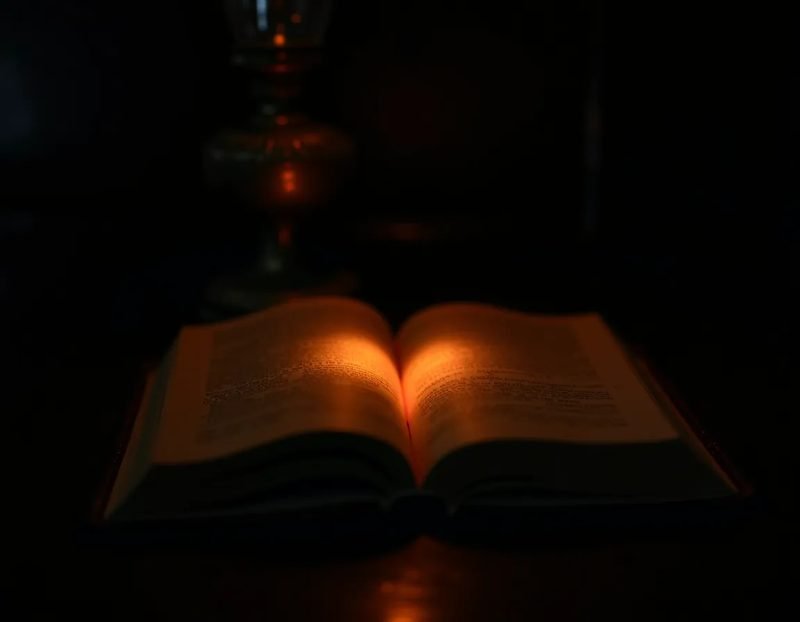
Amateurs say “low light.” Professionals think in ratios.
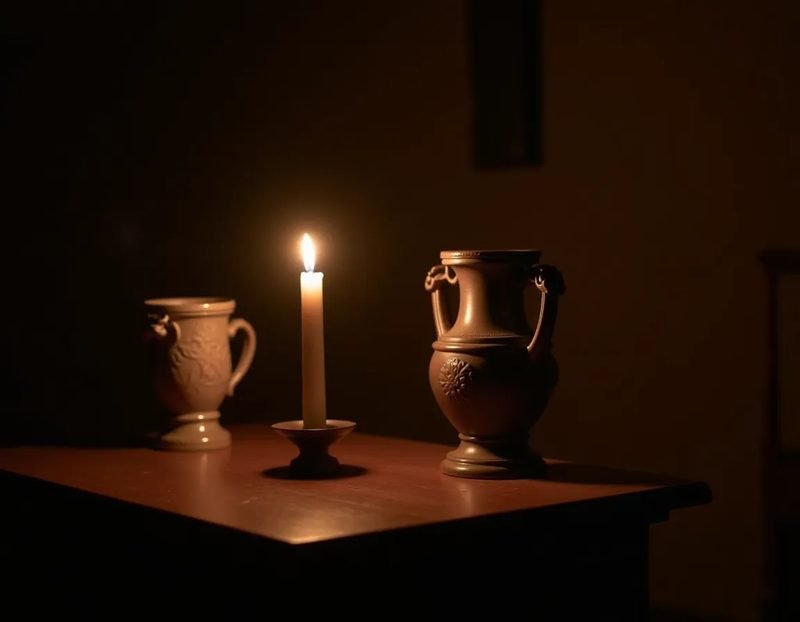
The goal is not darkness for its own sake. It’s contrast. A single light source at roughly 40% of what you’d consider comfortable reading light creates shadows. Shadows create depth. Depth creates uncertainty. When a participant cannot fully read the room, they fill the gaps with imagination, and imagination is your most reliable collaborator.
Placement matters more than intensity. Light coming from below the table surface, or from a lamp at seated eye level, distorts familiar faces and objects in ways the unconscious registers before the conscious mind can explain it. A lamp positioned to backlight your silhouette slightly adds authority. It’s the same principle that makes a judge’s bench feel different from a dinner chair.
Color temperature is underused. Warm amber light, around 2700K if you’re working with adjustable LEDs, creates an older, slower feeling in the room. Cooler light reads as institutional and modern. You want warm. You want the room to feel like it belongs to a different century, or at least to a part of this century that most people don’t visit.
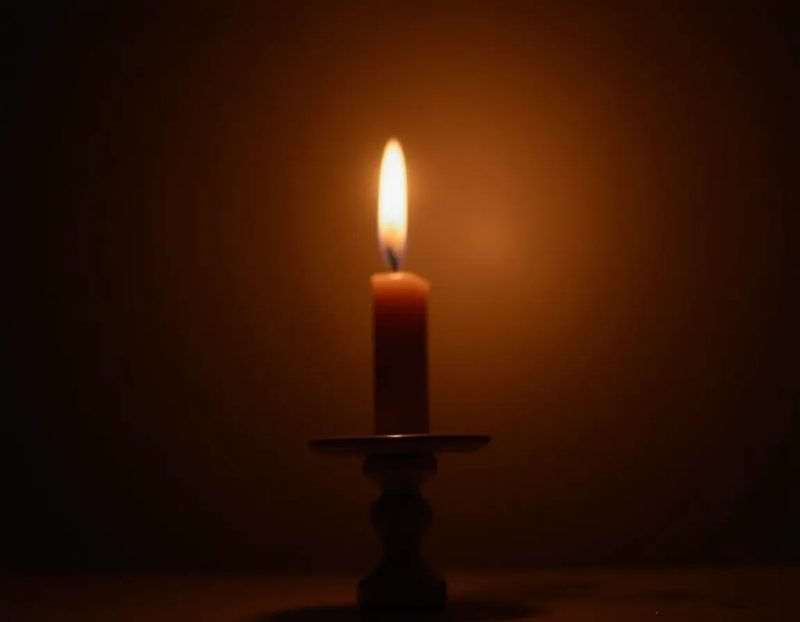
One candle is theater. Two is decoration. Five is ritual. If you use candles, commit. Arrange them in a pattern with internal logic, even if you never explain that logic. Participants will assume meaning. Let them.
The Table as the First Argument
Round tables are not a cliche. They are a functional choice based on sightlines, energy management, and group psychology.
A rectangular table creates a head. Someone sits at the head. That person leads. In a séance, you don’t want that dynamic visible. You want the appearance of an absence of hierarchy, the condition under which participants are most likely to surrender individual skepticism to the group. A round table says “we are all equal here.” That equality is what you’ll work against quietly, and precisely because it seems true, it will hold.
Surface texture and color matter. Dark wood, or a dark cloth over whatever you actually have, reduces contrast between objects placed on the table. This makes it harder to track exactly what’s there, in what position, and in what state. This is not deception. It’s environmental information management.
Table height matters. A surface that sits slightly lower than standard dining height makes participants lean forward. Leaning forward is an engaged, slightly vulnerable body posture. You want that posture before the first word.
Old tables work best, but it’s the character of oldness you’re after, not the antique price tag. A scratched, solid, dark wood table says “this has been used for things.” That suggestion costs nothing and gives you a great deal.
Prop Placement and Unconscious Reading
Every object in the room will be read. That is not an exaggeration. Participants scan unfamiliar environments compulsively, and they assign meaning to what they find. You are the author of that environment. Write carefully.
Props that suggest history are more valuable than props that suggest function. A sealed envelope on the table says “something is about to happen.” A leather journal, half-open, with handwritten notes visible from across the room, says “someone has been here before and left a record.” A small framed photograph of an unidentified person says “this concerns specific people.” These props don’t explain themselves. That’s the point. Explanation is the enemy of suggestion.
Placement should appear accidental. Objects arranged with obvious geometric precision look staged. Objects that look as though they were set down and not moved look inhabited. The technique: arrange with precision first, then displace each piece slightly. Two inches left. Three inches forward. Tilt one at an angle. Now it looks real.
Keep the center of the table clear. The center is where things will happen. If it’s cluttered before you begin, you’ve spent your budget early. Keep it open and let participants project into that empty space. Empty space in a charged environment is not nothing. It’s pressure.
The floor is part of your staging. A faded rug, a single book face-down near a leg of the table, something partially obscured by the tablecloth: these are not props for effects. They are texture. They say the room has a life beyond this evening.
Sound, Scent, and the Attending Senses
Performers forget two senses consistently. Don’t.
Sound: a completely silent room is not atmospheric. It’s oppressive. Oppression creates resistance. What you want is near-silence with occasional intrusion. A building settling. Distant traffic muffled by heavy curtains. If you can arrange it, a clock somewhere in the room, ticking, is extraordinary. Participants become aware of time passing. Time is what séances are about. The past intruding on the present. A clock makes that abstract idea concrete and audible, without you saying a word about it.
Avoid music at the table unless it’s barely audible and purely textural. Recognizable music pulls participants out of the room and into their own memory. You don’t want them in memory. You want them present, in this room, with you.
Scent: old books, cedar, very faint wood smoke if the space allows it. These are olfactory signals for “old,” “stored,” “still.” Avoid floral scents, which read as domestic. Avoid synthetic fragrances, which read as contemporary. What you want is the smell of things that have been in a room for a long time.
Beeswax candles do double work: light and a specific smell that reads as old-world and ceremonial. Worth the cost over paraffin, every time.
The Entry Protocol
The environment starts working before the door opens.
Where do participants wait before entering? What do they see, hear, and smell in that space? If you have any control over the pre-room, use it. A narrow hallway is better than a wide one. Something on the wall that doesn’t fully explain itself. A quiet exchange between you and someone else that stops when they approach. These are not tricks. They are environmental priming, and they work.
The moment of entry should be controlled. One person at a time, when possible. A participant who enters alone into a room they’ve never seen has a distinct experience from one who files in as part of a group still laughing from dinner. The entry is a threshold, and thresholds are psychologically loaded. Walk through a doorway and your brain categorizes the new room. You can guide what category it chooses.
Seat participants with direction. Don’t let them choose their own seats unless seating is genuinely arbitrary. Tell them where to sit with quiet authority. “Please, sit here” is sufficient. In complying, they’ve already yielded something. That’s the first act of the evening, and it happens before you’ve performed anything.
The Pause Before the First Word
Once everyone is seated and the room is set: wait. Not with a showman’s dramatic pause. Just wait. Ten seconds. Fifteen. Let the room fill itself. Participants will look at the table, at each other, at you. Their attention will have no anchor, so it floats. Floating attention is suggestible attention.
Then speak. Your first words should be plain and quiet. Not a preamble about the history of spiritualism. Not a disclaimer. Something simple and present: “Thank you for being here.” Or nothing at all. A look at each participant in turn, and then a small, deliberate gesture toward the table.
By now, the room has been working for twenty minutes. You haven’t performed anything yet. But you have already changed the people sitting in front of you. That’s what staging is for. The effects you run will land harder, read deeper, and stay longer in memory because of everything you built before this moment.
Annemann knew it. Corinda knew it. Hades knew it. The staging is not support for the magic. It is the first act of the magic. Design it accordingly.
The props, instruments, and atmospheric tools used by working bizarre magic performers are waiting at Arcane Relics. Browse the shop for séance staging props, spirit slates, mentalism instruments, and the complete library of bizarre magic texts that belong on a serious performer’s shelf.