
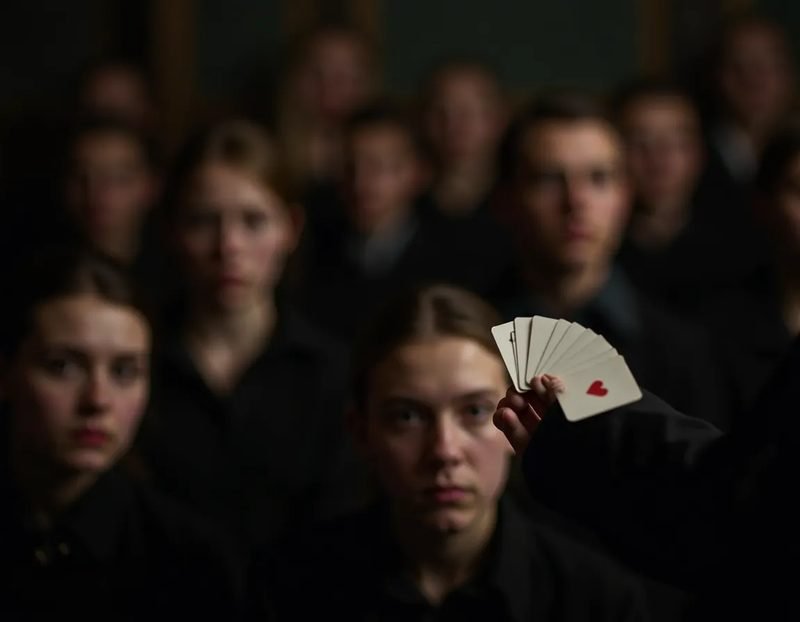
A woman folds her arms in the second row. That’s it. That’s the whole event. No word spoken, no scoff, just a shift in posture, and I feel the room’s temperature drop three degrees. Twenty people who were leaning forward a moment ago are suddenly sitting back, and none of them could tell you why.
I don’t believe skepticism is contagious in some mystical sense. I do believe belief is a herd behavior, and herds change direction faster than any single animal in them ever could.
This is the part most performers get wrong. They think a doubter is a problem to be managed after the fact, a heckler to be handled with a quip. That’s a different animal entirely. What I’m describing here has nothing to do with someone talking back. It has everything to do with the silent recalibration that happens in a group mind the moment one person’s certainty flickers.
The Room Doesn’t Doubt Alone
Social psychologists have a term for this, informational social proof, the tendency for people to look to others’ reactions when they’re uncertain how to interpret an ambiguous event. A mentalism effect is, by design, an ambiguous event. Nobody in that room has a framework for what just happened, so they borrow one. They borrow it from the person next to them.
Here’s the part that should trouble you. The borrowing isn’t rational, it isn’t even conscious, it happens faster than the analytical mind can weigh in. A raised eyebrow two seats over does more damage to your moment than a shouted accusation, because the accusation gets processed and often rejected, while the eyebrow just gets absorbed.
I’ve watched full rooms turn on a single crossed arm.
Robert Cialdini wrote about this decades ago in his work on social proof, though he was mostly talking about commerce and compliance. Mentalism is a stranger cousin of that same mechanism. You’re not asking a room to buy something. You’re asking a room to accept an experience that violates its model of how the world works, and that’s a much heavier ask. It takes very little to tip the scale back toward comfortable disbelief.
This Isn’t Heckling, and Treating It Like Heckling Will Cost You
A heckler wants attention. A heckler is loud, specific, and usually easy to spot from the stage because they’re performing too, just badly and for free. You have a dozen ready lines for that person, and you should.
The doubt I’m talking about wears no costume.
It shows up as a woman who stops nodding. A teenager who checks his phone at the exact wrong second. A man who mutters something to his wife that you can’t hear but can absolutely feel. None of them intend to sabotage you. Most of them don’t know they’re doing anything at all.
The mistake is addressing this the way you’d address a heckler, head on, with humor, in front of everyone. That move works on loud doubt. It backfires on quiet doubt, because now you’ve drawn the whole room’s attention to a person who wasn’t trying to be noticed, and you’ve confirmed, out loud, that something in the room needs defending. You just handed the doubt a microphone.
The Tipping Point Has a Shape
Every contagion has a threshold, the epidemiologists call it R-naught, the number of new infections one case produces. Belief contagion in a room works on the same math, and it has an actual, learnable shape if you’re willing to watch for it instead of watching your own hands.
Three signals tend to arrive together, and in this order.
- The stillness break. A room that’s been physically still, held breath, unmoving hands, suddenly shifts. Someone recrosses their legs. Someone reaches for a drink. This is the body exiting the trance state before the mind admits it.
- The glance exchange. Two people look at each other, not at you. This is the herd checking the herd. It happens in under a second and most performers miss it entirely because they’re focused on their own choreography.
- The verbal test. Someone says something quiet, often just a syllable, to the person beside them. This is the first vote being cast. If you don’t intervene here, the vote spreads.
Catch it at stage one and you have options. Catch it at stage three and you’re doing damage control in front of a room that’s already decided.
Reading the Room Before It Turns
You cannot watch every face. Nobody can, and the performers who claim they track the whole room are usually tracking a general mood, not individuals. What you can do is pick two or three anchor points before you start, not the friendliest faces, the most expressive ones, and check them the way a pilot checks instruments, briefly, repeatedly, without staring.
Your anchors will tell you the truth before the room says a word.
When I notice an anchor shift, I don’t chase it. Chasing doubt gives it weight it doesn’t yet have. Instead I do something almost invisible, I slow down. A half second of extra silence before a reveal reads as confidence to a room, and confidence is the one thing quiet doubt cannot survive next to. Doubt needs uncertainty to feed on. Don’t feed it.
There’s a deeper move here too, and it’s the one most books skip entirely. You can pre-empt the vote by naming the feeling before anyone else does. Something as simple as acknowledging, in character, that what you’re about to do “shouldn’t make sense” does something strange to a room, it takes the objection and makes it yours. Nobody wants to raise a hand and say the thing the performer already said.
What I Watch For, and What I Do About It
I’ve run enough private events around Louisville to trust a pattern over a hunch, and the pattern is always the same. The turn almost never comes from the loudest person in the room. It comes from someone competent, someone the room already respects, an engineer, a nurse, someone whose skepticism reads as credibility rather than negativity. When that person’s arms cross, the room doesn’t think “there’s a doubter.” The room thinks “the smart one isn’t buying it,” and that’s a far more dangerous thought to let spread.
I learned to find that person before I start, not during.
My method is low tech and it works. During the small talk before a show, I watch for who the room defers to, who gets asked the follow up question, who other guests glance at when something surprising gets said. That person becomes my quiet check-in point for the whole performance, not because I need their approval, but because the room is going to use them as a barometer whether I like it or not.
I’d rather know which way the barometer is pointing.
Building Immunity Into the Routine Itself
The strongest fix isn’t a reaction at all. It’s structural. Routines that depend on one unbroken chain of belief, where a single failed link collapses the whole effect, are the most vulnerable to this kind of contagion, because doubt only needs one weak point to enter. Routines built with redundant convincers, several independent moments that each confirm the impossibility on their own, are far harder for a single doubter to unravel, because there’s no single thread to pull.
Build in more than one reason to believe you. Rooms forgive a lot when they have multiple paths back to wonder.
There’s also a timing lesson buried in all this that’s easy to miss. The middle of a set is far more vulnerable to contagion than the opening or the closer, because the opening runs on curiosity and the closer runs on momentum, but the middle runs on sustained trust, and sustained trust is exactly what a raised eyebrow erodes fastest. If you know your set has a soft middle, that’s where your anchor-checking needs to be sharpest, not at the big finish everyone assumes is the risky part.
So no, this isn’t about scripted comebacks for hecklers, and it isn’t about being paranoid at every folded arm you catch in your peripheral vision. It’s about understanding that belief in a room is a shared, fragile, contagious thing, built collectively and unbuilt just as collectively, one glance at a time.
Watch for the glance. Not the shout.
If routines built to survive real rooms, not just friendly ones, are the kind of thing you build your act around, you’ll find pieces designed with exactly this in mind at Arcane Relics.