

Part 1 of 2 in Contact Mind Reading.
I don’t necessarily believe that thought travels through skin. I do, however, have a strong conviction that something travels, something real, something the body broadcasts without permission, and that a trained performer can read it with accuracy that has no comfortable explanation for a watching audience. Contact mind reading “what came to be called Hellstromism” is the only technique I’m aware of in the performing arts where the method and the effect are genuinely the same thing. There’s no deck to stack, no force to disguise. You hold someone’s wrist, and you find what they’re thinking about. The line between method and miracle is thinner than most performers are willing to admit.
Stuart Cumberland and the Lineage Before the Name
Stuart Cumberland didn’t invent contact mind reading, he just made it undeniable. Born in 1857, he spent the final decades of the nineteenth century working thought-reading demonstrations across Britain and the Continent, holding spectators’ wrists and locating hidden objects with a consistency that unsettled audiences who prided themselves on clear thinking. He performed for the Prince of Wales. He performed for scientists who came specifically to expose him and left without their explanation.
Cumberland was candid about the mechanism, more candid than most would have been. In A Thought-Reader’s Thoughts, published in 1888, he wrote plainly that he wasn’t reading minds. He was reading bodies. The hand tells you things the mouth won’t say, the muscles tell you things the hand doesn’t know it’s saying. That’s not mysticism. That’s a precise technical claim, and it holds up.
What Cumberland gave the art was credibility through volume. Hundreds of performances, hostile conditions, skeptical observers, consistent results. His track record made the technique impossible to dismiss as a fluke or a stunt. But his work also had a ceiling, a theatrical one. He operated in an era before amplification, before cameras, before the performing context shifted enough that a man holding a stranger’s wrist and walking silently across a stage started to look merely strange instead of inexplicable. His audiences were predisposed to attend closely. That predisposition wouldn’t last.
The performer who understood how to build for the new century was someone else entirely.
Axel Hellstrom and the Art That Took His Name
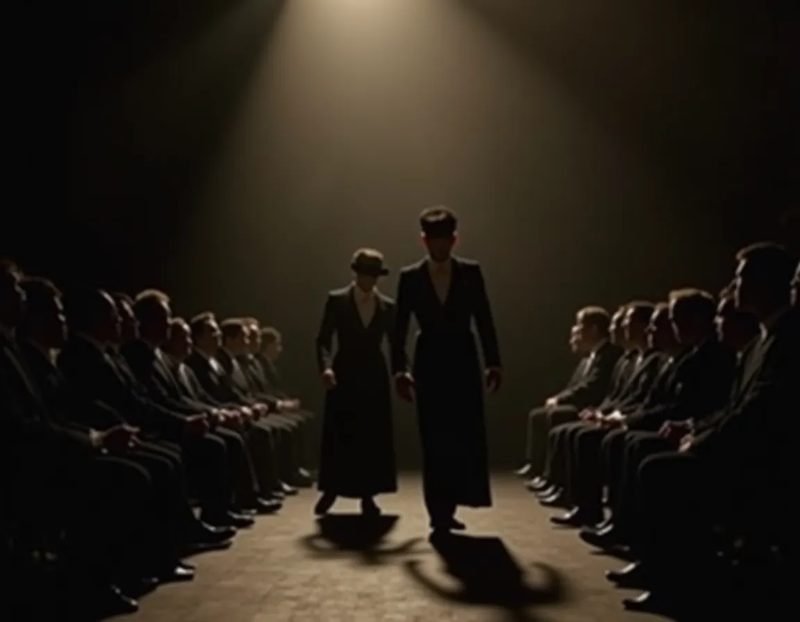
Hellstromism is named for a reason. Axel Hellstrom, a Norwegian-born performer working in the early twentieth century, didn’t merely demonstrate contact mind reading, he theatricalized it to the point where his name became the noun. He found hidden objects in large venues, duplicated drawings, identified numbers, all through skin contact, all in real time, in front of audiences who had no useful framework for what they were witnessing.
The genius wasn’t sensitivity. The genius was framing.
Hellstrom understood the single structural vulnerability of the method: the moment it looks like the performer is leading, the whole thing collapses into something mechanical. He spent enormous effort appearing passive, receptive, almost reluctant. He would pause. He would move in one direction, stop, correct. He would look uncertain at moments of actual certainty. All of this was calculated performance, but it read as genuine struggle. Audiences believed they were watching a man straining to catch something barely audible. They leaned in.
By the middle of the twentieth century, his name had become a category. If you were serious about the performing arts of the mind, you knew what Hellstromism was. If you didn’t, you weren’t serious.
What Is Actually Happening in Your Hands
Most accounts go vague here, and that vagueness is a disservice to any performer who might actually want to study this.
When you hold someone’s wrist and they know where the hidden object is, their body knows too. Not metaphysically. Physiologically. Moving toward the target, their forearm flexors tighten in increments too small to see but not too small to feel. Their breathing shortens. Their pulse shifts. Moving away, those signals reverse. The subject isn’t doing anything consciously, they’re not trying to guide you, but the information is present in the musculature. Your job is to read it.
Contact point matters. Wrist is better than hand, hand is better than elbow. You want access to involuntary movement at its most legible and least consciously controlled. Just below the palm, held with genuine lightness, the wrist gives you simultaneous access to flexor and extensor tension. You’re reading a dial, not listening for words.
The baseline pass is essential. Before committing to any direction, you move in several directions to calibrate the subject’s response pattern. Some people register strongly. Some barely. A few seem to generate no readable signal at all, and when you find one, you adjust your approach or acknowledge the limitation openly. Pushing through a dead signal produces bad work, it produces obvious work.
The real skill, the part that requires years and not weeks, is learning to accelerate toward resistance without telegraphing the acceleration. You’re using the subject’s muscular response as a guide while appearing to be guided. That inversion is the whole art, and you won’t find it in a book.
Why It Convinced Educated People
The structural misdirection in Hellstromism is unlike anything else in mentalism. In conventional mental effects, the performer conceals information, the audience knows information is being concealed, and the game is figuring out how. In contact mind reading, the mechanism is visible. The subject knows where the object is. The performer holds the subject. The performer finds the object. The chain of causation is transparent, the audience can observe every link, and they’re still left without an explanation they can use.
My spine chills when I think about that, even now.
The misdirection isn’t about hiding the mechanism. It’s about hiding which direction the mechanism runs. Audiences assume information flows from subject to performer through the contact point. They’re right that information travels. They have the direction reversed. The performer is pulling, testing, calibrating, and the subject is providing involuntary confirmation. The subject usually feels, afterward, that they helped make it work. That feeling is real. It’s just not the full story.
That’s what made Victorian scientists walk away unsettled. They couldn’t find the lie, because the lie wasn’t there. The redirection was in the framing, not the facts.
How It Nearly Disappeared
Television did serious damage. Contact mind reading depends on proximity. A live audience sees the physical connection, registers the subject’s honest uncertainty, watches the performer navigate in real time. The effect is immediate and visceral. On camera, the wrist grip looks like a prop. The subject’s face, which in a live performance reads as genuine concentration, compresses to a small square in the corner of a monitor. The primary evidence evaporates.
The postwar mentalism revival made things worse, though not intentionally. The generation of performers who rebuilt mental magic in the 1950s and 60s were rightly focused on no-touch methods, envelopes, cards, sealed predictions, effects that read as impossible precisely because there was no physical connection to explain them. That work was valuable and it was necessary. But it pushed contact reading to the edges, and once a technique loses its practitioners, it starts to lose its literature.
There’s also a practice problem that can’t be reasoned away. You cannot learn Hellstromism from a manuscript. The sensitivity required develops only through repetition on actual human beings, which means finding subjects, working privately, making errors, recalibrating from the ground up. Most performers, given the choice between a technique that demands that investment and a technique that works from a script, take the script. That’s not a criticism. It’s just honest about how scarce practice time really is.
The performers who stayed with it tended to stay quiet about it. Not from secrecy exactly, more from the difficulty of explaining it in an era when audiences assume any effect has a tutorial.
The Performers Who Are Bringing It Back
Something has been shifting in serious mentalism over the last decade, you can feel it if you’re paying attention. Performers building theatrical experiences rather than trick sequences. Work that moves slowly and lets a moment breathe. An appetite for effects that produce a specific kind of bewilderment, not the “how did you do that” of a card trick, but the quieter, harder-to-categorize feeling of watching something that doesn’t fit any available explanation.
Contact mind reading fits that world precisely.
It’s intimate. It’s slow. It puts the performer and subject in genuine physical connection, which creates a relational weight that no prediction envelope can match. For performers working in bizarre magic or theatrical mentalism, the theatrical framing writes itself. A practitioner who reads impressions through contact, who traces the emotional residue of an object through skin, isn’t performing a trick in any conventional sense. The technique becomes the performance, the method and the effect are genuinely the same thing, and the audience feels that truth even if they can’t articulate it.
The lineage running from Cumberland through Hellstrom to the present is a technical tradition that most contemporary performers have never seriously studied. The ones who have tend to produce work that doesn’t look like anyone else’s. That’s not an accident, it’s what happens when you develop a skill almost no one else is developing.
If you’re looking for the books, the resources, and the tools serious performers are working with right now, browse the Arcane Relics shop.
Continue reading: Part 2: The Hidden Object Hunt, Building a Contact Mind Reading Routine That Plays to a Full Theatre