Before the Crystal Ball: A History of Reflective and Scrying Instruments in Mentalism

Before the Crystal Ball: A History of Reflective and Scrying Instruments in Mentalism

Every mentalist who has worked a black mirror routine has felt it, that small pause before the sitter looks down and actually sees something. It’s not the crystal ball’s fault the trade thinks that way, though. The crystal ball is the newest instrument in this history, not the oldest, and it won over cunning folk and mediums alike for reasons that have almost nothing to do with mystery and everything to do with manufacturing. Before glass spheres sat on velvet cloths in every mentalism catalog, the sitter looked into ink, into obsidian, into a bowl of plain water drawn that morning from a well. Each instrument came with its own rules for what you were supposed to see, and those rules tell you more about how belief actually works than any crystal ball ever will.

Ink in a Boy’s Palm

Ink scrying is older than most performers realize, and it didn’t start as parlor entertainment. Cunning men in North Africa and the Middle East practiced a form of it for centuries, dripping ink into a boy’s palm or a shallow dish and asking him to describe what moved in the dark surface. The practitioner rarely looked themselves. That’s the detail that gets left out of the modern retelling, the seer and the sitter were often two different people, and the whole transaction depended on a child or an innocent party being the one to report what appeared.

Edward Kelley, the scryer who worked alongside John Dee in Elizabethan England, used a similar method with a young medium named at times in Dee’s own diaries. Dee wrote the sessions down in obsessive detail, dates, angels’ names, whole conversations transcribed as if dictated. Whatever you make of the content, the format is instructive. The instrument wasn’t the point. The protocol was.

A protocol is what separates a prop from a ritual, and ink taught that lesson early. Ask your sitter to describe rather than declare and you get texture, hesitation, the particular cadence of someone reaching for language to describe something without a name yet. That cadence is worth more than any gimmick you’ll ever build into a table.

The Obsidian Mirror and Its Long Trade Route
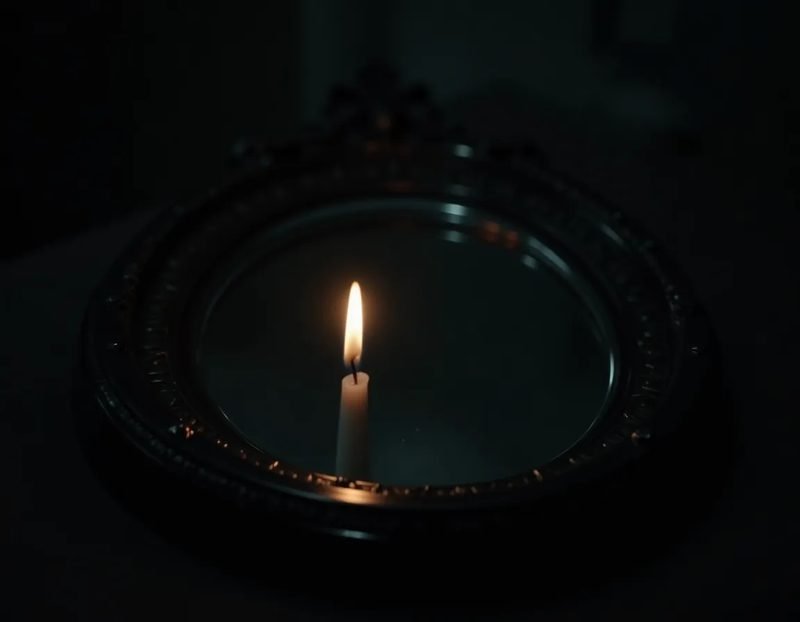
polished black obsidian mirror, angled to catch a sliver of candlelight

Dee’s other instrument, the one that actually survives and sits in a museum case in London, was a polished obsidian mirror. Volcanic glass, ground and buffed to a dark sheen, showing the sitter a reflection with none of the detail a silvered mirror gives back. That absence of detail was the entire mechanism. A black mirror shows you shape and shadow and lets your own visual system fill in the rest, and it has done that job in cultures that never spoke to each other.

The obsidian itself likely came from Mexico, carried across the Atlantic sometime after Cortés, which means Dee’s mirror was almost certainly a Aztec object repurposed for an English court magician’s séance table. Tezcatlipoca, whose name translates roughly to “Smoking Mirror,” was the deity associated with this exact kind of obsidian divination long before any European touched the stone.

I find that lineage more unnerving than anything printed on a modern spirit board. An object built for one civilization’s gods, ferried across an ocean, and pressed into service for a completely different set of angels and spirits. The mirror didn’t care whose ritual it was borrowed for. It just kept doing what black glass does, showing almost nothing and inviting the mind to supply the rest.

Still Water, the Instrument Nobody Had to Buy

Before ink, before obsidian, there was water. Hydromancy, if you want the formal term, shows up in Persian, Greek, and Mesopotamian sources going back further than most written magic history can reliably trace. A basin, a well, a still pond at the right hour. No trade route required, no rare mineral, no artisan grinding volcanic glass into a mirror finish. Anyone with a bowl and a quiet room had access to the instrument.

That accessibility is worth sitting with. Water scrying never needed a merchant class or an import trade to spread, it traveled on foot, in memory, from one household to the next. The oldest instrument in this whole tradition was also the cheapest, and it stayed in continuous use the longest precisely because nobody had to be wealthy or connected to practice it.

There’s a lesson buried in that for anyone building a scrying routine today.

The prop never made the moment. The stillness did.

Why the Crystal Ball Actually Won

So if ink, obsidian, and water all did the job, why does a glass sphere sit on nearly every mentalist’s prop shelf instead? The honest answer isn’t mystical. It’s industrial.

Lead crystal glass became cheap and consistent to manufacture through the 1800s, right as spiritualism was climbing toward its Victorian peak. A clear sphere photographed better in the newspaper engravings of the era than a bowl of dark water ever could, it held light in a way audiences found immediately readable as “magical,” and it didn’t require the sitter to squint into shadow the way a black mirror does. Spiritualist mediums adopted it fast, stage magicians adopted it faster, and by the time vaudeville mentalism acts were touring, the crystal ball had become shorthand. One prop, instantly legible to any audience, no explanation needed.

That’s a genuine advantage. I won’t pretend otherwise.

But legibility and depth are different qualities, and the crystal ball got famous for the first one while quietly borrowing the atmosphere of instruments with a far stranger past. Most audiences today have no idea a black mirror or an ink bowl predates the glass sphere by centuries. Tell them, and watch what happens to the room.

What the Old Instruments Still Teach a Working Mentalist

I’ve run scrying sequences at private events using a black mirror instead of a crystal ball, and the reaction is different every time, not because the method changes but because the object itself asks something different of the room. A crystal ball tells a sitter what to expect before you’ve said a word. A black mirror doesn’t. People lean in. They ask what they’re supposed to be looking for, and that question, right there, is the whole performance opening up.

Three things the historical record makes clear, and all three are counterintuitive if you’ve only ever worked with glass spheres.

First, the seer and the sitter were traditionally separate roles. Building that separation back into a routine, having the sitter report rather than you declaring, produces testimony that reads as far more convincing than anything you could assert yourself.

Second, ambiguity was the technology. Every instrument in this history, ink, obsidian, water, works by giving the eye almost nothing to grab onto. Modern crystal balls are often too clear, too refined, and that clarity can work against the very effect you’re trying to produce.

Third, the object’s history is part of its power, whether or not you narrate it. A sitter who learns her reflection is sitting inside the same kind of glass an Aztec priest once used carries that weight into the reading whether you mention it aloud or not.

I don’t necessarily believe the instrument itself holds anything beyond glass or stone. I do believe an object with four hundred years of use behind it sits differently in a sitter’s hands than one that came out of a box last Tuesday.

Choosing Your Own Instrument

If you’re building a scrying routine and reaching automatically for the crystal ball, ask yourself what that choice is actually buying you. Instant recognition, yes. But also every association your audience has already formed from a hundred cartoon fortune tellers and boardwalk booths.

A black mirror carries none of that baggage yet. Most sitters have never seen one, which means you get to define what it means in real time, in front of them, with no cultural shorthand fighting you for the frame.

Your instrument should match the story you’re telling, not the story every other performer on the circuit is already telling.

That’s the whole argument, honestly.

Explore the black mirrors, ink vessels, and other scrying instruments we carry at Arcane Relics.

Correction and update, 30 August 2026

I went back through the primary sources on the three instruments above, and the record is better than my memory of it. The piece stands as written. These are the corrections, in the order the errors appear.

  • Kelley was the scryer, not the man holding a young medium. Dee’s editor put it plainly in 1659: “Dr. Dee saw not himself; his business was to write what was seen (but in his presence though) and heard by Kelley.” Dee’s own diary for December 1581 has him telling his first scryer, Barnabas Saul, to look into “my great Chrystaline Globe… that I might write after his voyce.” The instrument was crystal, and later a polished black stone. There was no ink anywhere in the Dee material. I welded the Cairo method onto an Elizabethan table, and nobody practised that.
  • The mirror is Mexican. Full stop. “Likely came from Mexico” is out of date. In 2021 the British Museum’s obsidian mirror was tested by X-ray fluorescence and matched to the Pachuca source in Hidalgo (Campbell, Healey, Kuzmin and Glascock, Antiquity 95, 2021). Every obsidian mirror in that collection traces to Mexico.
  • What nobody has shown is that Dee used it. The Dee attribution rests on a label written by Horace Walpole around 1771, and the authority Walpole cites for it is Hudibras, a satire published seventy years after Dee died. Dee’s diaries mention crystal and “my Glass,” never a black stone, and a 1624 deposition describes his stone as “like Cristall.” To be honest: certainly Aztec, only traditionally Dee’s. I find that gap more interesting than the certainty I gave it.
  • Tezcatlipoca is context, not this object’s biography. Nothing shows this particular disc was a cult object, and the Mesoamerican sequence runs pyrite mirrors first, obsidian late. I have left the paragraph as it was, but read it as the culture the stone came from, not a claim about what this one saw.
  • Drop “Persian” from the water sentence. The claim that hydromancy came through Persia is a Roman literary flourish from Varro, repeated by Augustine and then Isidore. There are no Persian sources behind it.
  • The Mesopotamian bowls were not scrying. The Old Babylonian oil-on-water tablets (roughly 1900 to 1600 BC) read the behaviour of an oil film, whether it sank, split, ringed or clung. That is omen reading, not seeing pictures. The bowl is the first datable divinatory instrument, but it took another fifteen hundred years before anyone wrote down a vision in one: Apuleius, defending himself on a magic charge around AD 158, quoting Varro on a boy at Tralles who “sang what the future would be” in a hundred and sixty verses.
  • Lane, the source for the ink-in-the-palm story, later took it back. His 1836 Cairo account is the best description of the method in English, and a decade later, watching the same magician fail with two boys, he wrote that the successes were “to be attributed chiefly to the interpreter, but partly also to leading questions, and partly to mere guessing.” The interpreter was the method. That does not weaken the point about protocol. It sharpens it.
  • The crystal ball’s dates. Lead crystal glass dates from Ravenscroft’s patent in 1674, not the 1800s, and the cheap consumer sphere is a twentieth-century object. Andrew Lang wrote in 1905 that he “did not know how to procure one,” and a Chicago occult dealer’s 1909 catalogue put it in one sentence: real rock crystal “costing $50, but you can get an excellent Crystal or imported sphere for $3.” The sphere won on price and legibility between about 1900 and 1940, and the water bowl did outlast everything, exactly as I said. It lost anyway, because nobody could sell it.

The magicians, by the way, knew all of this early. Reginald Scot printed a description of a gaffed scrying glass in 1584, “toies artificiallie conveied into the glasse, which will make the water bubble,” and cited Cardano testing the trick on children. That is going to need a piece of its own.

The Swami Gimmick: How a Palm-Sized Device Became Nail Writing’s Workhorse

The Swami Gimmick: How a Palm-Sized Device Became Nail Writing's Workhorse

Nobody in your audience has ever heard the word “swami” used the way we use it. That’s the point. The gimmick takes its name from carnival mystics who wore rings loaded with a sliver of soft lead, scratching out messages while the mark watched their face instead of their hands. It’s one of the oldest working tools in mentalism, and it’s still sitting in the pockets of pros who never once mention it exists.

Born on the Midway, Built for the Stage

The swami gimmick didn’t come out of a magic factory. It came out of ten-in-one shows and mitt camps, where a “swami” needed to produce writing that looked like it arrived from somewhere other than his own hand. A thumb tip, a ring, sometimes just a folded strip of tin, loaded with a stub of soft lead or a chip of carbon. Cheap to build, brutal to detect if the presentation around it was solid.

Mentalists picked it up because the effect it enables, writing appearing on a blank surface with no pen in sight, does something a spoken prediction never quite manages. It leaves evidence. A spectator can hold the card. They can turn it over, run a thumb across the graphite, show it to the person next to them.

That’s a different kind of proof than “I felt you were thinking of the color blue.”

What’s Actually Inside the One You’re Wearing

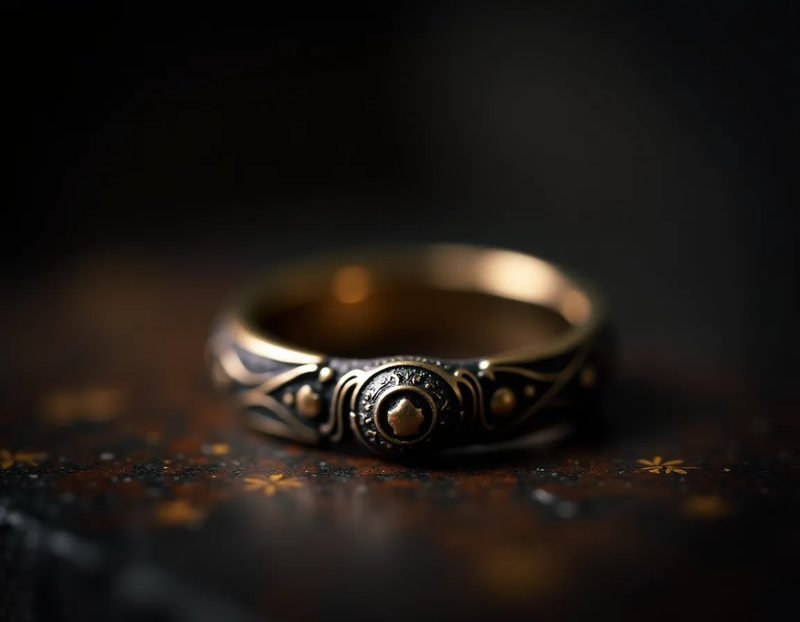
Close-up macro shot of a swami gimmick ring with the writing tip exposed

Strip away the mystery and it’s a small ring or thumb tip with a short length of soft material, usually a graphite or lead composite, mounted so it sits flush against your skin until you need it. Press the pad of your thumb or finger against paper at the right angle, and the tip transfers a mark. Release the pressure, and your hand looks empty again.

The construction sounds simple, it is simple, but simple isn’t the same as easy to build well. The angle of the mount, the hardness of the writing material, the way the metal sits against your finger without printing a ring-shaped tan line into your skin during a two hour gig, these are the details that separate a gimmick you forget you’re wearing from one you’re fighting with under a spotlight.

I’ve watched performers abandon nail writing entirely after one bad session with a stiff, oversized gimmick. That’s not the technique failing them. That’s the hardware.

The Difference Between Fooling a Volunteer and Fooling a Camera

Here’s what most write-ups on nail writing skip entirely. A volunteer standing eighteen inches from you, watching your eyes, your breathing, your patter, is a forgiving audience. Their attention is being managed by everything else you’re doing. A phone camera is not managed by anything. It doesn’t blink, it doesn’t get distracted by your voice, and it will happily zoom into sixty percent of frame on your writing hand if a livestreaming spectator decides that’s the interesting part of the shot.

This has changed what “fooled” means for anyone doing paid work now. A gimmick that reads as invisible to a live room can still get caught cold on a phone held at the wrong angle, and it will end up online.

The gimmicks that hold up under both conditions share a few traits. Low profile, so there’s no shadow or glint under harsh venue lighting. A tip that produces a clean mark on the first press, no second scratch, because a camera catches hesitation that a live eye reads as nothing at all. And material soft enough to write without visible pressure, since pressing hard enough to see white knuckles is the tell that gets clipped into a slow-motion “gotcha” video.

I test every gimmick I build or sell the same way. I write with it in front of a mirror first, then I write with it in front of a phone recording in slow motion. If it survives the second test, it goes in my kit.

Nail Writing Is Only Half the Job

Most performers meet the swami gimmick through nail writing and stop there, which is a shame, because the device earns its keep in billet work too. A folded piece of paper switched under cover of a pen tap, a duplication method for a “sealed prediction” that was never sealed with your actual answer inside, a last-second correction on a center tear when a spectator’s word doesn’t match what you loaded. The gimmick doesn’t care what the writing says or when it happens. It just needs your hand near paper for half a second.

That flexibility is why it survives as a working tool instead of getting replaced by something flashier. A thumb writer costs you almost nothing in setup, almost nothing in suspicion, and it goes back to being an ordinary hand the moment you’re done with it.

No wires. No electronics. No app pairing to a phone that might not connect right before your opening line.

Why Most of What’s on the Market Gets This Wrong

I’ve bought a lot of bad swami gimmicks over the years, before I started making my own. The usual failure is a ring that’s either too loose, so it rotates on your finger and puts the tip in the wrong spot exactly when you need it, or too tight, which means you’re aware of it the entire set and so is anyone shaking your hand beforehand. The second most common failure is a writing tip that’s too hard. Hard lead means visible pressure, visible pressure means a tell, and a tell in this business gets remembered even when nobody can name what they saw.

There’s also the matter of refill life. A gimmick that needs a new tip every third show isn’t a tool, it’s a chore, and working pros don’t have room in their week for chores that a better build would have solved once.

None of this is a knock on sleight of hand generally. It’s a knock on gimmicks made for the hobbyist market and sold to people doing paid work, where the standards aren’t the same and never should be.

Choosing Yours and Breaking It In

Fit comes first, before technique, before presentation, before anything. A gimmick sized wrong will undo good sleight of hand every time. Try it on, write with it cold for ten minutes, and pay attention to whether your hand still feels like your hand. If you’re thinking about the ring, your audience eventually will too.

After that, practice the release as much as the mark itself. The moment you lift pressure and your hand goes back to looking empty is the moment that actually sells the trick, not the writing. Most performers drill the writing and skip the release entirely, and it shows.

I build the swami gimmicks in my shop the way I wish someone had built the first one I ever bought, low profile, a tip that writes clean without a second pass, and a fit that disappears on your hand instead of announcing itself. If you’re doing nail writing or billet work for real audiences and real cameras, it’s worth using a tool built for that standard instead of one built for a magic-shop shelf.

Have a look at what’s currently in stock at Arcane Relics.

Curio as Credential: How the Right Prop Collection Signals Authority to Discerning Audiences

Curio as Credential: How the Right Prop Collection Signals Authority to Discerning Audiences

The Object Before You Say a Word

Your audience reads the table before they read you. They clock the props, the arrangement, the patina on that box, the condition of that envelope. All of this happens before your first line. It is visual argument, and it runs ahead of your script.

This is not a minor point. In bizarre magic and mentalism, belief is the mechanism. You are not selling a trick; you are selling a world in which the trick is plausible. That world needs furniture. The furniture needs to be right.

Modern manufactured props almost always fail this test, not because they are badly made, but because they are too perfectly made. They look like props. The audience does not know they know this. But they know. The nervous system is a better critic than the conscious mind.

What follows is a breakdown of specific object categories, how each one functions rhetorically in performance, and what distinguishes the objects that work from the ones that do not.

Why Age Is Not Merely Aesthetic

Why Age Is Not Merely Aesthetic

Age in an object carries information that cannot be faked cheaply. Patina on brass, foxing on paper, the particular softness of old leather: these are records of time that the nervous system processes directly. They bypass critical thinking. The brain registers “old” and draws inferences. This object existed before this performance. It has a life independent of tonight.

That independence is what you need. When a prop has clearly been manufactured for performance, it collapses inward. It announces its own fiction. When a prop has genuine age, or is presented within a coherent framework of genuine provenance, it expands outward. It implies a world the performer did not invent.

Annemann understood this intuitively, even working in an era when bizarre magic was not yet named as a genre. The objects in his work were functional, yes. But they carried weight. That weight came from selection, not manufacture.

The serious performer knows: the best props are not made. They are found. The distinction shapes everything that follows, from how you source material to how you handle it in front of people who have seen too many magic shows and will not forgive a cheap signal.

Why Every Arcane Relics Prop Starts Perfect, Then Gets Destroyed on Purpose

Every object we make begins its life in ideal condition. Clean joins. Crisp edges. Surfaces exactly as they should be straight off the workbench. We call this the “zero state”: the item as it would look the moment it was finished, brand new, before the world got its hands on it.

Then we start asking questions.

The questions are what separate a prop from a relic. When was this made? A rural cunning-man’s tool from the 1740s ages differently than a Victorian parlour curiosity. The wood type matters. The finish matters. Who owned it, and did they treasure it or throw it in a box? A loved object gets worn in specific places, where hands gripped, where it rested on a table. A neglected one gets different damage entirely.

Where was it found? That question alone changes everything. A piece pulled from a dry attic trunk has a particular kind of dust-sealed stillness to it. One recovered from a damp cellar carries a different story in every crack and bloom of discoloration. We match the aging to the origin, not the other way around.

The process is layered. First the physical surface: texture, wear patterns, patina. We work by hand, not by formula, because no two objects age identically. Then we address smell. Old paper, old leather, old wood. Each has a specific character, and a performer handing a folded document to an audience member should not be handing them something that smells like a craft supply store.

Feel is the last layer and the hardest to fake. The weight of something that has been handled for decades, the way paper softens over time, the way metal loses its sharpness. A spectator registers all of this before they consciously register anything. Get the feel wrong and you lose the moment before it starts.

We do this because your audience is closer than you think. They pick things up. They turn them over. Some of them know exactly what old things feel like. The aging we build into every Arcane Relics piece is not decoration. It is the performance.

Memento Mori and the Rhetoric of Mortality

Memento Mori and the Rhetoric of Mortality

No category of curio speaks faster than memento mori. A human skull on the table is not decoration. It is a statement about what kind of performer you are and what kind of territory you work in.

The skull says: I am comfortable with death. I have looked at it long enough that it sits next to my working materials without disturbing me. If that is my relationship with mortality, what else might I know?

This is the rhetoric of the object. It does not require explanation. In fact, explanation ruins it. The performer who points to the skull and says “I use this because…” has already lost the argument. The skull should sit there and do its work in silence.

Victorian mourning objects operate differently but in the same direction. Hair art, memorial brooches, jet jewelry, coffin plates: these objects carried grief in their original context. That context does not fully transfer, but a residue of it does. An audience today looking at a mourning brooch in a performer’s collection feels the weight of Victorian death culture, even without being able to articulate why. The object carries its history forward.

Memento mori work best when they are genuine, or least appear to be, at minimum when they fit within a collection that has clearly been assembled with knowledge. A genuine antique skull, a real period mourning piece, a verified Victorian death photograph: these carry the argument further than reproductions, because their details are specific and specific details do not lie.

The mass-produced skull from a Halloween supply chain communicates something. Just not what you want.

Ritual Objects: Implied History as Structure

Ritual objects present a different challenge. Unlike memento mori, which carry legible cultural codes on their own, ritual objects require context. A carved wooden figure means nothing without a framework. Within the right framework, it means everything.

This is where the performer’s knowledge becomes inseparable from the prop’s function. If you know what a poppet is, where it comes from, what traditions produced it and under what circumstances, that knowledge shapes how you handle it. Handling communicates knowledge. Audiences read hands the way they read faces. The performer who picks up a ritual knife incorrectly is announcing ignorance to anyone who knows better. And in the audiences that matter to the bizarre worker, there are always one or two people who know better.

For the bizarre worker specifically, the ritual object is not optional texture. It is structural. The frame of the performance, the implied world in which the effects are possible, depends on the objects being right.

Consider the specifics. A worn set of bone dice reads differently than a pristine set. A grimoire with marginalia, water staining, and a broken spine reads as used. A ritual knife with a patinated blade and a wrapped handle reads as handled. These details are not about deception; they are about coherence. The object should look like it belongs to the world you are describing, because the world you are describing should feel continuous with history rather than invented for Tuesday night.

Authenticity, where it exists, is preferable. A genuine 19th-century apothecary bottle, a real Victorian spirit cabinet photograph, an actual antique planchette: these carry the argument further than reproductions. But the key variable is not authenticity per se. It is specificity. An object with genuine details, specific markings, unusual features, a chip in the right place, will always outperform a generic reproduction. The specific is always more convincing than the general.

Antique Correspondence and the Written Artifact

Written artifacts are underused. This is a mistake that costs performers believability they did not know they were spending.

An antique letter in a performer’s working material does three things at once. It grounds the narrative in historical reality. It introduces a specific voice, the letter’s author, without requiring the performer to speak for that voice directly. And it creates a physical object that can be handed across, examined, held.

Passing matters. The moment an audience member holds the letter, the letter is real to them. They feel the age of the paper. They see the ink variation, the pressure of the nib, the idiosyncrasies of a handwriting style that is no longer alive. The nervous system does not distinguish between “this is old” and “this is relevant to what is happening right now.” Both impressions land simultaneously, and the overlap is the effect.

Antique newspapers function similarly. A specific date, a specific headline, a specific location: these details collapse distance. The audience stops experiencing the performance as performance and starts experiencing it as event. That is the goal.

For the performer building a working library of written artifacts: focus on legibility, specificity, and condition. A letter that cannot be read quickly is a prop that requires too much management. A letter with a clear narrative, even a mundane one, gives you material. The best finds are letters with unexplained references, odd closings, allusions to people and events that remain unresolved. That ambiguity is not a flaw. It is the mechanism.

Building the Collection Deliberately

There is no shortcut to a good collection. There is a method.

Start with function. Ask of every object: what does this do in performance? Not aesthetically, not symbolically in the abstract, but specifically. In which moment does this object work? What does it allow the performer to say without speaking? Objects that cannot answer this question belong in a private cabinet, not on a working table. The working table is not a museum; it is an argument, and every piece in the argument should be load-bearing.

Then move to coherence. A prop table that mixes periods, traditions, and aesthetics without a governing logic reads as a flea market, not a collection. The audience will not articulate this criticism, but they will feel the lack of authority. The collection should tell a single story about the performer’s obsession, even if that story is never spoken aloud. The story is told by proximity, arrangement, and the evident intelligence of the selections.

Estate sales, antique markets, and specialist dealers in occult and curio material are the right sources. Online auctions can work, but condition is harder to judge at distance. Photographs rarely capture patina accurately. The hand knows things the eye at screen distance does not. This is where Arcane Relics comes in we have done all this for you so that you can focus on the presentation

Build slowly. A small collection of objects that genuinely work is worth more than a crowded table that signals effort without authority. The performer with three right objects in the right arrangement will outperform the performer with thirty wrong ones, every time, before every audience.

Know what you have. If you pick up a Victorian mourning brooch at an estate sale, learn what it is. Read about mourning culture. Know the conventions: the meaning of jet versus French jet, the period conventions of hair art, the language of the imagery on coffin plates. That knowledge surfaces in how you handle the object, and handling is everything.

The credential is not the object. The credential is what the object reveals about the person who chose it.

Browse performance-ready curios, ritual objects, and bizarre magic props assembled for working performers at Arcane Relics.

“`