
Every mentalist who has worked a black mirror routine has felt it, that small pause before the sitter looks down and actually sees something. It’s not the crystal ball’s fault the trade thinks that way, though. The crystal ball is the newest instrument in this history, not the oldest, and it won over cunning folk and mediums alike for reasons that have almost nothing to do with mystery and everything to do with manufacturing. Before glass spheres sat on velvet cloths in every mentalism catalog, the sitter looked into ink, into obsidian, into a bowl of plain water drawn that morning from a well. Each instrument came with its own rules for what you were supposed to see, and those rules tell you more about how belief actually works than any crystal ball ever will.
Ink in a Boy’s Palm
Ink scrying is older than most performers realize, and it didn’t start as parlor entertainment. Cunning men in North Africa and the Middle East practiced a form of it for centuries, dripping ink into a boy’s palm or a shallow dish and asking him to describe what moved in the dark surface. The practitioner rarely looked themselves. That’s the detail that gets left out of the modern retelling, the seer and the sitter were often two different people, and the whole transaction depended on a child or an innocent party being the one to report what appeared.
Edward Kelley, the scryer who worked alongside John Dee in Elizabethan England, used a similar method with a young medium named at times in Dee’s own diaries. Dee wrote the sessions down in obsessive detail, dates, angels’ names, whole conversations transcribed as if dictated. Whatever you make of the content, the format is instructive. The instrument wasn’t the point. The protocol was.
A protocol is what separates a prop from a ritual, and ink taught that lesson early. Ask your sitter to describe rather than declare and you get texture, hesitation, the particular cadence of someone reaching for language to describe something without a name yet. That cadence is worth more than any gimmick you’ll ever build into a table.
The Obsidian Mirror and Its Long Trade Route
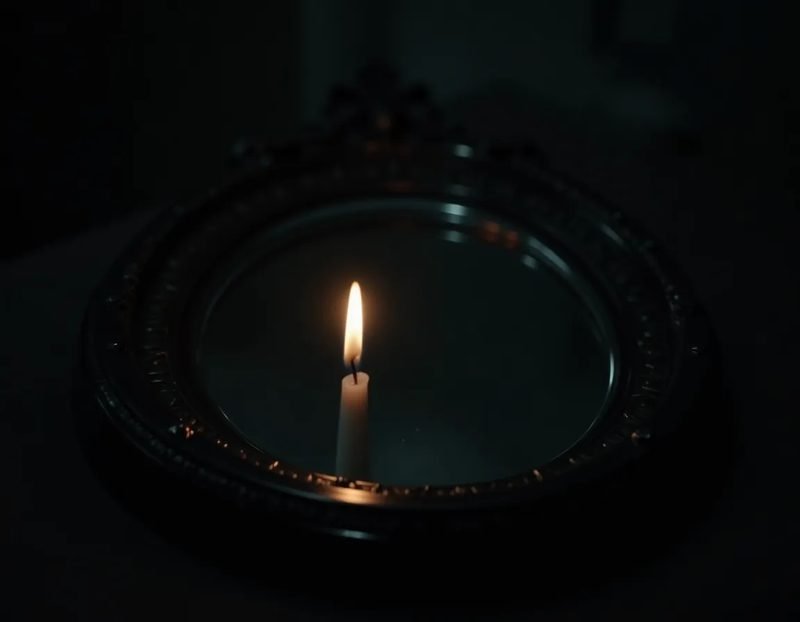
Dee’s other instrument, the one that actually survives and sits in a museum case in London, was a polished obsidian mirror. Volcanic glass, ground and buffed to a dark sheen, showing the sitter a reflection with none of the detail a silvered mirror gives back. That absence of detail was the entire mechanism. A black mirror shows you shape and shadow and lets your own visual system fill in the rest, and it has done that job in cultures that never spoke to each other.
The obsidian itself likely came from Mexico, carried across the Atlantic sometime after Cortés, which means Dee’s mirror was almost certainly a Aztec object repurposed for an English court magician’s séance table. Tezcatlipoca, whose name translates roughly to “Smoking Mirror,” was the deity associated with this exact kind of obsidian divination long before any European touched the stone.
I find that lineage more unnerving than anything printed on a modern spirit board. An object built for one civilization’s gods, ferried across an ocean, and pressed into service for a completely different set of angels and spirits. The mirror didn’t care whose ritual it was borrowed for. It just kept doing what black glass does, showing almost nothing and inviting the mind to supply the rest.
Still Water, the Instrument Nobody Had to Buy
Before ink, before obsidian, there was water. Hydromancy, if you want the formal term, shows up in Persian, Greek, and Mesopotamian sources going back further than most written magic history can reliably trace. A basin, a well, a still pond at the right hour. No trade route required, no rare mineral, no artisan grinding volcanic glass into a mirror finish. Anyone with a bowl and a quiet room had access to the instrument.
That accessibility is worth sitting with. Water scrying never needed a merchant class or an import trade to spread, it traveled on foot, in memory, from one household to the next. The oldest instrument in this whole tradition was also the cheapest, and it stayed in continuous use the longest precisely because nobody had to be wealthy or connected to practice it.
There’s a lesson buried in that for anyone building a scrying routine today.
The prop never made the moment. The stillness did.
Why the Crystal Ball Actually Won
So if ink, obsidian, and water all did the job, why does a glass sphere sit on nearly every mentalist’s prop shelf instead? The honest answer isn’t mystical. It’s industrial.
Lead crystal glass became cheap and consistent to manufacture through the 1800s, right as spiritualism was climbing toward its Victorian peak. A clear sphere photographed better in the newspaper engravings of the era than a bowl of dark water ever could, it held light in a way audiences found immediately readable as “magical,” and it didn’t require the sitter to squint into shadow the way a black mirror does. Spiritualist mediums adopted it fast, stage magicians adopted it faster, and by the time vaudeville mentalism acts were touring, the crystal ball had become shorthand. One prop, instantly legible to any audience, no explanation needed.
That’s a genuine advantage. I won’t pretend otherwise.
But legibility and depth are different qualities, and the crystal ball got famous for the first one while quietly borrowing the atmosphere of instruments with a far stranger past. Most audiences today have no idea a black mirror or an ink bowl predates the glass sphere by centuries. Tell them, and watch what happens to the room.
What the Old Instruments Still Teach a Working Mentalist
I’ve run scrying sequences at private events using a black mirror instead of a crystal ball, and the reaction is different every time, not because the method changes but because the object itself asks something different of the room. A crystal ball tells a sitter what to expect before you’ve said a word. A black mirror doesn’t. People lean in. They ask what they’re supposed to be looking for, and that question, right there, is the whole performance opening up.
Three things the historical record makes clear, and all three are counterintuitive if you’ve only ever worked with glass spheres.
First, the seer and the sitter were traditionally separate roles. Building that separation back into a routine, having the sitter report rather than you declaring, produces testimony that reads as far more convincing than anything you could assert yourself.
Second, ambiguity was the technology. Every instrument in this history, ink, obsidian, water, works by giving the eye almost nothing to grab onto. Modern crystal balls are often too clear, too refined, and that clarity can work against the very effect you’re trying to produce.
Third, the object’s history is part of its power, whether or not you narrate it. A sitter who learns her reflection is sitting inside the same kind of glass an Aztec priest once used carries that weight into the reading whether you mention it aloud or not.
I don’t necessarily believe the instrument itself holds anything beyond glass or stone. I do believe an object with four hundred years of use behind it sits differently in a sitter’s hands than one that came out of a box last Tuesday.
Choosing Your Own Instrument
If you’re building a scrying routine and reaching automatically for the crystal ball, ask yourself what that choice is actually buying you. Instant recognition, yes. But also every association your audience has already formed from a hundred cartoon fortune tellers and boardwalk booths.
A black mirror carries none of that baggage yet. Most sitters have never seen one, which means you get to define what it means in real time, in front of them, with no cultural shorthand fighting you for the frame.
Your instrument should match the story you’re telling, not the story every other performer on the circuit is already telling.
That’s the whole argument, honestly.
Explore the black mirrors, ink vessels, and other scrying instruments we carry at Arcane Relics.
Correction and update, 30 August 2026
I went back through the primary sources on the three instruments above, and the record is better than my memory of it. The piece stands as written. These are the corrections, in the order the errors appear.
- Kelley was the scryer, not the man holding a young medium. Dee’s editor put it plainly in 1659: “Dr. Dee saw not himself; his business was to write what was seen (but in his presence though) and heard by Kelley.” Dee’s own diary for December 1581 has him telling his first scryer, Barnabas Saul, to look into “my great Chrystaline Globe… that I might write after his voyce.” The instrument was crystal, and later a polished black stone. There was no ink anywhere in the Dee material. I welded the Cairo method onto an Elizabethan table, and nobody practised that.
- The mirror is Mexican. Full stop. “Likely came from Mexico” is out of date. In 2021 the British Museum’s obsidian mirror was tested by X-ray fluorescence and matched to the Pachuca source in Hidalgo (Campbell, Healey, Kuzmin and Glascock, Antiquity 95, 2021). Every obsidian mirror in that collection traces to Mexico.
- What nobody has shown is that Dee used it. The Dee attribution rests on a label written by Horace Walpole around 1771, and the authority Walpole cites for it is Hudibras, a satire published seventy years after Dee died. Dee’s diaries mention crystal and “my Glass,” never a black stone, and a 1624 deposition describes his stone as “like Cristall.” To be honest: certainly Aztec, only traditionally Dee’s. I find that gap more interesting than the certainty I gave it.
- Tezcatlipoca is context, not this object’s biography. Nothing shows this particular disc was a cult object, and the Mesoamerican sequence runs pyrite mirrors first, obsidian late. I have left the paragraph as it was, but read it as the culture the stone came from, not a claim about what this one saw.
- Drop “Persian” from the water sentence. The claim that hydromancy came through Persia is a Roman literary flourish from Varro, repeated by Augustine and then Isidore. There are no Persian sources behind it.
- The Mesopotamian bowls were not scrying. The Old Babylonian oil-on-water tablets (roughly 1900 to 1600 BC) read the behaviour of an oil film, whether it sank, split, ringed or clung. That is omen reading, not seeing pictures. The bowl is the first datable divinatory instrument, but it took another fifteen hundred years before anyone wrote down a vision in one: Apuleius, defending himself on a magic charge around AD 158, quoting Varro on a boy at Tralles who “sang what the future would be” in a hundred and sixty verses.
- Lane, the source for the ink-in-the-palm story, later took it back. His 1836 Cairo account is the best description of the method in English, and a decade later, watching the same magician fail with two boys, he wrote that the successes were “to be attributed chiefly to the interpreter, but partly also to leading questions, and partly to mere guessing.” The interpreter was the method. That does not weaken the point about protocol. It sharpens it.
- The crystal ball’s dates. Lead crystal glass dates from Ravenscroft’s patent in 1674, not the 1800s, and the cheap consumer sphere is a twentieth-century object. Andrew Lang wrote in 1905 that he “did not know how to procure one,” and a Chicago occult dealer’s 1909 catalogue put it in one sentence: real rock crystal “costing $50, but you can get an excellent Crystal or imported sphere for $3.” The sphere won on price and legibility between about 1900 and 1940, and the water bowl did outlast everything, exactly as I said. It lost anyway, because nobody could sell it.
The magicians, by the way, knew all of this early. Reginald Scot printed a description of a gaffed scrying glass in 1584, “toies artificiallie conveied into the glasse, which will make the water bubble,” and cited Cardano testing the trick on children. That is going to need a piece of its own.