
Character Is a Contract: Why Every Mentalism Persona Inherits an Ethical Debt

Character Is a Contract: Why Every Mentalism Persona Inherits an Ethical Debt

A persona is not a costume. Most performers treat it like one, something you put on before the show and hang back up after, and that’s exactly where the trouble starts. A costume comes off clean. A persona doesn’t. Once a room believes you are the person you’re presenting, that belief doesn’t evaporate when you take your bow, it follows people out the door, into their car, into the story they tell their spouse over a late dinner.

I don’t think most mentalists set out to deceive anyone about who they really are. I do think most of them never sit down and ask what they owe the audience once the deception, the theatrical kind, actually lands.

The Skin You Choose to Wear

Every working mentalist builds a second skin. You have to, the version of yourself that gets up at 2am to drive home from a corporate gig can’t be the same version standing under the light telling a stranger things about their dead father. The persona is armor and it’s also a kind of permission slip, it lets you say things your ordinary self would never have the nerve to claim.

Here’s the part most guides skip entirely: the persona isn’t built from nothing. It’s built from a specific claim about what kind of knowledge you have access to. Are you a reader of people, a channel for something older, a trained observer who just notices more than most? Each of those is a different promise, and each promise sets a different expectation in the room about what’s real.

I’ve built a few personas over the years that I quietly retired, not because they didn’t work, but because they worked too well and I wasn’t ready for what that meant. A character that claims spiritual authority gets treated with spiritual weight. People bring you their grief when you didn’t ask for it, they just handed it over because the character invited it.

That’s the debt nobody warns you about at the start.

What the Room Signs Without Reading
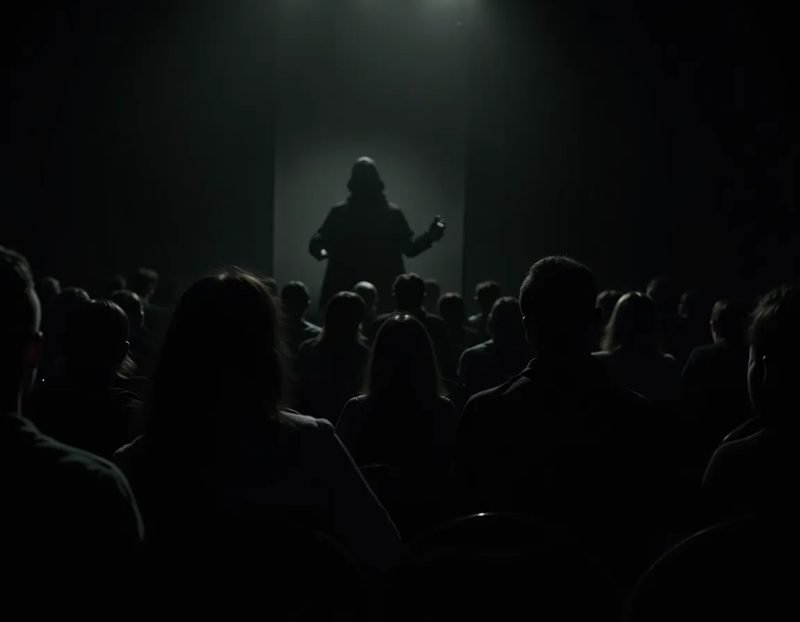
an audience seated in dim light, faces turned toward an unseen performer, candid and atmospheric

Think of it as a contract, because it functions exactly like one. The audience never reads the fine print, they just watch you commit to a claim, watch the claim survive contact with a few convincing moments, and then they sign without a pen. From that point forward, they extend you a kind of trust that has nothing to do with your actual technique and everything to do with the character you built.

A close-up magician who reveals a card trick has, at most, entertained someone for ninety seconds. A mentalist who convinces a room he can read grief off a wedding ring has entered someone’s inner life, whether he intended to or not.

I tested a version of this years ago at a private event in Springhurst, a small home gathering, nothing theatrical about the room itself. I was performing a reading that leaned into “sensing” rather than “guessing,” deliberately, to see how the language shifted the audience’s posture. A woman in the back stopped making eye contact with her husband and started making it only with me. Her hands went still in her lap. That’s the tell you’re watching for, and it landed harder than I expected it to.

I didn’t chase it further that night. I could have. That restraint is the whole argument of this post.

Three Debts Every Persona Owes

a weathered ledger or journal open on a table, ink pen resting across the page

Most performers think about persona ethics as a single blanket rule, something like “don’t claim real powers.” That’s true but it’s also thin, and it misses where the actual damage happens. There are three separate debts, and they get incurred at different moments in the act.

  • The debt of category. If your character implies contact with the dead, grief-adjacent audience members will test that implication in private, later, alone, when you’re not there to soften it. You owe them a landing spot for that, even if it’s just a line in your patter that quietly reframes the claim before they leave the room.
  • The debt of specificity. Vague cold reading rarely wounds anyone, it’s forgettable by design. But the moment you land something specific, a name, a date, a detail that couldn’t have been guessed, you’ve converted “entertaining” into “evidence” in that person’s mind. Evidence changes what they do with the information afterward.
  • The debt of duration. A stage psychic persona that only exists for forty minutes owes less than a persona built into your public identity, your website, your social presence. The longer the character persists outside the room, the more responsibility you’re carrying for how strangers act on what they believe about you.

Most performers price in the first debt and completely ignore the other two. That’s the gap this post is trying to close.

Building the Fallout In, Not Bolting It On

Here’s where it gets practical, and where I think most character work goes wrong from the very first sketch. Performers design a persona for maximum theatrical effect, get it working, and only afterward start bolting on disclaimers, caveats, the “of course I don’t actually claim” line tacked onto the end of an interview. That sequencing is backwards.

Design the ethical ceiling first. Decide, before you ever perform the character in front of a stranger, what category of claim you’re willing to let land as real, and what claim you will always, without exception, walk back before the audience leaves your presence. Then build the persona to fit inside that ceiling, not the other way around.

A concrete example, because vague advice is worthless here. If your persona implies psychic contact with a departed relative, decide in advance whether you’ll ever let a client leave believing you spoke to their mother, or whether your patter always includes language that reframes the moment as intuition, pattern-reading, cold reading dressed as warmth. Build that boundary into the actual script of the routine, not into a disclaimer you deliver once and hope sticks.

I write my own patter with a rule I don’t break: any claim that could change how someone grieves gets a built-in exit ramp, delivered inside the performance, not after it.

When the Contract Breaks

You’ll know the contract broke because the fallout doesn’t look theatrical, it looks domestic. Someone calls off a second marriage because of what you implied about their first one. Someone stops sleeping because you named a fear they never said out loud, and now they think you have access to something they can’t control.

A performer I trust told me about a persona he retired after a client showed up at his next event asking to “continue” a reading from six months prior, one he barely remembered giving. She hadn’t understood the reading ended when the lights came up. In her mind, the character was still open, still watching, still available.

My mouth went dry when I heard that story, because I recognized exactly how it happens. The performer did nothing wrong onstage. The character just outlived the room it was built for.

Writing the Ceiling Into the Character, Not Around It

If you build personas for a living, or you’re about to build your first one, the discipline is simple to state and hard to practice. Decide what your character is allowed to claim before you ever discover, mid-performance, how far a room is willing to let you go. Rooms will always let you go further than you planned, that’s the nature of a convinced audience, they stop pulling back on you.

Write your exit language into the bones of the routine. Not a caveat at the end, not a website disclaimer nobody reads, but a moment inside the performance itself where the claim gets gently, deliberately, returned to earth.

So yes, this is a design problem before it’s ever a moral one.

And if you are like me, and you’d rather build the character right the first time than repair the damage after, you’re already doing the harder, better work. That’s the whole game, honestly.

Browse the tools we build our own characters around at Arcane Relics.

Part 2: The Mask That Makes Promises, How Your Mentalism Persona Sets Ethical Constraints You Cannot Ignore

Part 2: The Mask That Makes Promises — How Your Mentalism Persona Sets Ethical Constraints You Cannot Ignore

In Part 1: The Second Skin Problem: Building a Mentalism Persona That Survives the Long Set, the argument was structural: your character has to be durable, internally consistent, something worn rather than just performed. That post was about craft. This one is about responsibility. And the gap between those two things is exactly where most performers cause the most damage.

The persona makes promises. Not explicit ones. You never announce your ethical commitments to a room. But the character does it anyway, through every atmospheric choice, every framing decision, every prop you select and every one you leave behind. Your audience hears those promises, calibrates their trust accordingly, and opens up in ways they would never open for a stranger. That’s the leverage you’re holding.

The question is what you do with it.

The Implied Contract

An implied contract is not a metaphor. It’s a psychological reality. When you walk into a room carrying a certain kind of presence, dressed a certain way, opening with a certain kind of language, the audience’s nervous system is already sorting the experience. Safe or unsafe. Playful or serious. Permitted entertainment or something more peculiar.

Your persona answers those questions before you answer them yourself.

A baroque, Victorian-inflected character tells the audience they’re in an antiquarian space, scholarly and curated. A raw, confessional mentalist who frames himself as a reformed cold-reader tells them they’re getting hard truths. A warmly theatrical character with a touch of self-deprecating humor tells them this is permitted fun, nothing too sharp. Each of those framings creates a contract, it specifies what is permitted to happen in this room and what is not. Break the contract and you don’t just lose the moment. You lose the trust, possibly for good, and trust is the only currency mentalism runs on.

Most performers build personas without ever naming this contract. That’s the problem.

The Three Promises Personas Make

Not all implied contracts look the same. The promises your character makes depend entirely on the register you’ve chosen to inhabit.

A theatrical persona rooted in ritual and antiquity, the kind of character who handles artifacts with deliberate reverence and traces an object’s history before using it, promises a museum experience. Curated. Contained. Respectful of the strangeness being invoked. Your audience relaxes into scholarship. The contract says: I am a guide in a carefully managed space, and I will not let anything loose that I cannot contain.

A persona built around psychological acuity, the cold and perceptive type who tells people things they didn’t volunteer, makes a different promise. That character promises honesty. Or at least, something honesty-adjacent. The implicit deal is: “I will see you clearly.” When that character pivots to emotional territory, the audience believes the read is real, their guard is genuinely down, because the persona signaled it had earned that access.

A warmly humanistic character, the kind that leans into shared vulnerability and frames the experience as a gift rather than a demonstration, promises care. That character says, without ever saying it: “Whatever I find in here, I will handle it gently.”

None of these promises are negotiable once the show starts. You made them when you walked in.

The sinister version of this, the part worth sitting with, is that audiences don’t audit their own trust. They don’t consciously think “I have agreed to the museum contract.” They just feel safe, or they feel seen, or they feel held, and they open accordingly. They don’t know what they’ve signed. You do.

Where Character Becomes Leverage

Here’s what the craft books don’t say clearly enough.

The persona protects you. I’ve said this before, and it’s true. The character gives you permission to go to strange places, to ask questions that would be intrusive from a stranger, to handle emotionally charged material without it feeling like an assault. The character absorbs the weight. That protection is real, it’s worth building carefully, and every serious performer in this space knows it.

But protection and leverage are the same mechanism.

The character that gives you permission to go deeper also gives you the ability to go further than you should. And because the audience is already inside the implied contract, they may not resist. They’ve decided to trust this particular version of events. They’ve already opened the door.

I’ve watched performers use a “psychic” persona to press into genuinely painful personal material, the kind a therapist would approach with years of training and a clear professional boundary. The character made it seem sanctioned. The audience went along. Nobody complained audibly afterward. But that room was not better for what happened in it, and neither was the person who got pressed.

The persona made the crossing possible. The performer chose to cross.

That’s the distinction that matters. The character doesn’t make the ethical decision. You do. Hiding behind “my character would do this” is not a defense. It’s an abdication, and a transparent one, to anyone paying attention.

The Vulnerability Window

There is a specific moment in any mentalism set where the audience is most exposed. You know when it is. You’ve felt it, that point where a spectator has stopped performing their skepticism and is simply present, open, waiting for what comes next. My breath slows when I notice it. It is not a small thing to walk into.

That window is not an opportunity to take more.

It’s the moment where the implied contract becomes most binding, not least. The audience arrived there because they trusted you enough to let go. Whatever you do inside that window bypasses the usual filters, it reaches the person rather than their defenses, and it will be remembered long after the specific technique is forgotten. Your audience may not be able to name what happened to them. But they’ll carry it for years.

The performer who uses that window to push into territory the audience didn’t agree to is breaking a promise. Full stop. The persona made that window possible. The performer owns what happens inside it.

I’m not arguing for soft work here. Bizarre magic is built on dark content, and I have no conviction that discomfort is something to apologize for. The question is whether the darkness serves the experience you promised, or whether it serves something else entirely. That distinction is everything.

Auditing Your Character for Ethical Drift

Most performers don’t audit their characters. They build them once, refine through performance, and assume the ethics are baked in because the character is, on balance, a decent sort. That assumption is worth testing.

Try this. Write down the three most emotionally intense moments in your current working set. Not the technically demanding ones. The ones where the room goes genuinely quiet and something real moves between you and a spectator. Now ask two questions: What did my character promise this person before we arrived here? And did what I do inside that moment honor the promise?

If you can answer yes to both, the character is working cleanly.

If you pause on the second question, you’ve found the drift. Characters drift slowly, across months and years of refinement. A technique gets added because it’s effective. A piece of language gets sharpened because it creates more reaction. The character absorbs each change quietly, and at no single point does anyone consciously think “this is crossing a line.” But drift is cumulative. The character you’re performing today may be making promises the character you started with would never have made, and breaking them routinely without anyone catching it until the room feels subtly wrong and you can’t locate why.

The audit isn’t about softening your work. It’s about closing the gap between what the character promises and what you deliver. That gap is where audiences get hurt and reputations collapse, usually not in one dramatic moment, but slowly, case by case, room by room.

Run this audit every six months. Treat it like checking your props for wear. The character drifts the same way a deck gets marked, gradually, invisibly, until someone else notices before you do.

What Staying in Character Means

Staying in character is usually framed as a craft problem. Consistency, commitment, not breaking the frame. Those things matter, and Part 1 covers them in the depth they deserve. But staying in character is also, at the deepest level, an ethical commitment.

If the character you’ve built is honest about what kind of experience it offers, and if you perform that character without exploiting the access it grants, then staying in character and staying in integrity are the same act.

The moment they diverge, the moment you use the character’s established trust to do something the implied contract doesn’t cover, is the moment you’ve broken both at once.

Performers who’ve built long, serious careers in mentalism and bizarre magic share one quality I keep noticing. They’re genuinely careful about what their characters promise. Not timid. Careful. A character can be genuinely unnerving, can press into uncomfortable territory, can leave an audience carrying something that haunts them for weeks! And still stay entirely within what it promised. That is the goal. Not safety. Honesty.

Your audience trusted you enough to let you in. How you handle that is what the character is truly made of.

So yes, the props you carry, the objects you select, the atmosphere you build are all part of what the character promises. If you’re building or refining your persona with this kind of care, take a look at what we carry at Arcane Relics.

Continue reading: Part 3: The Promise You Didn’t Mean to Make — When the Persona Puts You in Ethical Situations You Never Planned For