
The Medium Who Was Never Caught: D.D. Home and the Limits of Séance Room Skepticism

Every Victorian medium of note got caught eventually. Eusapia Palladino was caught with a freed foot mid-levitation. The Davenport Brothers were exposed by a magician who could replicate their cabinet trick and did, on stage, for money. Even the Fox sisters, who arguably started the entire spiritualist movement, confessed to cracking their own toe joints. Daniel Dunglas Home performed physical mediumship for three decades, in the homes of skeptics, scientists, and two emperors, and nobody ever produced a confirmed exposure.
I don’t think Home communicated with the dead. I don’t think anyone has, honestly, not in the way a séance room implies. But I’ve spent a long time studying how performers control rooms full of hostile, educated observers, and Home’s record is not normal. It’s not even close to normal.
That gap between “clearly not supernatural” and “never caught” is where this story lives. It’s worth sitting in that gap for a while.
A Medium Who Didn’t Need the Dark
Home was born in Scotland in 1833, raised partly in the United States, and began sitting for spirits as a teenager in Connecticut. By his twenties he was touring the drawing rooms of the European aristocracy, and by his thirties he had sat with Napoleon III, Empress Eugénie of France, and Tsar Alexander II of Russia. He was said to elongate his own body by several inches in front of witnesses. He handled burning coals without injury. He played an accordion, one-handed, inside a cage where no hand could plausibly reach the keys. And in 1868, in a townhouse on Ashley Place in London, he reportedly floated out one third-story window and in through another, in front of three witnesses who each later swore to it in writing.
That last one is the claim that made him famous, and it’s also the one that should make you suspicious of every account, because it depends entirely on what the witnesses could actually see from where they sat.
Here’s the detail most retellings skip. Most mediums of the era worked in near-total darkness, or behind a spirit cabinet, because darkness hides mechanism. Home did the opposite. He performed in full gaslight or soft twilight, seated in the open, often holding hands with the very skeptics who’d come to catch him.
That’s not recklessness. That’s confidence in a different kind of cover.
Working in view removes the one objection every debunker reaches for first: “you can’t see anything, of course it’s fake.” Home took that objection away before anyone could raise it, and then let the room’s own trust do the rest of the work.
The Room Was Always Someone Else’s
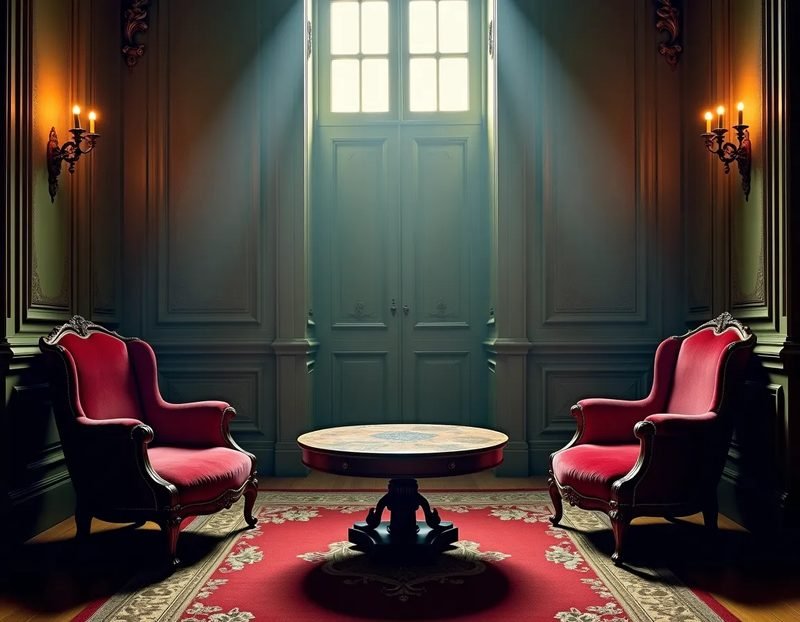
Home almost never performed the same sitting twice with the same guaranteed setup. He sat in other people’s homes, at other people’s tables, arranged by other people’s servants. On paper, that sounds like a disadvantage, no home turf, no rigged furniture, no confederate planted in advance.
In practice it was the opposite. A traveling medium who works exclusively in rooms he doesn’t control gets to say, honestly, “I brought nothing with me.” And when nothing can be found sewn into his sleeves or wired under the table, because there was no time and no access to wire anything, the investigation runs out of places to look.
Compare that to the Davenport Brothers, who toured with their own custom cabinet everywhere they went. Once someone got a good look at the joinery, the whole act had a permanent weak point that followed it from city to city. Home never gave critics that kind of fixed target.
He also chose his sitters, or rather, his patrons chose them for him, which is a distinction I think about a lot. A sitting arranged by a countess, filled with her own guests, is not a neutral investigation. It’s a room where the host has social capital riding on the evening going well. Nobody wants to be the guest who accuses their hostess’s medium of fraud at her own table. Home understood, maybe instinctively, maybe by hard experience, that the social pressure of a room does half the work any prop ever could.
Crookes and the Limits of What Science Could Test
The most serious formal investigation came from William Crookes, a chemist who later discovered thallium and served as president of the Royal Society. Crookes ran controlled sittings with Home between 1871 and 1873, using instruments of his own design meant to measure force and weight changes during the phenomena. He published his findings in the Quarterly Journal of Science, and his conclusion was that he could not explain what he’d observed by any means known to him.
Skeptics tore into Crookes for decades afterward, and fairly, his controls were nowhere near what a modern conjuring-literate investigator would demand.
But here’s the part that actually matters for our purposes: Crookes was not a fool, and he was not an easy mark. He was one of the sharpest experimental minds in Britain. The fact that his instruments and his rigor still weren’t enough tells you something about the ceiling of period investigation, not about the reality of spirit contact.
A controlled experiment is only as good as the assumptions baked into its controls, and Crookes built his controls to catch the kind of fraud he expected. Home, whether by design or by instinct, never gave him that kind of fraud to catch.
He Never Took a Fee, and That Detail Did a Lot of Work
Home refused to charge admission or accept direct payment for sittings, a policy that set him apart from nearly every rival medium of his day. He lived instead on gifts, patronage, and the occasional inheritance dispute (one of which, the Lyon case, cost him dearly in court and in reputation).
That refusal wasn’t purely principle. It was armor.
A medium who takes money for a service can be sued for fraud, prosecuted for obtaining funds under false pretenses, or simply dismissed as a huckster with an obvious motive. A medium who accepts hospitality and gifts from people who consider him a personal friend occupies a much stranger legal and social position. Robert Browning loathed Home so much he wrote an entire poem, “Mr. Sludge, ‘The Medium,'” savaging him thinly disguised as a con man. Browning never caught him in anything provable either.
That’s the whole pattern in miniature. Plenty of people despised Home. Nobody could make the accusation stick.
What This Case Still Teaches a Working Performer
I’m not telling you to go build a floating act, and I’m certainly not telling you to claim spirit contact with a client’s dead relative. That’s a line I won’t cross and you shouldn’t either.
What I am telling you is that Home’s real skill wasn’t the levitation. It was room management.
He picked venues where he had no time to rig anything, which made “there’s a hidden mechanism” an unlikely accusation before he’d even sat down. He worked in enough light that darkness itself was never a valid objection. He let hosts and patrons develop a social stake in his credibility before the skeptic in the room ever opened his mouth. And he structured his entire economic relationship with clients so that ordinary fraud law barely applied to him.
None of that requires anything supernatural. All of it requires a performer who thinks less about the trick and more about the conditions the trick lives inside.
I’ve run private sittings and readings around the greater Louisville area for years now, and the lesson holds at any scale. A piece of misdirection built into your patter matters less than the room you’ve built around the piece. Control the conditions before you worry about the method.
That’s the real trade Home was practicing, whatever else he claimed to be doing in that drawing room on Ashley Place.
The Object as Evidence, Even When the Story Isn’t
Cases like Home’s are why I collect the way I do. A written account from 1868 can be embellished, misremembered, or invented outright. An object that survived from that era, a medium’s table, a spirit bell, a sitting-room instrument built to Crookes’s own specifications, carries a different kind of weight. It doesn’t need you to believe the ghost story. It only needs you to sit with the fact that people once staked their reputations on what happened around it.
That’s the quality I look for in every piece we carry.
If tales like this one get under your skin the way they get under mine, you my friend, are exactly who this shop was built for. Take a look at what’s currently in the collection.