
I don’t claim Eusapia Palladino floated a table. I don’t claim a spirit named John King pressed a phantom hand against a sitter’s shoulder in the dark. But I have a firm conviction that her career is the most useful case study a séance performer can read, and almost nobody reads it correctly.
Most people stop at the exposure. She was caught, so she was a fraud, so the story ends. Most people are wrong about where the story ends.
She was caught in Cambridge, in Paris, in New York, and at her own table in Naples. She kept getting invited back by physicists, physiologists, and an astronomer who had mapped the canals of Mars. That should bother you. It bothers me, and I’ve spent a fair amount of time thinking about why.
A Girl from Apulia With No Schooling
Palladino was born in 1854 in Minervino Murge, in southern Italy. She was orphaned young, raised in Naples, and she never learned to read. She wasn’t a drawing-room medium with a lace collar and a lending library. She was a heavyset peasant woman with a strong jaw and a rough voice, and she worked in the dark.
That matters. Her audience was professors, and they were sitting across from someone they could not classify. She didn’t flatter them or speak their language. She simply sat, sweated, groaned, and asked to be held tighter.
Then things moved. Tables tilted with all four legs off the floor. A curtain bellied out from the corner of her cabinet as if someone stood behind it. Tambourines and guitars on a stool inside that cabinet sounded on their own, and sitters felt fingers pinch and stroke them through the cloth.
In 1891 the criminologist Cesare Lombroso sat with her in Naples. He had been a loud opponent of spiritism. He came away writing that he was ashamed of how stubbornly he’d fought the possibility. A man with his reputation doesn’t write that sentence lightly.
Cambridge, 1895, and the Trick Everyone Remembers
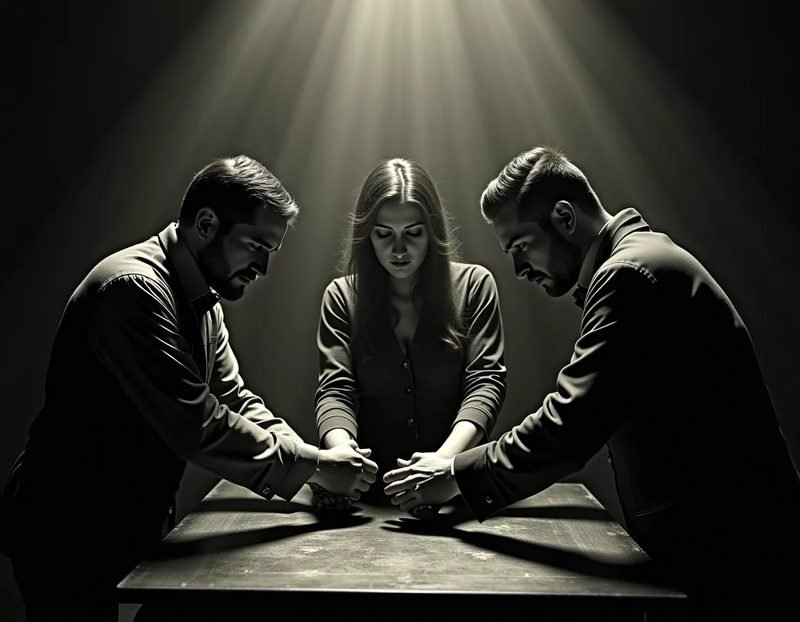
The exposure that gets quoted came from the Society for Psychical Research. In 1895 she sat at Cambridge, in a house belonging to Frederic Myers, with Richard Hodgson among the observers. Hodgson was a hard man to fool. He’d already taken apart Madame Blavatsky’s phenomena in India.
What he saw was hand substitution. Two controllers held her wrists, one on each side. In the dark she would bring her hands together, let one controller grip both, and free the other hand to touch, lift, and tap. Each sitter believed he still had a hand of hers. One of them was holding two.
It’s a beautiful little piece of work, and I mean that as a professional. It requires no apparatus, and it works on the exact thing a sincere sitter is trying to do, which is pay attention to his own hand.
The SPR declared her a fraud. The word landed hard, and the papers ran with it.
Then it didn’t stick.
The Investigators Who Kept Coming Back
Here’s the part that should reorganize how you think about belief. After Cambridge, the serious people did not walk away. Charles Richet, who would win a Nobel Prize in physiology, kept sitting with her. In Paris, around 1905, Pierre and Marie Curie attended sessions, and Pierre wrote privately that he thought there was a whole new territory of facts worth studying. That is a man who had just been handed a Nobel himself.
In 1908 the SPR sent three investigators to Naples: Everard Feilding, W. W. Baggally, and Hereward Carrington. Baggally was a working conjuror who had watched a long line of mediums fail under his eye. They sat with her over a series of nights, and they saw her cheat. They also came away saying that some phenomena could not be accounted for by the tricks they’d caught.
That is the residue argument, and it is the engine of her whole career. Every exposure proved she would cheat. None of them proved she always cheated. The gap between those two statements was large enough to live in for thirty years.
Whether the residue was real is not the point of this column. Whether the gap was useful is.
The Confession Built Into the Act
Palladino’s defenders made a claim that any performer should find delicious. Trance, they said, made her cheat. In deep trance she reached for the easy path, freeing a hand, nudging with a knee or a foot, and she didn’t do it consciously. Her supporters even argued that sitters should expect a mix of trickery and genuine effect, and should catch the difference themselves.
Think about what that does to a skeptic. He isn’t watching a woman who claims to be perfect. He’s watching a woman who admits she’s fallible and asks him to police her. Every catch makes him feel sharper. Every failure to catch makes him feel more unsettled. The investigation itself becomes the entertainment, and he’s the star of it.
By 1910 in New York, Hugo Münsterberg and a crowd of American academics sat with her and went home calling it plain trickery. It made headlines. It did not erase Naples or Paris, because those sittings were already in print, argued over, and defended by men who had staked their names on them.
That is what investment looks like. Once a sitter has told his colleagues he saw something, the exposure has to defeat him, not just her. People defend their own witnessing harder than they defend any belief handed to them.
What a Séance Performer Can Steal
I ran a small table-work evening at a private event in Springhurst not long ago. Nothing grand. A dozen people, low light, a lightweight table and one very simple move. I let a woman on my left notice something slightly off, a hand where she didn’t expect it.
The room changed. Her jaw tightened. She wasn’t angry, she was engaged, and for the next twenty minutes she was the most attentive sitter I’ve ever had. She wanted to catch me again. She never did, and she told everyone else about the one time she almost had.
Palladino would have understood that in her bones. If you’re building a séance or physical mediumship set, here’s what her career teaches.
- Let controls be imperfect, on purpose. A flawless demonstration gives the skeptic nothing to hold. A demonstration with a visible seam gives him a project.
- Make the sitter your co-investigator. Ask them to hold, to watch, to report. People defend what they helped produce.
- Frame the fallibility before anyone finds it. A performer who says “some nights it doesn’t behave” has already inoculated himself against the night it doesn’t.
- Keep one moment you can’t explain away. Not a claim, a moment. What the audience does with it is their business.
- Never argue with an exposure. Palladino mostly didn’t. She sat again next week.
I’m not telling you to be sloppy. I’m telling you that polish and belief are different currencies, and Palladino mostly traded in the second.
Belief That Survives Being Challenged
She died in Naples in 1918, and the argument didn’t die with her. Modern writers on her case still split. Some see a shrewd peasant woman who outplayed the best minds in Europe. Others see a genuine puzzle wrapped in ordinary fraud. I lean toward the first, and I still can’t shake the second.
That’s honestly the whole lesson. The performer who survives exposure isn’t the one with the cleanest method. It’s the one who leaves the audience with an unfinished question they’d rather keep than close.
It is a strange thing to admire a woman who cheated. I admire her anyway.
If you build séance work, physical mediumship pieces, or anything meant to leave a room quiet and unsettled, you know the tools matter. Weight, sound, texture, a table that has the right feel under the fingertips. You’ll find working pieces built with that seriousness at Arcane Relics. Come see what’s on the shelves, my friend. The dark is waiting for you.