A ticket seller in a lobby, a cardboard skeleton in the window, and a house full of teenagers who’d been told the lights would go out at midnight and that nobody was responsible for what happened next. That’s the whole business model. It worked for about thirty years.
The Séance Gets a Box Office
I don’t claim the spook show was a séance. It wasn’t, and the people running them knew it. I do, however, have a strong conviction that it was the first time spirit theatre stopped being a parlor secret and became something a stranger could buy for the price of a matinee.
Before that, the séance was intimate, expensive, and private. A medium worked a small room with a cabinet, a trumpet, and a sitter list she’d studied for weeks. The Fox sisters had gone public in the previous century, and stage performers like Howard Thurston had folded spirit effects into full evening shows. But the format stayed a luxury. You had to be invited, or you had to pay a lot.
Then, in the early 1930s, performers began booking themselves into movie houses after the last feature. Same seats. Same screen. A fraction of the price. The audience was no longer a circle of the grieving or the curious. It was two thousand kids and their dates.
That changes everything about how you build a ghost.
How the Shows Were Built
The format was consistent enough that you can lay it out like a recipe. A stage act of conventional magic came first, often with a levitation or a sawing, to warm the room and establish the performer as capable. Then the “ghost” half, which is the part collectors chase now.
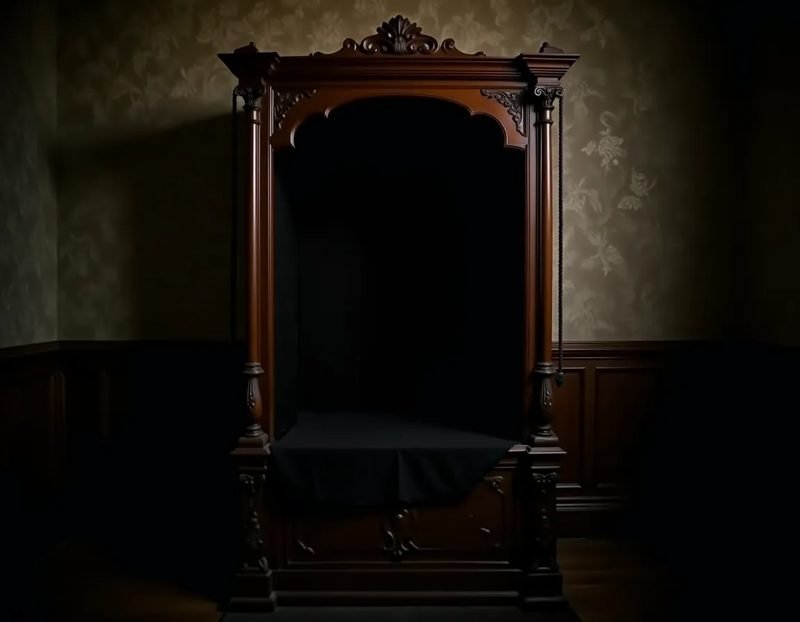
The spirit cabinet was the backbone. A performer, or a bound volunteer, went inside. Bells rang, tambourines flew, a hand appeared at the aperture. This was straight out of the Davenport Brothers’ repertoire, recycled for a mass crowd a full seventy years later. Nobody in row Q cared that the method was old. They cared that it was dark.
Alongside it ran the packaged manifestations, and this is where the shows earned their reputations:
Luminous painted objects under blacklight, so a skull or a gauze figure seemed to float with no support.
Dark-suited assistants against black velvet, handling props that appeared to move on their own.
Wire-run “ghosts,” cloth figures that swept over the audience on a line from the projection booth to the stage.
Rattling, breathing, and thumping from the pit and the balcony, timed to the performer’s patter.
Dr. Silkini, Jack Baker, and the touring outfits that followed the Dell and Ade circuits worked variations of this. Some carried a full crew. Some carried a trunk and a projectionist who owed them a favor. The scale varied wildly. The structure barely changed.
Why the Blackout Was the Signature
Ask most performers what made the spook show work and they’ll say the props. They’re wrong. It was the dark.
Total darkness does three things at once, and every one of them helps the performer. It hides the method, obviously. It removes the audience’s sense of scale, so a cloth figure eight feet away feels like it’s on your lap. And it breaks the social contract of the theatre. In a lit room, you’re a spectator. In the black, with a stranger’s shoulder against yours and something brushing your hair, you’re a participant, whether you agreed to it or not.
That’s the part that sold. The manager would announce a “blackout” during the show, a marked stretch of a few minutes when the house went completely dark and the ghosts were, in the patter, “released” into the audience. Screams were expected. Screams were, in fact, the product.
I feel it in my stomach when I think about a room that size going black on purpose. Two thousand people, all holding the same breath, all sure something is about to touch them. You cannot fake that hush with a soft lighting cue. You have to actually remove the light.
Which is exactly why so few modern performers will do it properly.
The Business Behind the Fear
Here’s the detail that gets lost in the nostalgia. These were commercial products, engineered at the level of the lobby card.
The shows shipped with advance material: heralds, window cards, newspaper mats, even pre-written radio spots. Some promised a “ghost guarantee” or a nurse in the lobby. Some issued “certificates of courage” afterward. The gimmick was to make attendance a dare, then reward the survivor with proof.
Theatre owners loved it because midnight was dead time. An empty house at 11:30 p.m. earns nothing. A full one, at a premium price, earns a lot, plus concessions. By the late 1940s, and into the fifties when horror films gave the shows a second wind, a strong spook act could out-draw the feature it followed.
Then television arrived, the monsters moved to the living room, and the circuit thinned out by the late sixties. A few outfits carried on. Most of the trunks went into storage.
And that’s where the story gets a little unnerving for collectors.
What Survived in the Trunks
What survives is mostly ephemera and hardware, and it’s peculiar stuff. Hand-lettered cabinet panels with wear where a thousand hands pushed the same spot. Painted skulls, the paint gone chalky. Show scripts in a performer’s pencil, cues marked in the margin with a circled “DARK.” I’ve handled a folded ghost sheet with a stiffened grommet edge, and I’ll admit my hands went still. It’s a piece of cloth. It’s also the exact object that made a room scream.
Those pieces matter for a reason beyond nostalgia. They show you what the performers actually prioritized. The hardware is crude. The timing notes are obsessive. Nobody was proud of the ghost. They were proud of the pacing.
What a Modern Performer Should Steal
You don’t need a theatre. I’ve done a scaled-down version of this in a client’s home in Anchorage, twelve guests, one room, every lamp off. Here’s what I noticed. The dark still works. It works better small, honestly.
Take these lessons, not the costumes:
Announce the blackout. Tell your audience the lights are going out and roughly when. Anticipation does half the work, and the spook shows knew it.
Commit to real darkness. A dimmed room is a mood. A dark room is an event. Cover the exit signs if the venue allows it, and check first.
Give the audience one physical moment. A breath of air, a light touch, a sound behind them. One, placed well, beats ten scattered.
Time it like a script. The old performers marked the dark in pencil. You should too.
Keep the method boring and the effect enormous. The tricks were old. The delivery was not.
The spook show taught a lesson bizarre performers keep relearning. People will pay to be frightened, as long as they feel it was their own choice.
Nothing sells like a dare.
If you are like me and you build your evenings around the hush before something unexplained happens, then you my friend, are home. Browse the shop at https://arcanerelics.com/shop/ and find the piece that turns your next room into one.
A woman’s hand starts moving before she tells it to. She isn’t trying to write anything, she says so herself, but the pen keeps dragging across the page in loops and jagged little peaks. Someone in the room whispers that it looks like a name. Nobody in that parlor in 1858 would have called it a magic trick. They called it proof.
The Séance Table Before the Cabinet
Automatic writing predates the rapping cabinets and the levitating trumpets by a good margin, and it did something those later effects couldn’t. It left behind a document. A ghost that raps twice for yes is gone the moment the séance ends, but a page covered in trembling script sits on the table afterward, ready to be read, copied, mailed to relatives, published in a spiritualist newspaper. That’s a different kind of evidence entirely, and the Victorians understood exactly what they were looking at.
The practice traces back through Andrew Jackson Davis and the early American spiritualist movement of the 1840s and 50s, though mediums claiming pen-guided revelation existed well before spiritualism had a name for itself. What changed in the mid nineteenth century wasn’t the phenomenon. It was the audience. A newly literate, newly skeptical, newly scientific public wanted something they could hold and examine, not just a knock in the dark.
By the 1870s automatic writing had mediums touring with it as a headline act. Reverend William Stainton Moses filled notebooks with material he claimed came from spirits identifying themselves by name and biography. Decades later, Pearl Curran, a St. Louis housewife with no formal education past eighth grade, produced hundreds of thousands of words of archaic English verse and prose she attributed to a seventeenth century spirit named Patience Worth, using a Ouija board and then, later, direct automatic writing. Scholars still argue about what was happening in Curran’s mind. Nobody argues that the material was strange, dense, and produced with a fluency she couldn’t reproduce in her own conscious writing style.
I don’t know what was moving Pearl Curran’s hand. I doubt anyone alive does.
The Mechanism Nobody Wanted to Believe
Here’s the part most performers skip past, and it’s the part that actually matters if you want to build a routine on this rather than just borrow its aesthetic. Automatic writing works because of something real, measurable, and not remotely supernatural, the ideomotor effect.
Michael Faraday investigated it in 1852, not with a pen but with a table. Sitters would rest their fingers lightly on a tabletop during a séance, and the table would rock, slide, tilt, seemingly guided by nothing. Faraday built an apparatus that could detect which direction force was actually being applied, and he found it every time. The sitters were moving the table. They weren’t lying about it and they weren’t tricking anyone on purpose. Their own small, unconscious muscle movements, driven by expectation and belief, were doing the work, and their conscious minds simply weren’t reporting it as their own action.
Automatic writing runs on the identical principle. A person holding a pen who expects, hopes, or fears that the pen will move without her intention is unconsciously supplying the tiny movements that make it move. The physiologist William Carpenter formalized the term “ideomotor action” a few years after Faraday’s table experiments, and it’s held up. It’s the same principle behind dowsing rods, behind a pendulum swinging over a name on a table, behind a planchette gliding to letters on a board.
I don’t necessarily believe the mind is capable of producing coherent narrative under full unconscious control, not the way Pearl Curran’s output suggests. I do have a strong conviction that the physical mechanism, the hand moving without the moving hand’s owner claiming credit, is completely real and completely explainable.
By the way, that’s what makes it useful to us. A real, documented psychological mechanism is a far better foundation for a bizarre magic piece than a prop that only works because the audience agrees not to look too closely.
When the Board Became a Toy
Somewhere in this history the automatic hand and the automatic board split into two different cultural objects, and it’s worth understanding why, because it shapes how a modern audience reacts to each.
The planchette, a small heart-shaped device on wheels with a pencil fitted through it, was patented in France in the 1850s specifically to make automatic writing easier for ordinary sitters to produce. It’s a direct ancestor of the Ouija board. When William Fuld and his business partners commercialized the talking board in the 1890s, they took the ideomotor mechanism and simplified it into a parlor game, and that simplification is exactly why the board reads as toyish today while a page of trembling handwritten script still reads as troubled.
A Ouija board announces itself as a game. Everyone at the table knows the rules and half of them are half performing their own belief. A handwritten page found in a drawer, or produced under conditions the sitter didn’t fully control, doesn’t announce anything. It just sits there, demanding an explanation nobody in the room wants to give it.
That distinction is the whole reason automatic writing survives as a serious tool in bizarre magic while the talking board mostly gets left to novelty shops.
Why a Modern Room Still Falls for It
Skepticism has gotten sharper since 1858, not weaker, and that actually helps this kind of work rather than hurting it. A contemporary audience has seen enough television psychics and enough debunking videos to distrust a floating trumpet on sight. Handwriting reads differently. Handwriting feels like biography, not performance.
Most performers dismiss this effect as dated. They’re wrong, and they’re wrong for a specific reason: they’re thinking about the Victorian trance medium version instead of the psychological one. You don’t need a costume or a fainting spell to make a page of script land. You need the spectator to believe, even briefly, that the movement producing it wasn’t fully theirs.
I tested a version of this at a private event in the Louisville area a while back, working with a folded note and a pen the sitter held herself. I watched her hand hesitate at the second letter, catch itself, then keep moving in a script that didn’t match her normal signature style at all. Her breath caught before she even looked down at what she’d written.
That reaction is the entire effect. Everything else is scaffolding around it.
Building It Without the Cliché
The trap most performers fall into with automatic writing is treating it as a prop instead of a psychological event. They buy a pre-written slate, reveal it with a flourish, and wonder why the room claps politely instead of going quiet.
A few things separate the pieces that actually unnerve a room from the ones that just decorate a table.
The handwriting itself needs to look wrong in a specific way, not generic spooky scrawl. Real automatic writing from the historical record tends to be cramped, inconsistently sized, sometimes angled steeply against the line, occasionally trailing off mid word. Genuine urgency looks different from a font choice.
The sitter’s own hand should be doing real work, or appearing to. A pre-written reveal is a magic trick. A pen that seems to move under a spectator’s own fingers is a psychological event, and those live in completely different parts of an audience’s memory.
Don’t explain the mechanism to the room. Explaining ideomotor action to your spectators kills the moment faster than any technical flaw would. Save that conversation for your fellow performers, not your audience.
Let the content stay a little unresolved. The historical cases that still get discussed, Curran’s Patience Worth material especially, are compelling partly because they were never fully solved. A message that answers every question feels written. A message that raises one more than it answers feels found.
The pieces that stay with a room are the ones that borrow the mechanism honestly and the atmosphere sparingly.
What the Page Leaves Behind
A rapping cabinet ends when the lights come back up. A page doesn’t. That’s still, more than a century and a half later, the real advantage automatic writing has over almost every other séance era effect, it produces an artifact your spectator can carry out of the room with them, fold into a pocket, find again at two in the morning when they can’t sleep.
I’ve collected more than a few handwritten pieces over the years, letters, journal fragments, notes tucked into books, some with histories I can trace and some I can’t. The ones that unsettle me most aren’t the ones with the most dramatic content. They’re the ones where the handwriting itself seems to be fighting something, strokes smeared, pressure uneven, a word crossed out and rewritten harder than it needed to be.
If you are building bizarre magic work around physical evidence, artifacts that carry weight because of what they appear to have witnessed rather than what a performer claims about them, automatic writing deserves a permanent place in your repertoire. It’s one of the few séance era techniques built on a mechanism that’s actually true.
We keep a working collection of handwritten and troubled pieces suited to exactly this kind of routine. If you are like me and find yourself drawn to objects that seem to carry their own history, take a look at what’s currently available.
I don’t claim Eusapia Palladino floated a table. I don’t claim a spirit named John King pressed a phantom hand against a sitter’s shoulder in the dark. But I have a firm conviction that her career is the most useful case study a séance performer can read, and almost nobody reads it correctly.
Most people stop at the exposure. She was caught, so she was a fraud, so the story ends. Most people are wrong about where the story ends.
She was caught in Cambridge, in Paris, in New York, and at her own table in Naples. She kept getting invited back by physicists, physiologists, and an astronomer who had mapped the canals of Mars. That should bother you. It bothers me, and I’ve spent a fair amount of time thinking about why.
A Girl from Apulia With No Schooling
Palladino was born in 1854 in Minervino Murge, in southern Italy. She was orphaned young, raised in Naples, and she never learned to read. She wasn’t a drawing-room medium with a lace collar and a lending library. She was a heavyset peasant woman with a strong jaw and a rough voice, and she worked in the dark.
That matters. Her audience was professors, and they were sitting across from someone they could not classify. She didn’t flatter them or speak their language. She simply sat, sweated, groaned, and asked to be held tighter.
Then things moved. Tables tilted with all four legs off the floor. A curtain bellied out from the corner of her cabinet as if someone stood behind it. Tambourines and guitars on a stool inside that cabinet sounded on their own, and sitters felt fingers pinch and stroke them through the cloth.
In 1891 the criminologist Cesare Lombroso sat with her in Naples. He had been a loud opponent of spiritism. He came away writing that he was ashamed of how stubbornly he’d fought the possibility. A man with his reputation doesn’t write that sentence lightly.
Cambridge, 1895, and the Trick Everyone Remembers
The exposure that gets quoted came from the Society for Psychical Research. In 1895 she sat at Cambridge, in a house belonging to Frederic Myers, with Richard Hodgson among the observers. Hodgson was a hard man to fool. He’d already taken apart Madame Blavatsky’s phenomena in India.
What he saw was hand substitution. Two controllers held her wrists, one on each side. In the dark she would bring her hands together, let one controller grip both, and free the other hand to touch, lift, and tap. Each sitter believed he still had a hand of hers. One of them was holding two.
It’s a beautiful little piece of work, and I mean that as a professional. It requires no apparatus, and it works on the exact thing a sincere sitter is trying to do, which is pay attention to his own hand.
The SPR declared her a fraud. The word landed hard, and the papers ran with it.
Then it didn’t stick.
The Investigators Who Kept Coming Back
Here’s the part that should reorganize how you think about belief. After Cambridge, the serious people did not walk away. Charles Richet, who would win a Nobel Prize in physiology, kept sitting with her. In Paris, around 1905, Pierre and Marie Curie attended sessions, and Pierre wrote privately that he thought there was a whole new territory of facts worth studying. That is a man who had just been handed a Nobel himself.
In 1908 the SPR sent three investigators to Naples: Everard Feilding, W. W. Baggally, and Hereward Carrington. Baggally was a working conjuror who had watched a long line of mediums fail under his eye. They sat with her over a series of nights, and they saw her cheat. They also came away saying that some phenomena could not be accounted for by the tricks they’d caught.
That is the residue argument, and it is the engine of her whole career. Every exposure proved she would cheat. None of them proved she always cheated. The gap between those two statements was large enough to live in for thirty years.
Whether the residue was real is not the point of this column. Whether the gap was useful is.
The Confession Built Into the Act
Palladino’s defenders made a claim that any performer should find delicious. Trance, they said, made her cheat. In deep trance she reached for the easy path, freeing a hand, nudging with a knee or a foot, and she didn’t do it consciously. Her supporters even argued that sitters should expect a mix of trickery and genuine effect, and should catch the difference themselves.
Think about what that does to a skeptic. He isn’t watching a woman who claims to be perfect. He’s watching a woman who admits she’s fallible and asks him to police her. Every catch makes him feel sharper. Every failure to catch makes him feel more unsettled. The investigation itself becomes the entertainment, and he’s the star of it.
By 1910 in New York, Hugo Münsterberg and a crowd of American academics sat with her and went home calling it plain trickery. It made headlines. It did not erase Naples or Paris, because those sittings were already in print, argued over, and defended by men who had staked their names on them.
That is what investment looks like. Once a sitter has told his colleagues he saw something, the exposure has to defeat him, not just her. People defend their own witnessing harder than they defend any belief handed to them.
What a Séance Performer Can Steal
I ran a small table-work evening at a private event in Springhurst not long ago. Nothing grand. A dozen people, low light, a lightweight table and one very simple move. I let a woman on my left notice something slightly off, a hand where she didn’t expect it.
The room changed. Her jaw tightened. She wasn’t angry, she was engaged, and for the next twenty minutes she was the most attentive sitter I’ve ever had. She wanted to catch me again. She never did, and she told everyone else about the one time she almost had.
Palladino would have understood that in her bones. If you’re building a séance or physical mediumship set, here’s what her career teaches.
Let controls be imperfect, on purpose. A flawless demonstration gives the skeptic nothing to hold. A demonstration with a visible seam gives him a project.
Make the sitter your co-investigator. Ask them to hold, to watch, to report. People defend what they helped produce.
Frame the fallibility before anyone finds it. A performer who says “some nights it doesn’t behave” has already inoculated himself against the night it doesn’t.
Keep one moment you can’t explain away. Not a claim, a moment. What the audience does with it is their business.
Never argue with an exposure. Palladino mostly didn’t. She sat again next week.
I’m not telling you to be sloppy. I’m telling you that polish and belief are different currencies, and Palladino mostly traded in the second.
Belief That Survives Being Challenged
She died in Naples in 1918, and the argument didn’t die with her. Modern writers on her case still split. Some see a shrewd peasant woman who outplayed the best minds in Europe. Others see a genuine puzzle wrapped in ordinary fraud. I lean toward the first, and I still can’t shake the second.
That’s honestly the whole lesson. The performer who survives exposure isn’t the one with the cleanest method. It’s the one who leaves the audience with an unfinished question they’d rather keep than close.
It is a strange thing to admire a woman who cheated. I admire her anyway.
If you build séance work, physical mediumship pieces, or anything meant to leave a room quiet and unsettled, you know the tools matter. Weight, sound, texture, a table that has the right feel under the fingertips. You’ll find working pieces built with that seriousness at Arcane Relics. Come see what’s on the shelves, my friend. The dark is waiting for you.
In Part 1: Spirit Slates and Their Shadows: The Forgotten Spiritualist Prop That Still Haunts the Stage, I talked about how people began using the chalk slate in the 1800s. I see many people still use the chalk slate sometimes today. The slate has this name for a reason. But that was not all. The Victorian séance room looked like a stage. The medium came in and did the same thing every time. Most of that system has not been used for over one hundred years. I made this post after I shared the other posts. The spirit trumpet looks like a horn. The end of the spirit trumpet comes to a point like a cone.
The Spirit Trumpet: Voice from the Dark
People use tin or aluminum to make the spirit trumpet. People place the spirit trumpet on the séance table before they switch off the lights. The spirit trumpet works just like the name says. At night, the thing moved. The thing went to the other side of the room. The thing spoke. I see this when people talk in quiet voices. Sometimes people speak loudly from the other side of the circle. The Davenport Brothers used trumpets for tricks in the show. Many people have heard about Etta Wriedt.
Etta Wriedt and other direct-voice mediums used tricks with the trumpet. I heard that Wriedt can match voices in many languages. Wriedt did not know those languages. The investigators did not know what had happened. Most of the time, the method did not work. I liked how the staging looked. The way people make the trumpet tells the story. Most séance trumpets came apart easily. The séance trumpet had two or three parts. The parts fit together.
The medium could put the séance trumpet together or take the séance trumpet apart in a few seconds. The wide end often had a line made with glowing paint. People usually used zinc sulfide for the paint. People saw the trumpet move at night. The glowing band made people look at the place the medium pointed to. People saw the glowing band and walked where the medium showed the way. The medium pointed. People looked at the spot. A lot of people play music, but they do not use the trumpet. Not a lot of people play the trumpet.
A trumpet you can fold and that has a glowing band might look odd to people today. Here are some easy ways to change how the trumpet sounds. Most people do not think a horn can float in the air. That gap gives a chance. The séance cabinet looked like a small stage. People sat together in the Séance Cabinet during séances. The Séance Cabinet was a small closed room made for these meetings. The cabinet made people feel closed in and made the gatherings seem like a show. The room changed how everyone felt during the séance. The Davenport Brothers used the séance cabinet in the 1860s.
The Séance Cabinet: Confinement as Theatrical Architecture
After that, many people began to use the séance cabinet for séances. Setting things up was easy. The medium sat inside a small wooden box. The box had a window. The box had a curtain. The lights turned off. Many people play different types of instruments. I saw hands come out from the opening. When the lights turned on, the ropes were still wrapped around the medium. The Davenport method does not mean much for people who perform today.
The cabinet set this rule for the theater. The cabinet said, I am stuck here. You cannot blame the cabinet. But sometimes, strange things just happen. That building is still there. The building looks strong. The building was still there in 1865. Annemann said that if you use confinement, you can make conviction stronger. When people in the crowd see the performer tied up, they think the next part will be harder. The cabinet got the idea and made the idea real.
Most period cabinets used two or three wood panels. The front had a curtain. Inside, the sitting space was small. There is nothing special here. Secondary Controls: The Mechanics of the Witnessed Release
The story started when something happened outside the cabinet. The cabinet stayed silent. It helps when you remember to hold back. Secondary Controls: The release control changed how the séance went. I saw someone look at the release control. The release control had a big role in the séance.
Secondary Controls: The Mechanics of the Witnessed Release
The sitters held the medium’s hands in the dark. They used their hands to tie the wrists together. They sat close to the feet of the medium. A Victorian séance felt like people came and went. The sitter watched for signs or answers. The sitter waited. The medium tried to move with ease. I saw that I had to use the other controls. A secondary control takes place when the sitter thinks the sitter is holding the medium. The sitter holds something else.
This hand might belong to someone else. The medium can move the arm to the other side. The medium can bring the arm back again. Sometimes the arm is not real. Sometimes a device picks things up like a hand, but the device does not use the person’s real hand. Hereward Carrington talked about these things in “The Physical Phenomena of Spiritualism” in 1907. Carrington tried to show the tricks. Many performers used the book for help. He knew some good ways to trade things. When the sun goes down, I use my hands to touch what is close to me.
Some people can trick touch with ease. A medium can keep the sitter’s hands on the table. The medium can lift one hand for a short time, and the sitter might not notice it. The odd performer knows how to use the other controls. The strange performer can use the whole system. The strange performer can do things in the dark. This is not rope escape. This seems personal to me. Someone in the crowd thinks the medium holds the person by the hand. The person looks up and sees the medium on the other side of the room, away from everyone else.
The medium holds some bright things. Some things only show halfway. These things rarely happen in a stage escape act. The sitter saw the effect and agreed with it. This is why people see the impossible thing. You can help small things stand out, or you can lift someone’s spirit. This does not need much work. It takes longer to make the whole spirit feel real. You need to get ready and make a plan to do it right. Any medium can show up after you set things up.
Luminous Accessories and Partial Materialization
I notice someone has a hand raised. Sometimes I see a face behind the gauze. You might spot two glowing eyes in the dark. The props did not stand out to me. If you put zinc sulfide on muslin or on thin gauze, the fabric gives off a soft light. If you use a hidden rod to hold the fabric or put the fabric over your hand, the fabric can look like it is floating. Some people took some wire. They bent the wire. The wire looked like hands. People put glow paint on the wire hands.
People reached out their hands to other people. The others sat down. Each person took a foldable stick and held the stick. Some people took rubber gloves. Some people put some glowing stuff on the rubber gloves. They filled the rubber gloves with air. The gloves puffed up. The gloves looked like hands. I put my hands on the thin cloth by the cabinet door. Katharine Bates wrote about a séance from the 1880s.
People at the séance said they saw a spirit hand. People touched the hand. People felt how warm the hand was. The spirit took the paper and wrote some messages. The spirit hand would pick up the gifts people brought to the séance. When the séance was over, the hand was not there anymore. Two out of the three things are rubber gloves. The rubber gloves have warm water inside. You can write this part yourself. Most people who perform today have never tried glowing accessories.
A glowing hand can do more than just make people laugh. When someone makes a glowing hand with care and uses the glowing hand in the right story, the glowing hand can have a bigger impact. When there is no light and the sitters stay quiet, everything feels strange. Choose the best music for the story. The feeling stays even when the lights are on. The billet work in the séance room feels like the main test in the meeting. The message that was intercepted stands out during the billet work. Someone stopped the message at this time. Someone writes a question on a sheet of paper. Then the person seals the paper.
Billet Work and the Intercepted Message
The medium takes the sealed paper and reads the question out loud. The medium keeps the paper closed. Sometimes it feels like it burns. Many Victorian mediums used billet reading. The technology started out as something simple. After some time, the technology improved. You can hold the billet in your hand when you pick up the billet. Someone can check the billet before the lights go out. Someone can take out the billet and put in a blank billet. One person sits at the top and makes the thumbnails.
Someone helps people in the waiting room. Someone else can look behind the stage before the greeting starts. Annemann wrote Practical Mental Magic in 1944. Corinda put out “Thirteen Steps to Mentalism” after that. Corinda took the ideas and made the ideas better. The strange performer cares about the past. When you pick up a billet during a séance and say the message is from someone who has died, you are using something created for the séance. It fits, but it does not work well for a modern mentalism show. I think a modern mentalism show needs something else. The sitter wrote the name of the sitter’s dead mother.
You know this already. When you watch things happen at a séance, the feeling is different from the way you learn things during mentalism at a business event. The meaning changes based on the situation. When people have a séance, a billet reading can seem personal and a bit strange. Some Victorian mediums used to start with a prayer. Someone said the prayer. An assistant got some sealed slips and placed the slips in a basket. The assistant picked up the basket and took the basket to a nearby room. The medium asked questions. The knocks gave answers in a code.
After that, the medium went back inside. Basic. It works fine. The sitters made up their minds before the medium started to talk. People used the Ouija board before 1966. Parker Brothers began selling the Ouija board in 1966. The Ouija board by Parker Brothers came in a box. People in America began to use talking boards for spiritual reasons in the 1880s. People once used planchettes to try to speak with spirits. Most people do not think the talking board is scary.
Most people do not see the talking board as a toy. People in the Victorian era used a tool to talk to spirits. People saw the talking board in plays before Parker Brothers made the talking board. Some people take the tool to parties. Some people buy the tool because it is fun. A long time ago, people wrote by hand on pieces of wood. People used thick boards when people made the first writing boards. Most planchettes were made from wood. A small glass ball or lens sat in the middle. The glass helped the planchette move across the table easily.
The Talking Board Before Parker Brothers Got Involved
Two people place their fingers on the planchette. The thing moved. I saw it point at the letters. The system kept the messages. Most times, the ideomotor effect moves the planchette. Small muscle movements, shaped by what people think will happen and by what others in the group do, make the pointer move even if people do not want to move the pointer. This is real physiology, not magic. After some time, the performer sees the change. What matters is that when many people sit in the same room, they work together to share a message. These people did not plan for this message.
I do not think this is what I wrote. That can help the scene stand out. A hand-made talking board that someone used in a real séance feels different from a Hasbro board. The materials matter. The wood feels heavy in my hands. Someone wrote the letters by hand. The planchette has some brass parts. These things make people see it in a new way. If you want to set up a séance show, the tool you pick matters just as much as how you use the tool. Someone got the Victorian Arsenal ready for a show today.
I saw people moving things and checking that everything was set. The place felt busy and everyone looked full of life. The instruments listed above are not kept in the museum. These methods use props. If you use any of these in a magic show or a mind-reading show, the audience will notice something else. This new feeling can help people when people have already seen most things. These are some notes about integration. First, share the background. Put the Victorian arsenal on the stage for the show. After that, bring in the props.
The trumpet needs a frame. The board needs a frame around it. The cabinet needs a frame to stay sturdy. If you put them in a modern mentalism show, they look like tricks. If you add a séance scene to the story, even if it is simple, the history of séances gives it more meaning. The séance scene can help the story move forward. The room shows how people lived in the past. A tin trumpet with tape over a crack sounds different from an old trumpet that still works. People notice the quality of the material, even when people do not know the reason. The look of something can change how a room feels.
Staging the Victorian Arsenal in a Modern Performance
If something looks real, the room feels one way. If it does not look real, the room feels another way. When something changes about the object, how it looks can change how people feel in the room. Sometimes something that looks real can make the room feel different. When the object moves or changes, the feeling in the room can change too. People can use darkness as a tool. The darkness covers everything. Darkness changes many things as well. Many Victorian mediums worked in the dark. Let us put the context before the props.
The trumpet needs a frame. The board needs a frame. The cabinet needs a frame. If I use these in a modern mentalism show, these look like tricks. So I do not want to use these. When you set up a séance, even a simple séance, the history behind séances gives it meaning and helps tell the story. The meaning of the séance comes from the history of séances. The story of the séance feels richer because of the past. The time in the room is right. A tin trumpet that has tape over a crack is not the same as a good period instrument.
Context before props. The trumpet, the board, the cabinet: these objects need a frame. Drop them into a contemporary mentalism show and they look like gimmicks. Build a séance context, even a stripped-down one, and they carry historical weight that does the dramatic work for you.
Period accuracy reads in the room. A tin trumpet with tape over a crack is not the same as a properly constructed period instrument. Audiences respond to material quality even when they cannot articulate why. The apparent authenticity of the object changes the room’s receptivity to what happens with it.
Darkness is an instrument, not just cover. Victorian mediums worked in darkness because darkness is a psychological condition. Sitters lose spatial reference, hearing sharpens, touch becomes unreliable. This works whether your audience is sitting in 1882 or 2025.
One prop at a time. The temptation is to stage a full Victorian séance with everything available. Resist it. One well-executed trumpet effect in a minimal performance is more powerful than a prop-heavy spectacle. Weight comes from detail, not volume.
People can tell when something is good, even if people do not know the reason. If the object looks real, the room reacts more. If the object does not look real, the room reacts less. The way the object looks changes how the room reacts. People can use darkness as a tool. Darkness does more than just hide things. Victorian mediums held sessions in the dark. The dark can make people feel and think in different ways. When people get lost, people listen more. The sense of touch does not feel as sharp.
This will work for the audience in 1882 or in 2025. Take one prop each time. I want to set up a real Victorian séance with all the usual things. Do not let it win. A single trumpet sound in a simple show can get more notice than a show with many props. Weight comes from the detail, not from how much detail there is. The darkness made people feel something deep inside them. The darkness touched something real in every person. Sometimes the sitters do not know where the other sitters are. I hear better now. The sense of touch gets weaker. This works for people in 1882 and for people in 2025. Pick up the prop. Put the prop down. Pick up the next prop. Hold only one prop at a time. You can hold a Victorian séance and use anything you find. Try your best and keep moving forward. A loud trumpet draws more attention in a small show. When there are many props in the show, people notice the trumpet less. The detail helps it stand out more. Just because you own many things, it does not mean the things are heavier. People who understood attention, belief, and the mind set up the Victorian séance room with skill. People kept the knowledge after the spiritualist movement ended. Some people learned what they could and showed others. The knowledge stayed when the movement was done. Anyone who wants to do the work the right way can use it. If you want instruments from a certain time, if you want to set up a séance show, or if you need props with real history, you can go to the Arcane Relics shop. Everything at the place works well for people who care about doing a good job. The place does not like people who want something different.