
A woman in the third row stopped breathing. I know because I was watching for it. The pendulum, a vintage brass bob on a twelve-inch chain, had swung three times toward her left hand, the hand resting over the sealed envelope on the table between us. She hadn’t told me which hand held the card. Nobody had.
I don’t claim pendulum divination is supernatural. I don’t claim anything about it, actually. But I’ve sat in a hundred rooms where a small weighted chain made a crowd go genuinely, uncomfortably quiet, and that quality of silence is worth understanding, worth earning, and worth building a full working around.
This guide isn’t for the curious. It’s for the performer who wants a sustained atmospheric piece that can run five minutes or forty-five, depending on what the room needs and what you’re willing to carry into it.
Choosing Your Performance Pendulum
Visual Impact: Stage vs. Close-Up
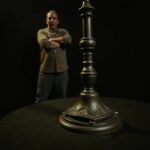
At close range, almost anything works if you handle it with intention. A faceted crystal point, a sphere of polished jet, a Victorian brass plumb bob pulled from an architectural salvage bin: all of them read as deliberate when you’re moving with deliberateness. Stage is a different problem entirely. The pendulum needs to carry from the back row without becoming a cartoon prop, which means size, reflectivity, and contrast against your clothing all matter in ways they simply don’t at a parlor table. A heavy faceted crystal on a twenty-inch silver chain catches light in ways a small brass bob can’t match from fifteen feet. Think about that contrast before you commit. White crystal on black. Aged brass on cream linen. You’re composing a visual before you say a word, and first impressions in this kind of work are hard to walk back.
Materials and What They Communicate
Crystal says spiritualist. It drops the audience squarely into the Victorian parlor tradition, the medium’s cabinet, the table-tipper’s circle. That’s not a criticism; it’s narrative shorthand that does real work before you explain anything. Brass lands older, more occult-adjacent, suggesting the alchemist’s workbench rather than the seance room. Glass, particularly hand-blown or period-looking, reads as scientific instrument: the apothecary’s counterweight, the clockmaker’s tool. Each material positions you differently in the audience’s imagination, and those positions aren’t neutral.
Does the material change how the pendulum actually responds? No. Does it change how the audience receives everything you do with it? Completely. Know which character you’re performing, then pick accordingly.
One physical note worth carrying: hold a brass bob in your palm for two minutes before performance. It takes body heat and holds it. That warmth transfers to a spectator’s hand when you pass it over, and they’ll register it as something even if they can’t name what. Small details like that compound.
Chain Length and Weight
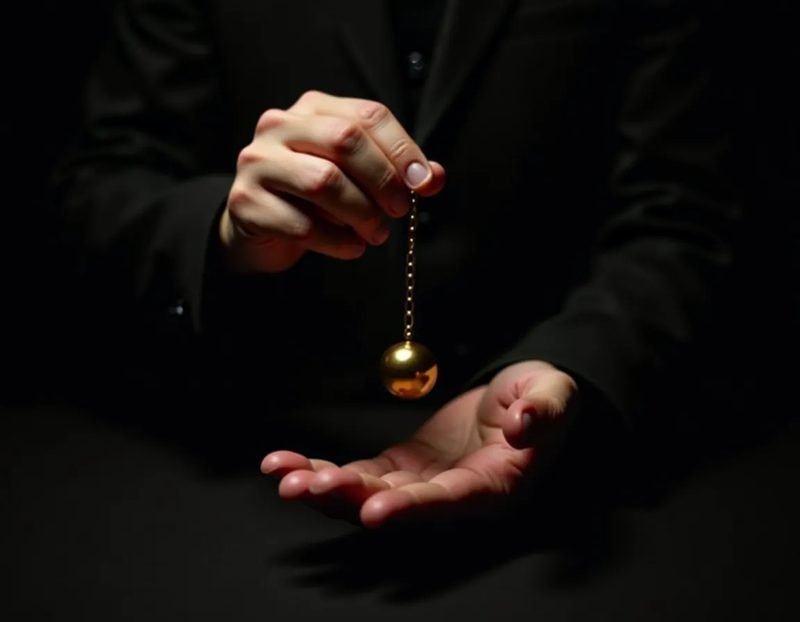
Twelve to sixteen inches for close-up, sixteen to twenty-two for parlor and small stage. The bob should be heavy enough to resist minor air currents but not so heavy that genuine micro-movement gets suppressed. Eight to fourteen grams is the practical range for most performers. Lighter pendulums are more expressive. They’re also more susceptible to environmental drift. Know what you’re holding before you’re holding it in front of people who are watching for something to happen.
Calibrating Your Pendulum: The Ideomotor Effect and the Scripted Programming Moment
The Ideomotor Response
I was skeptical of this mechanism for years. Still skeptical of certain claims made around it. But the ideomotor effect is not mysticism; it’s textbook kinesiology, documented and named by William Carpenter in 1852, observed by Chevreul before him, replicated in laboratory settings ever since. When you concentrate on a direction or a charged concept, your neuromuscular system generates micro-contractions in the hand, wrist, and fingers that produce motion you don’t consciously direct. The pendulum amplifies and externalizes those contractions into visible movement. That’s the mechanism. The body thinks, and the pendulum surfaces what the body is thinking.
Which means a performer who understands this can work with it deliberately, scripting the moment when signals get established, and a skilled reader can sometimes detect genuine ideomotor activity in a spectator’s hand before the spectator is aware of it themselves.
That second part is where it gets useful.
Establishing Your Signals
Before any public working, calibrate. Hold the pendulum over your extended palm, chain still. Think about “yes,” a clear affirmative, your own name spoken silently, something you know with absolute certainty. Let movement emerge without forcing it. Note which axis it favors. For most practitioners, yes runs on a forward-back line relative to the body; no tends to cross perpendicular; “I don’t know” rotates in a slow, undecided circle. These aren’t universal; your signals belong to your nervous system specifically, and consistent daily practice of three to five weeks will settle them into something you can trust under the specific pressure of a working audience.
Scripting the Programming Moment for an Audience
Most performers skip the calibration ritual entirely. This is wrong, and it shows in the working. The calibration itself, performed openly in front of the audience before you approach the charged material, is where the piece earns its credibility. You introduce the pendulum, explain that it responds to unconscious nervous system signals, demonstrate yes and no against low-stakes verifiable statements: your own name, a true date, a color you’re holding in mind. Then you bring the spectator into that same framework before asking them anything that matters. The moment lands as mysterious because it is genuinely slightly mysterious, even when you understand the mechanism completely. That’s honest theater. And honest theater holds longer than manufactured mysticism tends to.
The Performance: Presenting Pendulum Divination for an Audience
Setting the Scene
The pendulum needs a surface. Not always a table, but usually something to anchor the visual frame: a printed chart, a spread cloth, an aged map, something with texture that tells the audience they’re in a specific kind of room. Dead silence is preferable to ambient music for this work. Music gives an audience something to do with their ears; silence forces them to watch the swing, and watching the swing creates exactly the kind of sustained, slightly uncomfortable attention you’re after. If you can burn something beforehand, do it. Not for effect. For encoding. Smell binds memory more aggressively than any other sense, and people remember the room where they witnessed something they couldn’t quite explain.
Structuring the Presentation
Three-phase structure works reliably. First, explain the mechanism honestly, or honestly enough, so the audience understands what kind of experience they’re in. Second, demonstrate with low-stakes questions they can verify in real time. Third, apply to the charged working. That escalation from transparent to opaque is what builds the dread. By the time you’re asking the question that actually matters, the audience has watched the pendulum respond. They believe it works. The question of how becomes secondary to what it’s about to reveal.
Questions That Work
Binary questions are your foundation. “Is this the card?” “Did she choose the left hand or the right?” But don’t dismiss the open question directed at a chart. “Which direction points toward the thing she hasn’t said aloud?” is a different kind of theater than a forced-choice reveal, and it plays longer. Avoid questions the audience finds trivial, because if the answer doesn’t matter to the room, the swing doesn’t matter. Something should feel genuinely at stake when the pendulum moves, or you’re doing a demonstration, not a performance.
Advanced Techniques: Maps, Charts, and the Pendulum as Truth Detector
Pendulum Charts
A pendulum chart is a printed or hand-drawn semicircle divided into labeled sections, each marking a possible answer or category. Hold the pendulum above the center point, ask the question, and read the swing direction against the labels. The chart converts a binary tool into something capable of multi-answer responses without gimmickry. Most performers reach for sectored charts in emotional or thematic workings: life areas, unnamed fears, things a spectator is carrying but won’t say out loud. Print yours on aged stock, something with weight and texture. A sloppy chart tells the audience you haven’t committed, and they’ll follow that lack of commitment straight out of the moment.
Map Dowsing on Stage
This is one of the strongest visual formats in pendulum work, and it’s underused by a wide margin. Spread a map on a table or on the floor of the performance space. Have a spectator think of a location, a country, a city, a street they know well. Walk the pendulum slowly over the surface, watching for micro-responses in your hand and secondary signals in the spectator’s posture and face as you pass over different regions. The image of a performer moving a small weight over a large surface while a room holds its breath is genuinely strange in a way that most contemporary mentalism doesn’t manage anymore. You don’t need the exact street. A correct country lands hard. A correct city lands harder. Structure the working to the accuracy threshold you can actually deliver, not the one that would impress you in the planning stage.
The Pendulum as Truth Detector
This gets misused. Often badly. The principle isn’t unsound: when a person suppresses a true response, neuromuscular tension distributes into the periphery in ways a trained observer can sometimes detect. A pendulum held over a spectator’s extended hand can register this, but only when the performer is watching closely for secondary signals rather than exclusively reading the swing. Don’t present this working as infallible. Present it as sensitive. That framing is more accurate, and it’s counterintuitively more unsettling for an audience to sit with than a confident false claim of certainty.
Combining with Book Tests
The cleanest combination I’ve built: the spectator selects a word from a book test and holds it in mind without speaking it, the pendulum traces over a printed alphabet chart while you read the direction of swing, and the book test confirms at the close. Two independent mechanisms arriving at the same answer. The audience doesn’t know what to do with that. Or, more precisely, they know what they saw but they don’t know what to make of it, which is exactly where you want them standing when you stop.
Troubleshooting: When the Swing Doesn’t Cooperate
The pendulum stops responding when you stop trusting it. That’s the cause nine times in ten. Anxiety constricts micro-movement, the chain goes dead, and you’re standing in front of a patient room holding a lifeless weight. Know this going in so it doesn’t catch you.
Other causes: air conditioning drafts (always check the room before you commit to a staging position), a spectator whose skepticism has gone physically rigid in a way that inhibits their own ideomotor response, and simple fatigue. Don’t schedule this kind of working at the end of a long set if you have any choice in the matter. It’s front-loaded. It needs presence, not endurance.
If the swing dies mid-working, don’t fill the silence with words. Let it be still. Then reset publicly, re-establish your signals in view of the audience, and re-approach the working from the beginning of that beat. The reset reads as ritual. It buys credibility back, not time. Most performers skip this step and reach for patter instead, and it shows immediately.
And this, which doesn’t feel like practice but is: five minutes every morning, pendulum over a blank page, no question attached, just watching what the chain does. It tells you more about your current state than any amount of pre-show preparation could. The pendulum isn’t a prop you pick up on show night. It’s a practice that earns show night.
That’s the whole thing, really.
Find the Right Tools at Arcane Relics
The prop matters. Not as a fetish object. As a communication tool that tells the audience what kind of experience they’re in before you’ve spoken a sentence, and that has to be right before anything else can be.
Arcane Relics carries performance pendulums, pendulum charts, and related bizarre magic props selected for working performers who think carefully about this kind of material. If you’re serious about building a pendulum working that holds, take a look at what’s currently in stock. Browse the full inventory at arcanerelics.com/shop/.