
Nobody hands you their hand and asks you to write with it. That’s the wall automatic writing breaks through, and it’s why the effect still lands two centuries after it was born in a parlor in upstate New York. I don’t believe a spirit ever guided a pencil across a page. I do believe something real happens in the body when a performer sets up the conditions correctly, and that gap between what’s real and what’s staged is where this entire piece of magic lives.
The Parlor Where It Began
Automatic writing didn’t start as a magic trick. It started as a devotional practice among Spiritualists in the 1850s, spreading fast in the wake of the Fox sisters and their rapping séances. Sitters would hold a pencil loosely over paper, empty their minds, and wait. Sometimes nothing came. Sometimes pages filled with looping, unfamiliar script that the sitter swore they hadn’t written on purpose.
The case that still gets cited in serious literature is Pearl Curran, a St. Louis housewife who in 1913 began producing enormous volumes of poetry and prose she attributed to a seventeenth-century woman named Patience Worth. Curran had no formal education to speak of. The material she produced was stylistically consistent, archaic in vocabulary, and utterly unlike anything she wrote under her own name. Psychologists studied her for years and never fully closed the case.
Around the same period, the Swiss psychologist Théodore Flournoy was documenting a medium named Hélène Smith, whose automatic writing sessions produced what she claimed was a Martian language, complete with its own grammar. Flournoy didn’t believe a word of the Mars story. What he found instead, and wrote up at length, was a mind capable of generating complex, internally consistent material entirely outside conscious authorship.
That’s the thread worth pulling. Not the ghosts, the mechanism.
What’s Actually Happening in the Hand
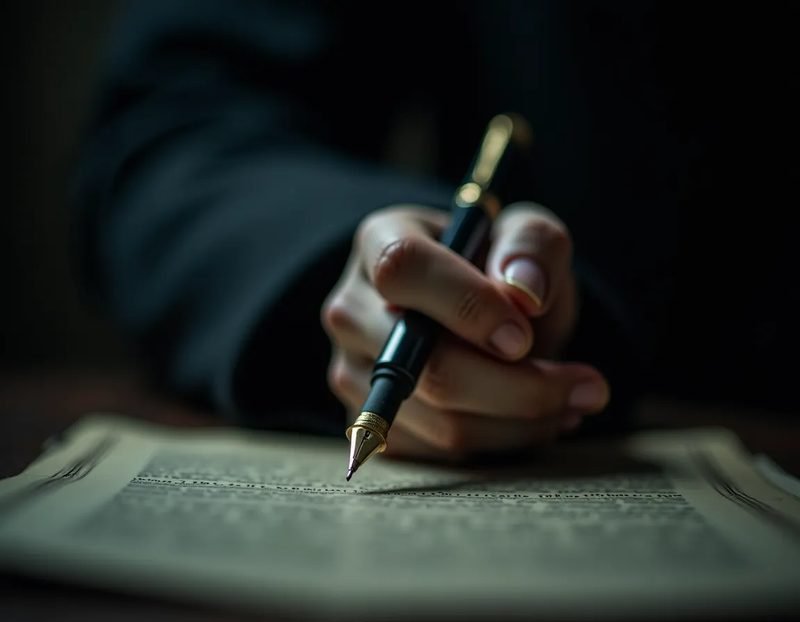
Here’s what most performers get wrong about automatic writing: they treat it as pure theater, a hidden gimmick with a story bolted on. It’s more interesting than that, and the honest version of the pitch is stronger for it.
The underlying phenomenon has a name. It’s called ideomotor response, first formally described by the physiologist William Benjamin Carpenter in 1852. His claim was simple and it has never been overturned, the body will sometimes execute small muscular movements in response to a thought or expectation, without the conscious mind registering the action as voluntary. It’s the same mechanism behind a dowsing rod, a Ouija planchette drifting toward a letter, and a pendulum swinging in the direction a person is quietly hoping it will swing.
The French chemist Michel-Eugène Chevreul had already documented the pendulum version of this back in 1833, and his explanation held up. Small, involuntary muscle contractions, invisible to the person making them, driven by expectation rather than deception.
Layer dissociation on top of that. A relaxed, trance-adjacent state narrows conscious attention and lets the ideomotor pathway run without editorial interference from the part of the brain that usually vetoes strange impulses. This is not hypnosis in the stage sense. It’s closer to the state you fall into driving a familiar route and arriving with no memory of the turns.
Put those two things together, a body that moves on its own and a mind quiet enough to let it, and you have a genuine psychological phenomenon that a trained performer can put to work honestly. The audience isn’t watching a lie. They’re watching a real human capability, aimed at a theatrical end.
Building the Instrument
The classic apparatus is the planchette, a small heart-shaped or teardrop board riding on three points, one of them a pencil. It rolls freely under light fingertip pressure, and its weight distribution matters more than most builders think. Too light and it skitters unpredictably. Too heavy and it resists the small involuntary pushes that make the whole effect believable in the first place.
For a working piece, I favor a board with two brass casters at the rear and the writing point set slightly forward of center, it gives the tool a natural pull toward the paper rather than away from it. The pencil should be soft, a 2B or softer, because a hard lead skips and breaks the illusion of fluid, unconscious motion.
If you’re building a straight automatic writing routine rather than a planchette piece, the pen itself is the prop. A slightly weighted fountain pen, heavier in the barrel than a modern ballpoint, changes how it moves across paper and reads as more deliberate, more antique, more serious. Paper choice matters too. A cheap legal pad kills the mood before you’ve said a word. Cream stock with a slight tooth to it holds ink the way older paper did, and that tactile difference registers with a room even if nobody in it could tell you why.
The Physical Technique
The technique underneath the presentation has two parts, and you need both.
First is the genuine skill of dissociative writing, which any performer can train. Sit with a pen resting on paper, breathe slowly, and let your hand rest without directing it. Most people, with practice, can produce loose scrawls, loops, and eventually legible fragments this way, especially if they’ve primed themselves beforehand with a specific word or phrase held loosely in mind. This isn’t fake. It’s a real, trainable ideomotor skill, and building it honestly gives your performance a foundation that doesn’t depend on props at all.
Second is the controlled version, where you guide the outcome toward a specific reveal, a name, a number, a phrase tied to your prediction. This is where craft replaces mysticism. You slow your breathing, soften your shoulders, let your eyes go unfocused. Your hand does move on its own, or close enough to it that no observer can tell the difference, and you’re steering with the barest fraction of conscious pressure required to land the content where you need it.
My hands go cold every time I run this live, even now. That reaction is real, it’s not performed, and I’ve stopped trying to suppress it because it reads as truth to the room.
Framing Language That Sells the Moment
The words you use before your hand ever touches the pen do half the work. Don’t announce “automatic writing” like a lecture title, it flattens the moment. Instead, slow the room down first.
Tell them what you’re not claiming. Something like: I don’t know what moves a hand when the mind steps back and lets it. I’ve never had proof of anything beyond the page in front of me. But I’ve watched my own hand produce words I did not consciously choose, more than once, and I no longer dismiss it as coincidence.
Then narrow the frame to something concrete and personal to the moment, a name only one person in the room would recognize, a date, an object someone is holding. Vague mysticism bores a modern audience. Specificity, even eerie specificity, is what keeps them leaning forward.
And let the ending stay unresolved. Don’t explain the mechanism to your audience, ever. The moment you rationalize it out loud, you’ve handed them permission to stop feeling it.
Bringing It Into a Modern Set
The trap most performers fall into with automatic writing is treating it as a costume piece, candles, lace, a fake Victorian accent. That reads as nostalgia, not danger, and a modern audience clocks it as theater within seconds.
Strip the aesthetic down instead. A plain notebook. A single pen. No séance table trappings unless your whole show already lives in that world. Let the psychological weight of the moment do what the props used to do. I’ve run a stripped-back version of this at private events around Louisville, no planchette at all, just a pen, a borrowed notebook, and silence held a beat too long before the hand starts moving. The reaction in the room has nothing to do with era. It’s about a person watching another person do something their own hand has never done.
That’s the real inheritance from the Spiritualist parlor, not the props, the permission to sit with something the rational mind can’t fully close the book on.
If this piece is calling to you, the tools for building it honestly, planchettes, weighted pens, aged stock notebooks, live in our shop. Browse the full collection at arcanerelics.com/shop.