
Nobody in your audience has ever heard the word “swami” used the way we use it. That’s the point. The gimmick takes its name from carnival mystics who wore rings loaded with a sliver of soft lead, scratching out messages while the mark watched their face instead of their hands. It’s one of the oldest working tools in mentalism, and it’s still sitting in the pockets of pros who never once mention it exists.
Born on the Midway, Built for the Stage
The swami gimmick didn’t come out of a magic factory. It came out of ten-in-one shows and mitt camps, where a “swami” needed to produce writing that looked like it arrived from somewhere other than his own hand. A thumb tip, a ring, sometimes just a folded strip of tin, loaded with a stub of soft lead or a chip of carbon. Cheap to build, brutal to detect if the presentation around it was solid.
Mentalists picked it up because the effect it enables, writing appearing on a blank surface with no pen in sight, does something a spoken prediction never quite manages. It leaves evidence. A spectator can hold the card. They can turn it over, run a thumb across the graphite, show it to the person next to them.
That’s a different kind of proof than “I felt you were thinking of the color blue.”
What’s Actually Inside the One You’re Wearing
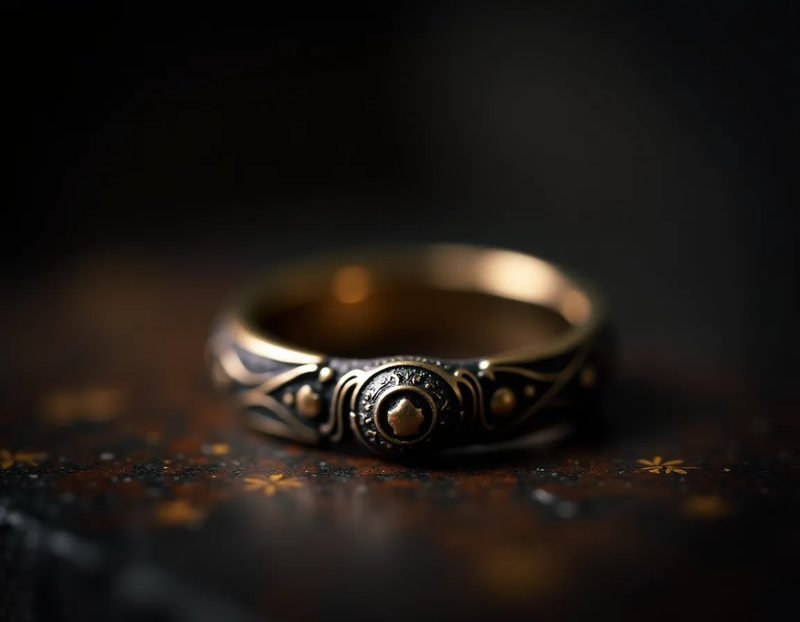
Strip away the mystery and it’s a small ring or thumb tip with a short length of soft material, usually a graphite or lead composite, mounted so it sits flush against your skin until you need it. Press the pad of your thumb or finger against paper at the right angle, and the tip transfers a mark. Release the pressure, and your hand looks empty again.
The construction sounds simple, it is simple, but simple isn’t the same as easy to build well. The angle of the mount, the hardness of the writing material, the way the metal sits against your finger without printing a ring-shaped tan line into your skin during a two hour gig, these are the details that separate a gimmick you forget you’re wearing from one you’re fighting with under a spotlight.
I’ve watched performers abandon nail writing entirely after one bad session with a stiff, oversized gimmick. That’s not the technique failing them. That’s the hardware.
The Difference Between Fooling a Volunteer and Fooling a Camera
Here’s what most write-ups on nail writing skip entirely. A volunteer standing eighteen inches from you, watching your eyes, your breathing, your patter, is a forgiving audience. Their attention is being managed by everything else you’re doing. A phone camera is not managed by anything. It doesn’t blink, it doesn’t get distracted by your voice, and it will happily zoom into sixty percent of frame on your writing hand if a livestreaming spectator decides that’s the interesting part of the shot.
This has changed what “fooled” means for anyone doing paid work now. A gimmick that reads as invisible to a live room can still get caught cold on a phone held at the wrong angle, and it will end up online.
The gimmicks that hold up under both conditions share a few traits. Low profile, so there’s no shadow or glint under harsh venue lighting. A tip that produces a clean mark on the first press, no second scratch, because a camera catches hesitation that a live eye reads as nothing at all. And material soft enough to write without visible pressure, since pressing hard enough to see white knuckles is the tell that gets clipped into a slow-motion “gotcha” video.
I test every gimmick I build or sell the same way. I write with it in front of a mirror first, then I write with it in front of a phone recording in slow motion. If it survives the second test, it goes in my kit.
Nail Writing Is Only Half the Job
Most performers meet the swami gimmick through nail writing and stop there, which is a shame, because the device earns its keep in billet work too. A folded piece of paper switched under cover of a pen tap, a duplication method for a “sealed prediction” that was never sealed with your actual answer inside, a last-second correction on a center tear when a spectator’s word doesn’t match what you loaded. The gimmick doesn’t care what the writing says or when it happens. It just needs your hand near paper for half a second.
That flexibility is why it survives as a working tool instead of getting replaced by something flashier. A thumb writer costs you almost nothing in setup, almost nothing in suspicion, and it goes back to being an ordinary hand the moment you’re done with it.
No wires. No electronics. No app pairing to a phone that might not connect right before your opening line.
Why Most of What’s on the Market Gets This Wrong
I’ve bought a lot of bad swami gimmicks over the years, before I started making my own. The usual failure is a ring that’s either too loose, so it rotates on your finger and puts the tip in the wrong spot exactly when you need it, or too tight, which means you’re aware of it the entire set and so is anyone shaking your hand beforehand. The second most common failure is a writing tip that’s too hard. Hard lead means visible pressure, visible pressure means a tell, and a tell in this business gets remembered even when nobody can name what they saw.
There’s also the matter of refill life. A gimmick that needs a new tip every third show isn’t a tool, it’s a chore, and working pros don’t have room in their week for chores that a better build would have solved once.
None of this is a knock on sleight of hand generally. It’s a knock on gimmicks made for the hobbyist market and sold to people doing paid work, where the standards aren’t the same and never should be.
Choosing Yours and Breaking It In
Fit comes first, before technique, before presentation, before anything. A gimmick sized wrong will undo good sleight of hand every time. Try it on, write with it cold for ten minutes, and pay attention to whether your hand still feels like your hand. If you’re thinking about the ring, your audience eventually will too.
After that, practice the release as much as the mark itself. The moment you lift pressure and your hand goes back to looking empty is the moment that actually sells the trick, not the writing. Most performers drill the writing and skip the release entirely, and it shows.
I build the swami gimmicks in my shop the way I wish someone had built the first one I ever bought, low profile, a tip that writes clean without a second pass, and a fit that disappears on your hand instead of announcing itself. If you’re doing nail writing or billet work for real audiences and real cameras, it’s worth using a tool built for that standard instead of one built for a magic-shop shelf.
Have a look at what’s currently in stock at Arcane Relics.