
A locket doesn’t have to be haunted to make a room go quiet. It only has to be opened at the right moment, by the right hands, with a small braid of someone’s actual hair inside. I don’t claim these objects hold anything. I do, however, have a firm conviction that they do something to a crowd that a prop built last Tuesday never will.
Why the Victorians Made Grief Wearable
After Prince Albert died in December 1861, Queen Victoria wore black for the rest of her life, and an entire empire followed her lead into a mourning economy with rules about fabric, duration, and jewelry. Jet from Whitby became the fashionable stone of sorrow. Hair, though, was the intimate material, the one thing that didn’t fade, rot, or lie.
The logic was simple and a little brutal. A portrait shows how someone looked. Hair is a piece of them. It was cut at the deathbed or after, sorted, and turned by a professional hairworker or a patient relative into brooches, rings, watch chains, and bracelets.
Some of it was sentimental. Some of it was industrial. Catalogs sold hairwork by the ounce, and there was a trade in “hair” that never came off the head of the beloved at all.
That last detail matters. Hold onto it.
The Objects Worth Hunting
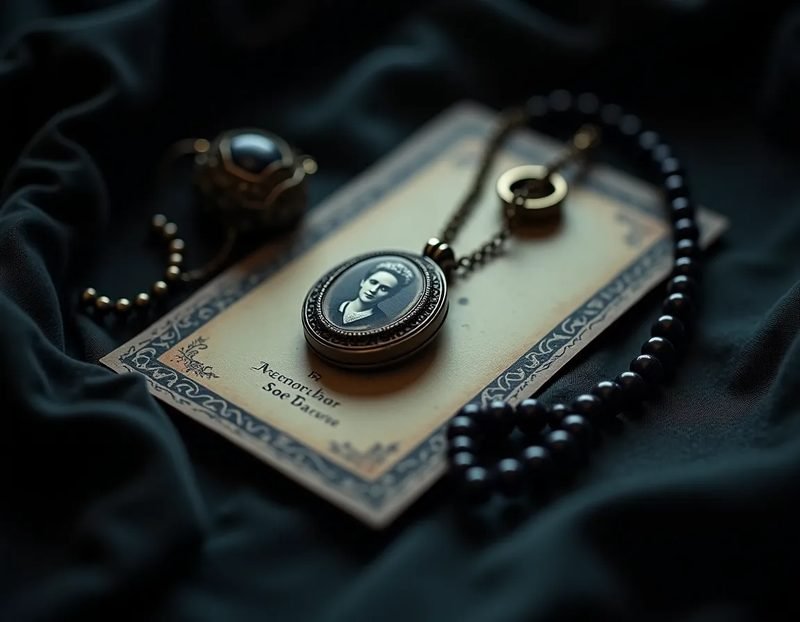
Not every piece is equal on stage or in a collection. Here’s what I’d chase, in rough order of storytelling power:
- Locket with hair compartment. Usually a glass-backed cavity behind or beside a portrait. The hair is often coiled, sometimes seed-pearl bordered. Openable, which is the whole point.
- Mourning rings. Black enamel bands, often engraved inside with initials, a death date, and an age. Older examples run back into the 1700s, and the inscriptions are gold for a performer.
- Woven hair brooches. Table-work and palette-work hair under a domed crystal. Beautiful, static, and best as a set-dressing piece.
- Memorial cards and funeral ephemera. Black-bordered, printed verses, a name and a date. Cheap, paper-light, and easy to handle repeatedly.
- Jet jewelry. Carved, faceted, warm to the touch in a way glass imitations never are.
Post-mortem photographs and cased images get the most attention online, and they’re also the most overpriced and the most ethically tangled. I’d rather you start with a ring.
Spotting Reproductions Before They Cost You
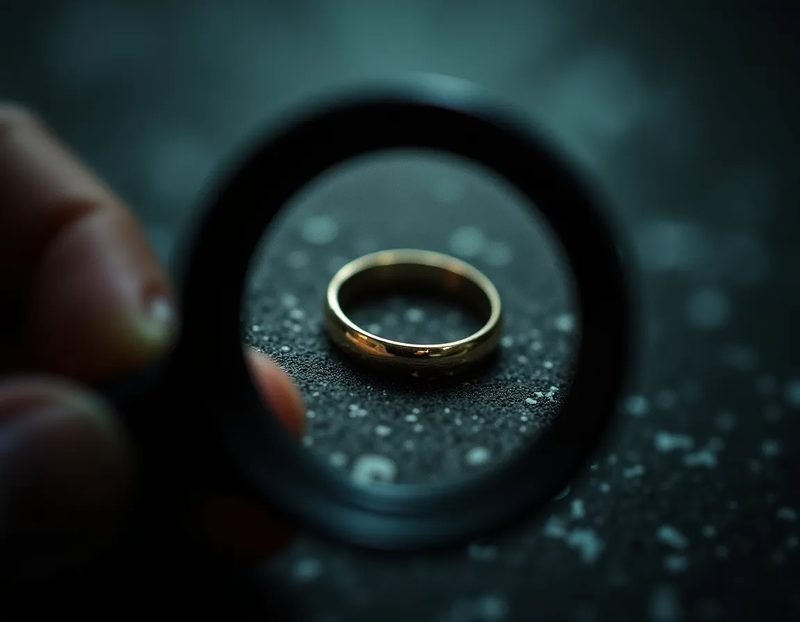
The market is crowded with fakes and “inspired by” pieces, and the tells are physical. Learn them.
- Weigh it. Real jet is light and slightly warm. Black glass, called French jet, is heavier and cold. Plastic is featherweight and often has a seam line you can find with a fingernail.
- Read the hair. Antique hairwork uses fine, uneven strands that have aged in color, with visible tension in the weave. Modern synthetic fiber is too uniform and has a faint sheen under a loupe.
- Check the backs. Old brooch pins have hand-cut catches and hinge wear. A crisp, machine-stamped pin on a “1860s” piece is a red flag.
- Look inside rings. Genuine engraving has slight irregularity, and the wear on a band sits where a finger actually pressed it. Laser-perfect script is modern.
- Distrust the story. A seller who gives you a full biography of “Eleanor, taken by fever” for a piece with no paper trail is selling fiction. Fine, if you know it.
And that hair I told you to remember? Ask if it’s real. Ask if it’s even human. A good dealer will tell you honestly, and a good performer can use either answer.
Let the Object Carry the Weight
Here’s where most performers go wrong. They buy a beautiful piece, set it on the table as decoration, and then run a standard routine around it. The object is wallpaper.
Flip that. If your effect works without the piece, the piece isn’t doing anything. Build it so the story cannot exist without the object in your hand.
I tried this at a private event in Anchorage with a plain black-enamel mourning ring and a sealed envelope. I didn’t announce a séance. I passed the ring to a woman near the front and asked her to read the inside of the band aloud. Initials, a date, an age of nineteen. Nothing else.
The room changed. My hands went still on the table, and I felt the quiet arrive before I understood it.
I hadn’t done anything yet.
That’s the lesson. A real inscription does the work of ten minutes of patter. Your job is to stay out of its way, then give it a reason to matter, a name that lands, an impression that matches, a revelation that feels like the object answered and you just listened.
Three Structures That Actually Work
You don’t need a new trick. You need a frame. These three work with almost any method you already own.
The Inscription Reading
Let a spectator discover the engraving themselves. Whatever you reveal afterward, a name, a date, a feeling, gets filtered through what they just read aloud. The lesson: the audience should touch the truth before you touch the mystery.
The Locket That Opens Twice
Load a small folded slip, a photograph, or a lock of hair, whatever your method calls for, so that the locket is opened once as a ritual and once as a payoff. The first opening establishes it as ordinary. The second is where the room stops breathing. Use your own gimmick or a hidden compartment, I won’t tell you which.
The Memorial Card as Billet
Funeral cards are the right size, the right tone, and the right kind of dull to handle without suspicion. Have someone write a name on the back, one they’ve lost, and don’t ask for more. It carries emotional weight that a blank business card never will, and it does so with a straight face.
A warning, though, and I mean it. Work with grief carefully. Someone in your audience has lost a person this year. Give them an exit, never push, and let the reveal comfort rather than pry. To be honest: the performers who forget this aren’t just tasteless, they’re bad at their job.
The Ethics of Handling Someone’s Hair
Real human hair from a real person who died is a strange thing to own, more so to perform with. Some collectors won’t touch it. Others treat it as history. I fall somewhere in the middle.
My rule: I will happily own and display it, and I’ll tell an audience what it is when they ask. I don’t invent a dead girl to make a piece scarier than it is. If the provenance is unknown, I say so. “I don’t know whose this was” is a stronger line than any fabricated name, and it leaves a gap the audience fills themselves…usually with something worse than I’d have written.
Handle pieces with clean, dry hands. Store hairwork away from light and humidity, in acid-free tissue, because the very thing that makes it valuable is fragile. And keep a written note of what you know and what you don’t. Future owners will thank you.
Start With One Piece
You don’t need a cabinet. You need one honest object with a real inscription, a modest budget, and the patience to learn what it does to a room. Buy the ring before the brooch. Read the band before you write the script.
The Victorians spent a century trying to keep the dead within arm’s reach. Your job is smaller, and stranger. Let a room feel, for ninety seconds, that they succeeded.
If you’re hunting for props that carry that kind of weight, you my friend, are home. Browse the collection at arcanerelics.com/shop.