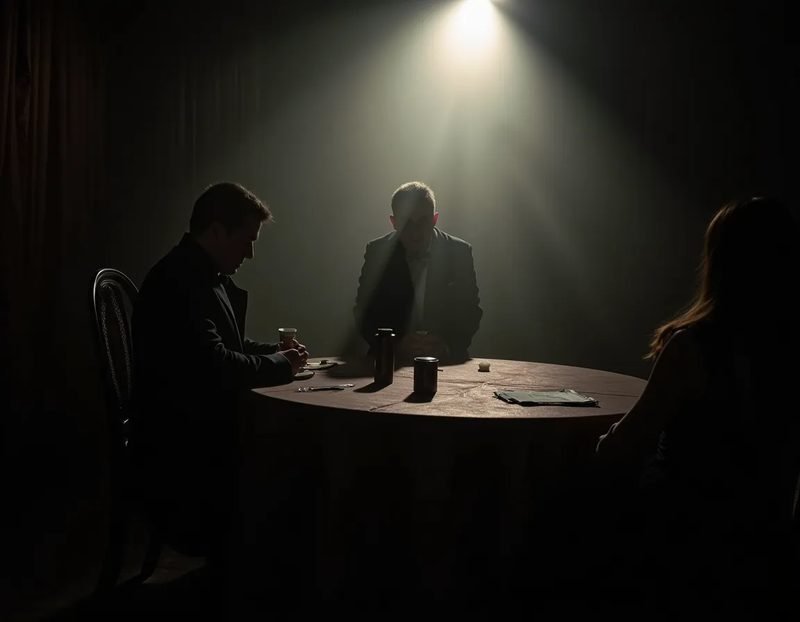
Part 3: The Promise You Didn’t Mean to Make — When the Persona Puts You in Ethical Situations You Never Planned For

Part 3: The Promise You Didn't Mean to Make — When the Persona Puts You in Ethical Situations You Never Planned For

The previous installment in this series, Part 2: The Mask That Makes Promises, made the case that your mentalism persona doesn’t just shape how you present, it shapes what audience members believe they’re entitled to receive from you. The character communicates access. It implies that certain truths might move through you that couldn’t move through anyone else in the room. People hear that before you open your mouth, and they act on it, sometimes weeks later, sometimes right after the bow. That’s where this piece begins. Not with the theory. With the room, and the moment when the contract your persona created is about to be called in.

The Moment Before You Understand What’s Happening

It doesn’t announce itself. Nobody walks up and says, “I need you to stand in for my grief therapist for the next twelve minutes.” What happens is quieter, and you miss it if you’re not paying attention to the register of the conversation.

A woman lingers while everyone else files out. She’s holding your business card with both hands. She says something like, “What you said about objects carrying memory. I have something I’ve been holding onto since my mother passed and I was wondering…”

You catch it at that ellipsis. My hands go still, and I mean that literally, I stop whatever I’m doing and give her my full attention, because I know the kind of moment I’ve just entered.

She isn’t curious about my methods. She’s looking for something that was apparently made plausible by the character I spent months building. A character that told a story about consciousness surviving matter and emotional residue persisting in physical objects.

I built a persona that made this conversation possible.

Now I’m in it.

Three Situations That Will Find You

three different performance environments, a parlor setting, a convention table, a private event, suggesting the range of

There are patterns to this. Performers working in bizarre and psychological territory encounter the same three situations with enough regularity that naming them directly is worth doing before we talk about navigation.

The Grief Seeker. Someone who has lost a person and is drawn to a performer whose character suggests knowledge beyond ordinary consciousness. They know, on some level, that you’re a mentalist doing a Thursday night show at the Riverside Hotel. But grief suspends the usual filters, it makes the unlikely feel worth trying, and your persona gave it a hook. They want to ask about the object. The photograph. Whether you sense anything.

The Anchor. Someone who attends multiple shows, joins your mailing list, sends messages that start professionally and drift personal. They’ve made you a kind of orientation point. Your character, the one who perceives what others miss and understands situations with uncommon clarity, has become someone they want near their own decision-making. This isn’t infatuation in the conventional sense. It’s something harder to name and, in some ways, harder to address.

The Confirmation Seeker. Someone facing a real decision, a relationship, a job offer, a family crisis, who wants your character to weigh in. Not theatrically. They want the persona to tell them what to do because they believe, based on what you showed them, that you perceive something they can’t.

None of these people are hostile. None of them are irrational, given the information you gave them. That’s precisely what makes all three difficult.

The Grief Seeker Requires Honesty First

I don’t believe I have access to information about the dead. I want to be direct about that, because everything that follows in this section depends on the clarity of that position. If you do believe it, your calculus here is different from mine, and some of this won’t apply to you.

For the rest of us: when a grieving person asks whether you sense anything from their mother’s ring, you’re at an ethical fork. One path is to perform something reassuring wrapped in the language of your character. The other is to find a way out that doesn’t humiliate them, doesn’t dismiss what they’ve shared, and doesn’t make a claim you can’t support.

Cold reading them is not an option. The asymmetry of the situation, they’re vulnerable, they came to you in good faith, they’ve told you something true, makes that a violation no performance context excuses. I want to be blunt about that.

What works, and I’ve used versions of this in more than one room, is an honest redirect that stays inside the character’s logic without making claims. Something like: “What I do in a show is different from what you’re describing. I wouldn’t want to take something that means this much to you and treat it like a demonstration.” That framing respects the person. It doesn’t break the persona, it deepens it, because a character with real integrity draws exactly that line. Then you listen. Let them talk about the object, about the person. That’s almost always what they needed.

The Anchor Problem Moves Slowly

The Anchor situation is slower and easier to miss. You notice it when you’re checking your inbox before a show and realize you’ve traded nineteen messages with the same person over four months. Nothing alarming in any one message. But the pattern tells you something is happening that isn’t about your show schedule.

The instinct is usually to keep being warm and gradually reduce responsiveness. That instinct is understandable, it’s also usually wrong. A slow withdrawal reads as rejection by degrees, it tends to escalate what you’re trying to de-escalate.

The cleaner move is a single, direct message that names the limit without naming the person’s behavior as a problem. Something that communicates: my public work is available to you, my personal attention is necessarily limited, I appreciate your engagement with what I do. You say it once, hold that line, and don’t elaborate further.

Your persona created this. The character’s apparent perceptiveness, its suggestion of knowledge others lack, made you look like exactly what someone in this state would seek out. That’s yours to manage, not theirs to understand.

A Framework for the Live Moment

When the situation arrives in real time, you don’t have long. Here’s the framework I use, reduced to its working parts.

  1. Name the register first. Is this person operating in performance mode or genuine need? The tell is usually the shift from curiosity to confession. Someone asking about your methods is curious. Someone telling you about their sister is somewhere else entirely.
  2. Decide whether the character can help honestly. Sometimes the persona has an answer available that’s true. More often, the honest answer requires stepping partly outside it. You can do that without a full character break if you do it deliberately.
  3. Don’t perform comfort you don’t mean. A vague, reassuring non-answer is worse than a clear, warm redirect. People in real distress can read the gap between a genuine response and a performed one. They came to you because they believed your character perceived things. Don’t prove them wrong in the moment that matters most.
  4. End with something real. A referral. A limit stated plainly. A next step that’s genuinely available. Leaving someone suspended between “the performer listened” and “I don’t know what just happened” is a harm, even a mild one.

None of this is fast. That’s the point. Handling these moments well takes longer than the show, and factoring that into how you design the persona from the start is what this whole series has been arguing for.

The Character You’re Responsible For

The persona isn’t the problem. The problem is building a character without deciding in advance what it stands for when it’s pressed.

A mentalism character that makes claims it won’t honor in the hard moments is a liability to everyone who encounters it. A character with a coherent ethical core, one that knows its own limits and says so plainly when it has to, is something rarer. It’s also more convincing. Real authority knows its own edges.

So does the best mentalism.

The woman who pressed me in that lobby wasn’t wrong to believe my character might have something to offer her. She was working from the information I gave her. What I owed her, and what you owe everyone who responds to your persona in earnest, is a character whose promises you’ve thought through before you walk into the room.

That’s the whole game, honestly. Not building the persona. Building the person behind it who can handle what the persona invites.

If you’re looking for the props and presentation tools that help you build performance work serious enough to carry that weight, you’ll find what we carry at the Arcane Relics shop.

The Ethics of Belief: Simulation, Responsibility, and Where the Line Actually Is

The Ethics of Belief: Simulation, Responsibility, and Where the Line Actually Is

I don’t claim to be psychic. I want to be clear about that up front. But I’ve watched people leave a performance room with something altered in them, something I put there deliberately, and I’ve had to sit with what that means. Not abstractly. Specifically. The woman who pulled me aside after a show to ask, quietly, if her mother was really still with her. The man who couldn’t look me in the eye. The teenager who started crying before I’d even finished.

The field of mentalism has mostly avoided talking about this directly. Bizarre magic talks about it in circles, usually while patting itself on the back for being “theatrical” and “artistic,” as though the label exonerates everyone operating underneath it.

It doesn’t.

The Contract Nobody Reads Aloud

Every performance operates on an implicit agreement. The audience agrees, at some level, to be entertained. The performer agrees, at some level, not to actually harm them. What almost nobody negotiates explicitly is the middle territory, the zone where a spectator genuinely isn’t sure whether what they witnessed was artifice or something else entirely.

Stage magic solved this problem generations ago by making impossibility so flagrant that literal belief is the only irrational response. Nobody walks out of a large-scale illusion show thinking the assistant was actually bisected. The sheer scale of the impossible protects the audience.

Mentalism doesn’t have that protection. Everything a skilled mentalist appears to do is, in theory, humanly possible. A person could read microexpressions that well. A person could have trained their observational faculties to that degree. A person could be perceptive enough to infer what you’re thinking without asking you directly. The veil between “incredible skill” and “something I can’t explain” is thin in this work. Sometimes it’s invisible.

Bizarre magic deliberately tears that veil. That’s the genre. You’re not presenting feats of mental skill. You’re presenting encounters. And encounters leave marks.

Why the Standard Defense Doesn’t Fully Hold

antique séance table set with candles and mysterious objects, period atmospheric photograph

The standard bizarre magic defense goes something like this: it’s theatrical. We frame it as folklore, as story, as ritual metaphor. Nobody really thinks we’re communicating with the dead.

I accepted this for years. I was wrong to accept it so easily.

The theatrical frame is real, and it does important work. When Eugene Burger performed, he understood that ritual and atmosphere created a shared artistic experience, something closer to theater than to fraud, and most of his audiences understood that too, on some operative level. The “gathering” frame signals to participants that they’ve entered a different kind of space, where different rules of interpretation apply.

But here’s what I’ve observed across twenty years of doing this: the theatrical frame is not equally available to every person in the room. Some people, a percentage you can’t predict from the outside, don’t fully receive it. They came to be entertained and found themselves genuinely disturbed. Or genuinely convinced. Or genuinely moved in a way that didn’t dissolve when they walked out into the parking lot. Their source monitoring, the cognitive system that tags experiences as real or imagined, filed the experience wrong.

This isn’t their failure. It’s a predictable consequence of what we do.

What’s Actually Happening in the Spectator’s Brain

Source monitoring errors are well-documented in cognitive psychology. The brain doesn’t store experiences with clean metadata about their origin. It stores emotional impressions, sensory fragments, narrative threads. Later, when you try to recall an event, you’re reconstructing it. Reconstruction is susceptible to contamination from what happened afterward, from what you felt in the moment, from the story you told yourself on the drive home.

A mentalist who builds genuine emotional resonance into a reading, who connects an apparently impossible revelation to something personally meaningful, isn’t just impressing the spectator. They’re doing something to the spectator’s memory architecture. The emotional weight of the experience makes it feel more real in retrospect, not less. Hindsight compounds this: if someone comes away thinking “how could he have known that,” they tend to underweight the alternatives and overweight the inexplicable. The mind reaches for the most satisfying narrative, and “I witnessed something genuinely unexplainable” is often more satisfying than “a skilled performer used observational technique and misdirection.”

We know this. Any performer who’s read the psychological literature knows this. The honest question is what we owe the people sitting across from us, knowing it.

Not weaker work. That’s not what I’m arguing for.

The Spectrum, Honestly Described

Most conversations about ethics in this field stay deliberately vague because nobody wants to draw a map that might put themselves on the wrong side of a line. Here’s the map anyway.

  • Clear theatrical frame, impossible or overtly stylized premise. You’re playing a character. The setting is unmistakably theatrical. Anyone paying attention understands they’re watching performance art. The midnight séance at a magic convention sits here. Risk of sincere induced belief is low.
  • Ambiguous frame, plausible premise. You’re performing as yourself, or a lightly fictionalized version of yourself. The abilities you appear to demonstrate are within the range of human possibility. The setting feels intimate rather than theatrical. Most working mentalists operate here most of the time.
  • Sincere deception. You’re actively claiming real abilities you don’t have, to people who have no reason to suspect performance. This is where psychic frauds operate. Nobody reading this should be anywhere near this territory.

The problem is category two. That’s where most of us live. And most of us have never clearly articulated to ourselves what we actually owe an audience when we’re working in that ambiguous, powerful, genuinely dangerous middle space.

Where the Line Actually Is

I don’t think there’s one universal answer that applies to every performer in every context. I do have a position, and I’ll give it plainly.

The line is not about whether you induce genuine belief. In the ambiguous middle, inducing a kind of suspended uncertainty is the whole point of the work. Inducing it without awareness of what you’re doing, or without any considered sense of what happens if the effect lands harder than intended, that’s where the ethical failure lives.

Tony Andruzzi understood something the broader mentalism community still hasn’t fully absorbed: the performance doesn’t end when the effect ends. The way you exit the frame matters. The way you bring someone back from wherever you’ve taken them, that’s not housekeeping. It’s the work. It might be the most important part of the work. And most performers have no protocol for it at all.

My spine chills a little when I see someone induce what looks like genuine terror in a spectator and then just…move on. No landing. No reset. No moment of actual human contact after the effect. That’s not artistic confidence. That’s an ethical failure wearing confidence as a disguise.

What This Looks Like in Practice

I can’t tell you what your ethic should look like. But I can tell you what mine actually looks like, and you can take whatever’s useful.

I read the room before I read anyone in it. A corporate event for skeptical professionals is a different ethical context than a spiritualist circle where someone brought their recently widowed mother. The population in the room changes what any given effect will do. Performing the same material in both contexts without adjustment isn’t artistic integrity. It’s laziness.

I build exit ramps into performances where the material is working at the intense end of the spectrum. Not disclaimers. Disclaimers break atmosphere and insult the work. Something more like a tonal landing, a grounding gesture, a way of signaling without announcing that we’ve traveled somewhere real together and are now returning.

I pay attention after performances. My mouth dries when I see someone standing alone in a corner after a show, clearly still processing. That person needs a moment of genuine human contact. Not another effect, not a business card, not to be left alone with whatever I put in their head. This isn’t optional. It’s part of the job.

And I’m honest with myself about the times I’ve gotten it wrong, because there have been times. The reading that went somewhere I didn’t anticipate and I didn’t handle the landing. The effect that hit someone who clearly wasn’t in a stable place. You accumulate these over a career. They’re part of what it means to do this work with any seriousness over time.

We’re not psychics. We’re something more interesting and more responsible than that. We understand, at a working level, how belief forms and how to shape it. That’s not a trivial capability. The only honest response to a serious capability is a serious ethic.

If this is the territory you work in, start with the performers who thought hardest about these questions. Read what Burger wrote on bizarre magic philosophy. Study what Andruzzi actually said about the performer’s relationship to the audience. Then come find the tools that match the practice you’re building, at Arcane Relics.

The tools matter. The framework you bring to them matters more.