The Second Skin Problem: Building a Mentalism Persona That Survives the Long Set

The Second Skin Problem: Building a Mentalism Persona That Survives the Long Set

I’m not going to tell you persona is everything. That’s a workshop line, and workshop lines are where real thinking goes to die. What I will tell you is that every mentalism persona that has held up under pressure, under real sustained scrutiny, under an audience that spent $150 a head and is ready to be bored, has one thing in common. It was built around something true. Not invented. Found. That’s the uncomfortable part, and it’s the part that almost nobody talks about in the persona conversation, because it’s harder than picking a color palette.

The Marketing Trap

Most of what gets written about mentalism persona is marketing advice wearing a philosophy costume. Pick a name. Decide if you’re mysterious or approachable. Choose whether you lean into the science framing or the spiritual one. This is useful the way picking a logo font is useful. It addresses the surface, not the load-bearing structure underneath.

The structural question is different. It’s not “how do you present yourself?” It’s “how do you create something that can carry the weight of genuinely inexplicable events without cracking under inspection?” Because here’s what’s actually true about mentalism that differs from most performance disciplines: the audience isn’t just watching for skill. They’re watching for a reason. They want a framework that makes the impossible containable. Not comfortable, necessarily. Containable.

A good persona provides that container. A thin one collapses at exactly the moment it matters most.

What a Persona Actually Does

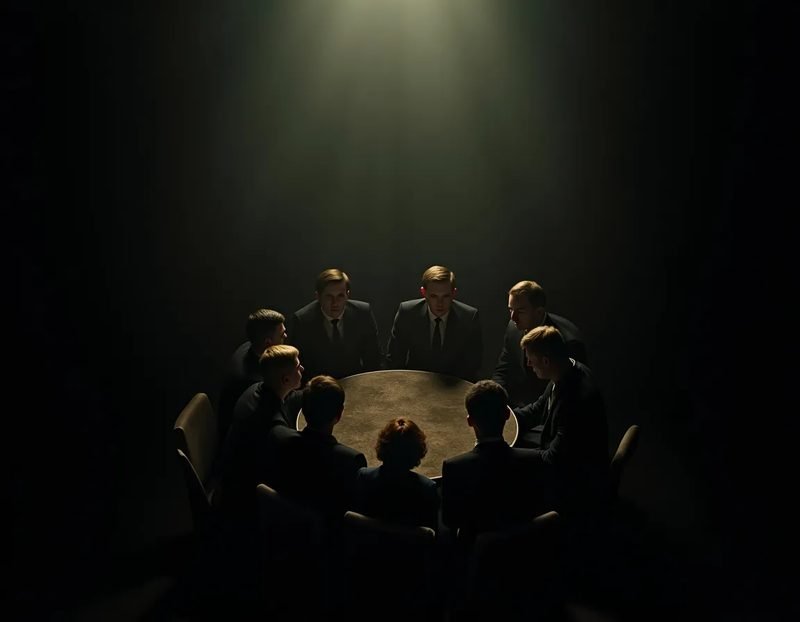
Close-up of a performer's hands resting on a table beside a worn leather notebook, dim light

I’ve watched performers with tremendous technical ability lose a room during a particularly strong effect. Not because the effect failed. Because they had nothing to hold it. The revelation landed, the audience went quiet, and the performer had no character architecture to give it meaning. The moment just sat there. Then it passed.

A mentalism persona isn’t decoration. It’s a load-bearing wall.

What it bears, specifically, is the audience’s need to interpret what they just saw. If you’re playing the scientist, their brain files the impossibility under “some kind of advanced psychology we don’t understand yet.” If you’re playing the spiritualist, it goes into a different folder. If you’re performing as yourself at your most distilled and specific, it goes somewhere harder to categorize, and that is usually the most powerful position to be in. But only if you built that version of yourself with real attention to what’s actually there.

The persona tells the audience how to feel. Not what to think. How to feel. That’s a different mechanism, and it operates before conscious analysis ever kicks in.

The Psychology You’re Already Using

Here’s something I’ve noticed after years of performing and years of watching other performers. The ones who say “I don’t have a persona, I just perform as myself” usually have a persona. It’s just unexamined.

That’s not a criticism. It’s an observation about how identity actually works under performance pressure. When you walk into a paid performance, you edit yourself. Everyone does, it happens before you’re even aware of it. The question is whether you’re doing the editing consciously or by accident.

Conscious persona construction starts with inventory, not invention. What do you actually believe about the nature of human attention? What’s your genuine relationship to the unknown? I’m a skeptic. I’ve said it in print, said it onstage. But I’m also a collector of things that have no comfortable explanation, a man who has sat across from people and known things about them that I had no legitimate way of knowing. The skepticism is real. So is the part of me that keeps getting pulled back toward the edges of what can be explained.

That tension is a persona. I didn’t invent it. I found it in myself, then I turned the volume up.

If you build a character entirely out of borrowed aesthetics, the audience will feel the seams eventually. Not because they’re analytically sophisticated. Because humans are unconsciously very good at detecting artifice, they may not be able to name what’s off, but they feel it somewhere around the second act, and once they feel it the room gets harder to hold.

Where Personas Actually Break

The most common failure I see isn’t a persona that was poorly designed. It’s a persona designed for highlights, not duration.

A lot of mentalism persona gets built around peak moments. The impossible revelation. The moment where the whole room goes quiet and someone’s hand comes up to their mouth. The persona, such as it is, gets constructed to serve those moments. And it looks fine in a six-minute video. It falls apart in a forty-minute set.

Here’s why. In a long set, there is downtime. There is patter. There are the three minutes between effects where you’re resetting and keeping the room engaged on nothing but your presence and your mouth. The persona has to survive those three minutes. And those three minutes, particularly the ones right after a strong effect when half the audience is still processing and the other half has glanced at their phone, are harder than the effect itself.

A persona designed around peaks has nothing for the valleys. So the performer contracts. Goes a little flat. Waits to get back to the strong material. The audience feels the gap, the continuity breaks, and once the continuity breaks even the peaks feel smaller than they should.

This is specifically a structural problem. It has a structural fix.

Building for Duration

Build your persona from a point of view, not from a set of behaviors. Behaviors are what you do. Point of view is why you do it. When you have a genuine point of view driving the character, you can inhabit the valleys because the character has something to think about, something to notice, something to be wary or curious or quietly amused by in any situation that comes up.

Nevil Maskelyne had a point of view. He believed exposure of fraudulent mediums was morally serious work, and that orientation shaped every moment onstage, not just the reveals. Theodore Annemann had a point of view that was darker, more obsessive, rooted in something that looked like genuine preoccupation with consciousness and what lies past the edge of it. You can feel it in his writing. It isn’t performance theory. It’s a disposition toward the world.

Neither of those are personas in the marketing sense. They’re orientations toward existence that happened to be expressed through magic performance.

Your point of view doesn’t have to be grandiose. It doesn’t have to be philosophically elaborate. It has to be specific and it has to be real. “I’ve spent twenty years being surprised by what people carry around without knowing it” is a point of view. “I’m interested in the places where belief and verifiable fact live uncomfortably close together” is a point of view. Both of those can hold a forty-minute set, because they’re orientations, not aesthetics. Build outward from that. What does someone with that orientation notice when they walk into a room? What do they find funny that other people don’t? What are they endlessly patient about, and what do they have absolutely no patience for? Answer those questions honestly and you stop thinking about persona in the moment. The character shows up because it’s already there.

The One Quality That Sustains It

The personas that last, the ones that genuinely become a second skin rather than a costume, share one quality. The performer doesn’t have to switch into them. There’s no moment backstage where you put the character on. You just turn a certain part of yourself up to the appropriate volume for the room you’re in.

That takes time to build. It takes performing in enough different conditions, for enough different audiences, in enough different rooms, that the gap between the person who drove to the gig and the person who walks out to perform slowly closes. The gap closes when the character is true enough that the only difference between onstage and offstage is volume.

If you’re still feeling that gap, it’s not a failure of performance technique. It’s feedback about where your persona still isn’t rooted in something real. Follow that feedback back to its source and find what’s actually there. Something is always there. That’s where the second skin is hiding, it’s been waiting for you to look directly at it.

The material you perform with and the props you surround yourself with can do real work in anchoring a character. They give it texture, specificity, credibility. They make a performer’s orientation toward the inexplicable feel inhabited rather than merely claimed. If you’re looking for effects and objects that support a serious, substantive mentalism practice, the Arcane Relics shop is where we keep what we consider the most intentional selection available.

Continue reading: Part 2: The Mask That Makes Promises — How Your Mentalism Persona Sets Ethical Constraints You Cannot Ignore

Reading Cold in a Warm Room: Why Some Venues Kill Mentalism Before It Starts

Reading Cold in a Warm Room: Why Some Venues Kill Mentalism Before It Starts

The room beats you to it, every time. You haven’t spoken yet, your props are still packed, and the audience has already decided how much to trust you. Quietly. In the forty seconds between sitting down and watching you walk out. That’s not paranoia. It’s venue acoustics, ambient lighting, and chair placement doing their slow, sinister work while you’re still checking your pockets backstage. Most performers spend their energy thinking about the effect they’ll open with. The better question is what the room has already opened with.

When the Room Talks First

Dead rooms and live rooms do opposite things to a mentalist, and both will ruin your work if you don’t know which one you’re in.

A carpeted corporate banquet hall with low ceilings swallows your silences. That pause after a revelation, the one you’ve rehearsed until it lands at exactly four seconds, drops like a stone into cotton. Nothing returns. The audience fills the gap with a cough, a whisper, a shift in the chair. You lose the effect not because your technique failed but because the room ate the silence you needed it to hold.

A live room, bare floors and high ceilings and hard walls, bounces sound in ways that feel uncontrolled. Your whisper carries. A restless audience’s murmur carries more. You can lose authority in both situations, and the two experiences feel nothing alike.

What you’re managing is reverberation time. Theatres are typically designed for an RT60 between 1.2 and 1.8 seconds, the time it takes for a sound to decay by 60 decibels. Most corporate event spaces were designed for nobody in particular. Their acoustics reflect that indifference.

Learn to read a room before anyone’s in it. Clap once, hard, and count the decay. In a live room the slap comes back at you clearly. In a dead room you’ll barely hear your own hand. Both require different adjustments, and knowing which you’re walking into, before a single spectator sits down, is worth the ten minutes it takes to figure out.

Where Lighting Sends Attention

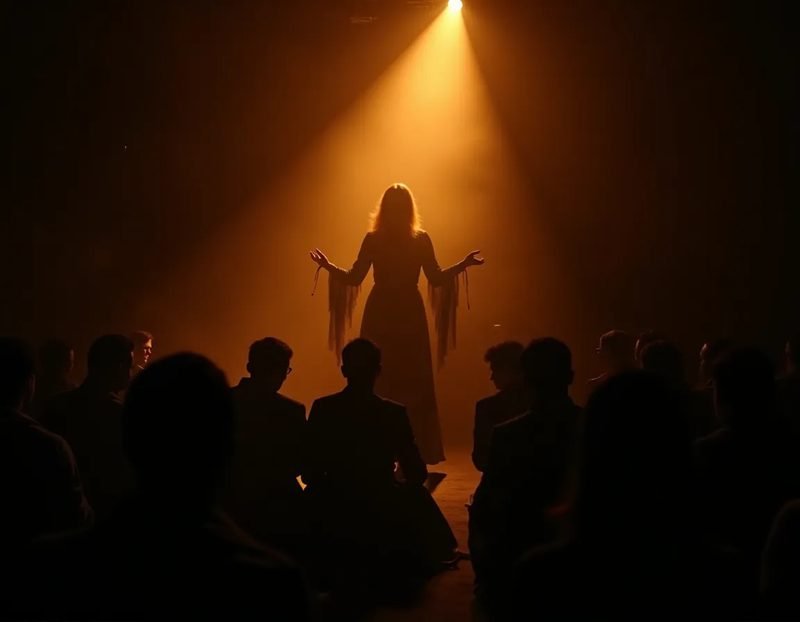
performer lit by a single warm spotlight with audience in soft low ambient light, strong contrast between stage and room

This is the part most performers get wrong.

They think about whether they can be seen. They should be thinking about what else can be seen.

A well-lit audience is a distracted audience. When house lights sit at 80%, every face in the room competes for attention with yours. People look around. They read the social temperature of the space, checking whether it’s acceptable to be moved by what they’re watching. That social triangulation is quietly chilling. A spectator who feels observed by their peers is a spectator who guards their reactions, sometimes quite deliberately.

I walked into a conservatory event once where the client had kept every overhead on full. My breath caught the moment I came through the door. The room felt like an operating theatre, there was nowhere for mystery to breathe. I knew within thirty seconds that I’d be working three times as hard for half the payoff that same material would earn in a properly-lit space. I was right.

Darkness is not your enemy. Directed light is your friend. A single warm fixture over your performing area, house lights dropped to 40%, is worth three additional effects in terms of audience commitment. It gives people permission to disappear into the experience without feeling watched by the person at the next table.

When you can’t control the lighting, at least know what you’re dealing with. Stand at your performing position during setup. Note where the light falls and where it doesn’t. Then build your running order around those fixed facts rather than pretending they don’t exist.

Seating Layouts and Who’s Already Checked Out

Cabaret seating. Theatre-style rows. Banquet rounds. Each creates a different psychological landscape, and each demands a different approach.

Theatre-style rows look ideal at first glance. Everyone faces front. But rows create anonymity, the spectator in row six, seat twelve is not a volunteer, she’s one face among forty-three. The emotional distance between you and her is as real as the physical one. Stand-up mentalism played to deep rows has to work considerably harder to manufacture intimacy than it ever should have to.

Banquet rounds are the most treacherous configuration in existence. At a table of eight, at least two people are facing away from you. Those two will disengage within five minutes. A disengaged spectator in a mentalism show doesn’t just sit quietly. They whisper to the person beside them. They rationalise your effects out loud. They open a quiet, dreadful hole in the room’s belief that spreads faster than anything you can patch from the front.

If you have any pull with the organiser, push for a horseshoe or a cabaret arrangement. If the tables are fixed, move yourself instead. Work the room rather than a fixed stage position, and find the turned-away spectators in your first ninety seconds. Get them looking at you directly before they’ve decided they don’t need to.

Cabaret seating, two or three to a small table angled toward the performance area, is genuinely the best configuration for close-up-adjacent mentalism. The proximity is intimate without feeling cornered, everyone can see you without contorting themselves into uncomfortable angles for forty-five minutes. So yes, push for cabaret if you can get it.

The Psychological Temperature of a Space

I don’t believe in vibes. I believe in causes.

When a room feels wrong before you start, something physical is producing that feeling. The space might be too large for the crowd, leaving cold dead air on all sides of a thin cluster of tables. Ambient noise from a kitchen might be setting the sonic baseline too high for any silence to register as meaningful. The chairs might be uncomfortable and the audience has been sitting in them for ninety minutes before you walk out.

Every one of these has a workaround.

A too-large room contracts around an audience if you move everyone to one end. Ask the event coordinator and frame it as a technical requirement. Most will accommodate you. Cold rooms, and I mean this literally, produce physically guarded postures. Crossed arms. Hunched shoulders. A room of people bracing against the temperature is a room of people who are not open to suggestion, and no prop or technique compensates for that. If the HVAC is losing the fight, layer your opening with energy and movement rather than stillness and silence. Get blood moving before you ask for quiet attention.

Ambient noise is trickier. A kitchen door that bangs every four minutes will interrupt your concentration at least once during something critical. Know this going in. Every venue has a rhythm, learn it before the event, and your show runs with that rhythm rather than against it.

The Pre-Show Audit

Get there early. This isn’t advice. It’s a requirement.

Walk the room alone. Clap in the corners. Sit in the seat that seems hardest to play to. Stand at your performing position and look at where the light falls, where the exits are, where the kitchen service door sits relative to your most delicate effects. Think about what this room will feel like in three hours, warm with fifty bodies and half a bottle of wine per table.

Then make two lists:

  • What you can change — lighting levels, chair positions, speaker placement, whether someone moves a table two feet to the left. Handle these before anyone arrives.
  • What you cannot change — low ceilings, a reflective back wall, a structural pillar between your performing position and twenty percent of the room. These are your constraints now. Build around them.

A performer who ignores a room’s fixed geometry is performing against the room. The room will win, it always does.

The most unnerving shows I’ve had weren’t technical disasters. They were beautiful venues with bad sight lines. Intimate events in rooms that hummed with fluorescent light and carried that peculiar, haunting pressure a low dropped ceiling creates when you’re trying to make someone believe something. You learn to recognise these rooms after enough of them. You start to appreciate them, not because they’re easy, but because you’ve prepared for exactly what they’re going to do to you and to your audience.

That preparation is the work nobody in the audience ever sees. It’s also the work that makes everything they do see feel inevitable rather than lucky. And that, honestly, is the whole game.

If you’re performing at this level and want props and effects built for performers who think this way, browse the Arcane Relics shop.