The Architecture of Dread: Building Atmospheric Tension Before a Single Word Is Spoken

The Architecture of Dread: Building Atmospheric Tension Before a Single Word Is Spoken

Why the Room Does Half the Work

Most performers walk into a venue and start thinking about their opening line. The serious ones arrive two hours early and start thinking about the air.

Atmospheric work is not decoration. It is not mood-setting in the theatrical sense, where lighting and set dressing support a story already written. In bizarre magic and mentalism, the atmosphere is the first act. By the time you speak your opening sentence, the audience should already be unsettled. They should not be able to explain why.

This is a learnable skill, repeatable, and entirely separate from your scripted material. What follows is a working framework for building genuine psychological tension before a single word of performance has been delivered.

Light as an Instrument, Not a Fixture

Light as an Instrument, Not a Fixture

Stage lighting is designed to make performers visible. Séance lighting is designed to make everything else uncertain.

The distinction matters. If your venue has a dimmer board, resist the temptation to simply lower the house lights to “atmospheric.” That produces darkness, not dread. Dread comes from selectivity: what is lit, what is shadowed, and where the eye keeps returning without finding resolution.

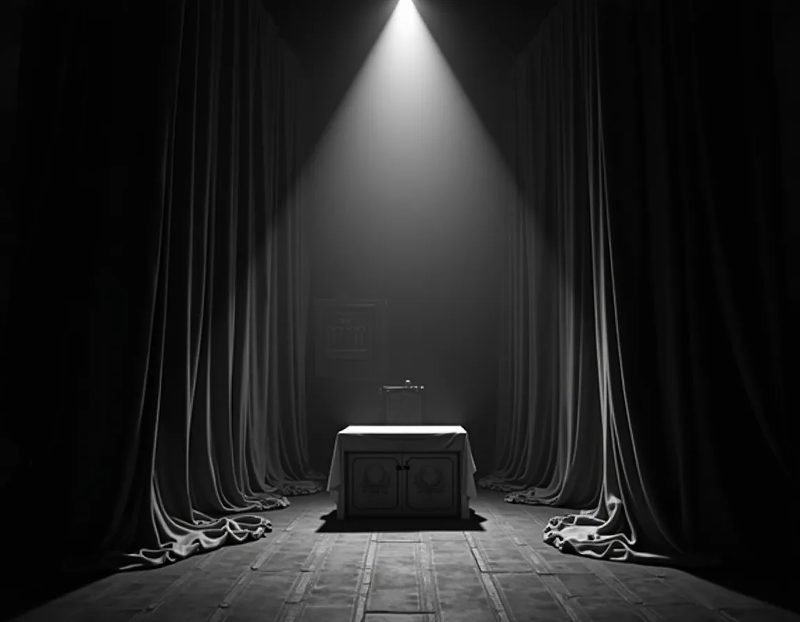
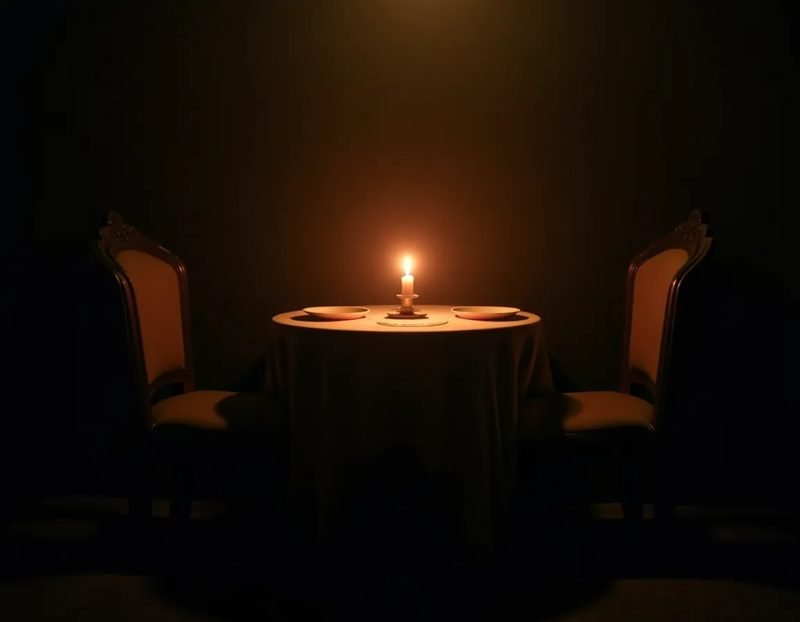
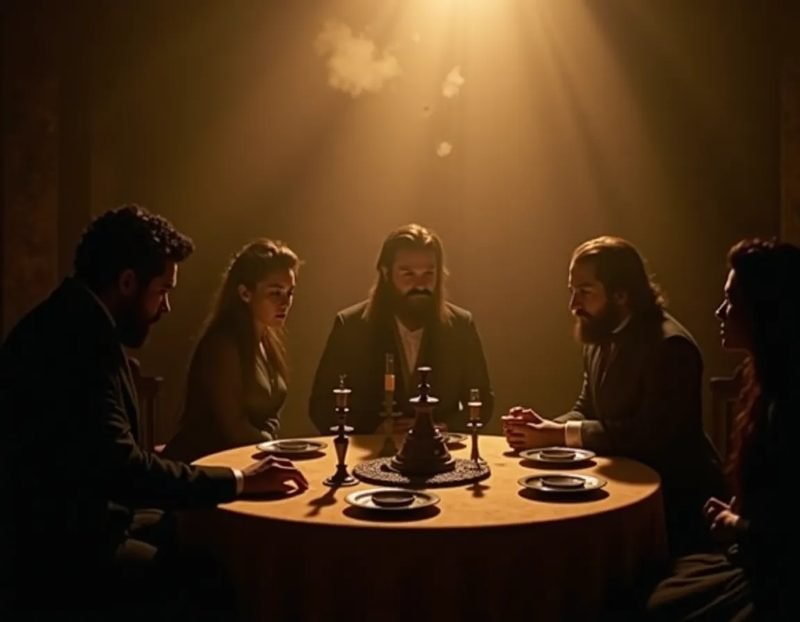
Practical light sources do this better than theatrical instruments in most intimate settings. A single oil lamp on a side table. A pair of candles at the far end of the room, positioned just beyond comfortable focus. One directional source that illuminates a prop without fully explaining it. The audience brain fills gaps. You want it busy filling gaps before you have said anything.

Color temperature matters more than most performers account for. Warm amber sources, around 2000-2200K, consistent with candlelight, read as old. They pull the room out of the present tense. Cool sources feel clinical; they work against you in a séance context unless you are deliberately building a paranormal investigation aesthetic. Know which world you are constructing before you choose your sources.

One practical note: never let all sources sit at eye level or below. A small upward-facing light placed behind an object casts its shadow onto the ceiling and walls. Shadows that move upward register as wrong. Use that.

Ambient Sound and the Grammar of Silence

Sound design for bizarre magic divides into two categories: what you play, and what you do not.

On the ambient side, the common mistake is choosing tracks that read as obviously “spooky.” Drone music, minor-key string clusters, anything that signals horror film. Genre signals safety. Safety is the opposite of what you want.

The more effective approach uses sound that is almost right. A field recording with one element that does not belong. A piece of early 20th-century phonograph music played slightly below normal speed. The sound of a building at night, with one creak that does not repeat on a predictable interval. The brain cannot habituate to irregular stimuli. It stays alert.

Volume is critical. The level should sit just below conversational speech. Guests will unconsciously lower their own voices to match. Quieter voices produce quieter bodies. Quieter bodies are more receptive, more focused, and significantly easier to direct.

On silence: learn to use it before you enter the room. If you have any control over the pre-show environment, build in a period of complete quiet before your arrival. Two minutes of ambient sound, then it stops. Then you enter. The contrast between ambient noise and silence reads as the approach of something. You become the thing that arrives after the sound stops.

The Grammar of Objects: Prop Placement Before the Show

The Grammar of Objects: Prop Placement Before the Show

Every object visible in your performance space before the show starts is making an argument. The argument is: something is going to happen here.

Prop placement is not prop display. Display arranges things to look good. Placement arranges things to create questions. There is a significant difference.

Consider the single, face-down playing card on an otherwise clear table. No deck in sight. No explanation. It was there when guests arrived. The card may mean nothing in the performance, and it does not matter. Its job was to put the question in the room.

Objects work best when placed at the edges of comfortable attention. Not centerpiece placement, not hidden; somewhere between. A pocket watch beside a chair nobody sits in. A closed book spine-out on a shelf, with a slip of paper protruding from its pages. A single glove. These items function as visual subordinate clauses. They suggest that a sentence is coming.

Avoid clutter. Three or four deliberate objects accomplish more than a full table of props. The brain treats abundance as decoration. Scarcity creates attention.

Asymmetry is your ally. Symmetrical arrangements read as controlled and designed, which is comforting. Slight asymmetry, the object that is almost but not quite aligned with its neighbors, reads as something interrupted. Something arranged by someone who was then called away.

The Pre-Show Encounter: Misdirection Before You Begin

If you have access to your audience before the formal performance begins, you have the most powerful pre-show tool available: live contact.

This does not mean performing. It does not mean doing effects in the lobby. It means controlled encounter design that plants material and primes psychology without being identifiable as performance.

The simplest version: you are present in the space as guests arrive, apparently occupied with something else. Examining an object, making a note, consulting a document. You do not immediately acknowledge the room. When you do make contact, it is brief. You learn one thing about one person, a name, a detail they volunteer, and you move on. That detail may or may not reappear in the performance. It does not matter either way. What matters is that every person in the room now holds a small, private uncertainty about what you know and when you learned it.

For seated séance work: the waiting period before guests are invited into the performance space is not dead time. If you can pipe your ambient sound into the waiting area at lower volume, do it. If your materials reference an absent third party, a medium, a deceased subject, a previous participant, refer to that person casually in pre-show conversation. “She left a note about this evening.” Do not explain it. Move on.

Annemann understood the value of the pre-show period and addressed it directly in Practical Mental Effects. Banachek’s Psychosomatic Mentalism contains sharp observations on managing the room before formal performance begins. The literature on this specific area is not extensive, but it exists. Read it carefully.

Pacing, Arrival, and the Productive Use of Waiting

The moment you enter the performance space is the first moment of the show. Most performers waste it by entering normally.

“Normally” means: the performer walks in, perhaps says hello, moves to their position, and begins. The audience has been given no reason to shift attention modes. They are still in receiving-information mode. That is not where you want them.

The alternative is to treat your entrance as a cue that something has changed. The change can be very small. You enter and do not immediately acknowledge the room. You stand at a position for a count of three before turning. You sit without speaking and adjust one object on the table before you look up. These behaviors are not theatrical in the dramatic sense. They are simply not normal. “Not normal” is the perceptual key you are looking for.

Pacing throughout the pre-show should be slower than feels comfortable. Silence should last longer than feels comfortable. The audience’s discomfort with silence is yours to use. When nobody speaks and nothing happens, attention increases. Expectation builds. When you break that silence, you arrive into a room that is listening very hard.

One technique worth considering: set a practical sound, a clock, a distant phone, a record player winding down, to trigger at a specific moment just before you speak. The transition from one sound state to another functions as a non-verbal announcement. It tells the room that something is about to begin without you having to say so. Your opening line drops into a space already prepared to receive it.

All of this is work that happens before your first effect. None of it requires new apparatus. It requires planning, early arrival, and a willingness to treat the room itself as part of your method.

The audience will not know why they felt it. They rarely do. That is the point.

Build the Room. Then Build the Show.

If you are working seriously in bizarre magic, the architecture of the experience is as important as the method behind any individual effect. A strong piece performed in a neutral room will land. The same piece performed in a room that has spent forty-five minutes building pressure will be remembered differently. It will feel like something actually happened.

That difference is not accidental. It is built.

At Arcane Relics, we stock props, atmospheric tools, and performance materials for practitioners who work at this level. Candle systems, antique staging pieces, and resources designed specifically for intimate and séance-style environments.

Browse the Arcane Relics Shop

“`

Cold Reading Is Dead — Long Live Warm Reading: A Mentalist’s Field Guide to Genuine Connection

Cold Reading Is Dead — Long Live Warm Reading: A Mentalist's Field Guide to Genuine Connection

“`html

The Problem Nobody Wants to Admit

Cold reading has a reputation problem. Not among magicians. Among everyone else.

The mechanics are on YouTube. James Randi spent decades documenting them. Pop psychology articles have turned Barnum statements into cocktail party trivia. The well-read layperson sitting down for a reading in 2026 has a reasonable chance of recognizing what a rainbow roping statement looks like. They might even catch you mid-delivery.

That’s not an accusation against cold reading as a body of knowledge. Corinda’s Thirteen Steps is still essential reading. Banachek’s work on psychological subtleties remains some of the sharpest thinking in the field. The problem isn’t the techniques. It’s using them as a primary performance framework when the audience has shifted under your feet.

Warm reading is different. It isn’t a trick. It isn’t a system you work from the outside in. It’s a set of skills, borrowed largely from behavioral psychology and clinical interview practice, that let you build a genuine picture of a person in real time. The result isn’t that your subject thinks you’re psychic. The result is that your subject feels genuinely understood. That’s a harder thing to achieve, and a much harder thing to dismiss.

What Cold Reading Actually Does (and Doesn’t Do)

What Cold Reading Actually Does (and Doesn't Do)

To be precise: cold reading works on probability. You make statements that apply broadly, delivered with enough specificity and conviction that subjects interpret them as personal. You invite them to do the interpretive work. When they confirm something, you build. When they don’t, you redirect without losing ground.

This is clever. Done well, it can be striking. The problem is that its success depends on the subject not knowing how it works, and on the performer maintaining control of the framing at all times. The moment a subject becomes skeptical, or starts testing rather than accepting, the whole structure gets fragile.

Warm reading doesn’t share that vulnerability. It doesn’t ask the subject to accept anything. It listens to what they actually say, notices what they actually do, and reflects it back with precision. The subject can be as skeptical as they like. You’re not making guesses. You’re observing.

That distinction is worth sitting with. Cold reading is a performance of insight. Warm reading is an exercise in it.

The Disclosure Loop

The core mechanic of warm reading is what behavioral researchers call the disclosure loop. The principle is straightforward: people reveal information about themselves continuously, most of it outside their conscious awareness. Your job is to create the conditions for disclosure, recognize what’s being offered, and use it precisely.

Creating conditions for disclosure means asking open questions. Not leading questions. Not questions that contain their own answers. Open questions that give the subject room to go wherever they’re inclined to go. “Tell me about something you’ve been carrying lately” is better than “I sense you’ve been under a lot of stress.” The first invites. The second performs.

What comes back is raw material. A subject might mention a family member. They might use a particular word twice. They might pause before answering, or answer quickly and then walk it back. All of that is data.

Recognition is where the skill lives. Most people hear words. A good warm reader hears the architecture of the response: where the subject went, where they didn’t, what they said with their body while saying something else with their mouth.

Reflection is the final step, and the most delicate. You take what you’ve gathered and give it back with precision and care. Not as a guess. As an observation. “You mentioned your father, but you shifted when you said his name.” That’s not a cold reading statement. That’s attention. Subjects feel the difference.

Behavioral Anchors and What to Do with Them

Behavioral Anchors and What to Do with Them

An anchor, in this context, is any specific detail a subject offers that you can tie your performance to. It could be a name, a relationship, a repeated choice of words, a physical gesture. Anchors are what separate a reading that feels personal from one that feels generic.

The mechanics of anchoring are not complicated. When a subject gives you something specific, you hold it. You don’t use it immediately. You let the conversation develop, then return to it at a moment of your choosing. “Earlier you said your mother was complicated. I want to come back to that.” The subject registers that you listened. That you remembered. That this reading is about them specifically, not about people in general.

This is also where behavioral observation earns its keep. Micro-expressions, posture shifts, changes in breathing rate, the way someone’s eyes move when accessing memory versus constructing an answer: all of it feeds the anchor bank. A good warm reader gathers more than they use. The selection is as important as the collection.

What you don’t do is over-explain. You use the anchor to illuminate something real, then let it sit. The subject will do the rest. The human mind is built to find meaning. Give it something genuine to work with and it will work.

The Difference Between Being Clever and Being Present

Here’s what most technical treatments of cold reading miss. The most technically skilled cold reader in the room is not necessarily the most effective one. Effectiveness in a reading context, especially one-on-one or in intimate group settings, depends heavily on genuine presence.

Presence is not a soft concept. It’s the quality of your attention. When a subject looks at you and talks, are you thinking about your next move, or are you actually listening? The subject can tell. Not consciously, usually, but they can feel the difference between being used and being heard.

This is where warm reading has a structural advantage. Because the method depends on actual listening, it trains presence as a byproduct. You can’t anchor what you didn’t hear. You can’t reflect what you weren’t attending to. The discipline of warm reading makes you a better listener, and better listeners are more effective performers. Full stop.

Annemann wrote about the performer’s need to genuinely care about the subject, not as a moral instruction but as a practical one. A performer who cares gets more information, builds faster rapport, and delivers readings that stick. That observation holds. Warm reading builds that quality into the method itself.

Building the Practice

This isn’t a skill you develop by reading about it. It’s a skill you develop by practicing it, systematically, in non-performance contexts first.

Start with observation. Spend time in places where you can watch people interact without participating. Coffee shops, waiting rooms, airports. Watch posture changes. Watch how people hold or break eye contact. Watch what happens to someone’s face when they’re asked a question they weren’t expecting. Build your vocabulary for what you’re seeing.

Move to conversation. Practice open questioning with people you know well enough to check your readings against afterward. Did you notice something real, or did you interpret noise as signal? Calibration takes repetition.

Add the performance layer last. Once you can observe accurately and question well, structure comes easier. You’ll know how to pace a reading, where to press and where to give room, when to surface an anchor and when to hold it.

Keep a log. Not of routines. Of observations. What did you notice tonight that you hadn’t noticed before? What did you use, and what did you leave on the table? The practitioners who develop fastest are the ones who treat every reading as data.

The Reading List and What to Do Next

If you’re serious about this, the reading list extends well past magic. Richard Bandler and John Grinder’s work on representational systems is dated in places but still useful for pattern recognition. Paul Ekman’s research on micro-expressions is the standard reference for behavioral baseline work. In the magic literature, Derren Brown’s Tricks of the Mind is worth reading not for the tricks but for its treatment of suggestion and misdirected attention. Banachek’s Psychological Subtleties series remains the most rigorous published thinking specifically for our context.

Props and tools matter more than some performers admit. A well-constructed reading deck, a thoughtfully designed stimulus object, or a structured interview framework can open a subject significantly faster than questions alone. The structure gives both parties something to focus on while the actual exchange happens underneath. The tool doesn’t do the work. It creates the conditions for the work.

What doesn’t work is treating warm reading as a softer, more ethical version of cold reading. It isn’t a substitute. It’s a different discipline with different demands, and it asks more of the performer. The return, for those willing to put in the time, is a reading practice that holds up under skepticism, generates genuine responses, and leaves subjects with something they didn’t walk in with.

That’s a harder standard than fooling someone. It’s also a more interesting one.

Arcane Relics stocks tools built for working performers: reading decks, psychological props, and materials for serious mentalism practice. No beginner kits. No shortcuts. Browse the shop at arcanerelics.com.

“`

Andrew DeRuiter

 Andrew de Ruiter has spent over 30 years as a magician and illusion engineer. He has authored 4 volumes on magic entitled Creative Ideas Concepts and Dreams.

Andrew is also a professional designer and builder of multiple escape rooms & haunted attractions. He is currently co-owner of Museum of Intrigue, which is based in Palermo and Syracuse, New York, and Shreveport, Louisiana, as well as 1Hour2Escape in Lewisville, Texas.

I like to call him The Dream Master! Just look at his concepts and ideas and you will know why.

Contact Andrew:

Chris Sipes

Dr. Christopher Sipes

 Seeing Real Flesh And Blood, Doing What Real Flesh And Blood Could not Possibly Do.

Chris Sipes is a seasoned professional with an extensive body of work.

While performing his world-class mentalism programs for corporations, he integrated magic and mentalism into a visual tapestry of dazzling magic and psychic phenomenon in a variety of programs; it’s that sense of mystery and enchantment that made him one of the hottest acts in the pharmaceutical industry. Chris, as a qualified Doctor of Psychology, demonstrated a stunning array of complex psychological influence and interactive mind reading in every performance.

Today he spends his time giving back to the magic community by building and developing Magical Artifacts, these artifacts can be found at arcanerelics.com.

Yes, Chris is a real doctor, but not of medicine. What his several Ph.D.’s mean in real terms is that he can’t cure you of anything but his name carries more letters than an overworked mailman. So don’t ask him about that weird growth on your toe.

Contact Chris: admin@arcanerelics.com

Joe Silkie

 Joe Silkie is one of the most innovative minds in magic – an inventor, writer, illustrator, and creator of numerous illusions from stage to close up.

As a veteran with over 40 years experience, he has created magical effects for Arby’s, Max Maven, Robert Baxt, Marc Salem, Michael Carbonaro, Vito Lupo, Peter Samelson, John Ferrentino, and several international amusement parks, among many others.

Most people in Magic may have not even known his name because, typically, Joe would rather stand in the background and watch people perform his effects than take the limelight himself.

John Ferrentino calls him the ninja of magic. Joe has asked him repeatedly not to.

Contact Joe:

John Ferrentino

John Ferrentino is from New York, but that’s not his fault. Known as the godfather of magical comedy, he realized audiences loved to feel like they were watching somebody who wasn’t necessarily very skillful, but very funny in failure. The fact that John is also an accomplished magician meant he always had the last laugh, and he has delighted audiences for at least the last 137 years (he just had a birthday and won’t say which – this is a guess).

John has appeared on over 50 television shows on HBO, VH1, SHOWTIME, A&E and THE COMEDY CHANNEL, and was a regular guest on FOX’S COMIC STRIP LIVE for 5 years.

He was also the world’s first “rock’n’roll magician”, having been the opening act for Crosby Stills and Nash, touring the world with them for 10 years, before continuing his travels performing around the globe on every major cruise line.

He is currently a regular performer at the world famous MAGIC CASTLE in Hollywood, and loves the shrimp cocktail.

Collaboratively myocardinate focused potentialities after transparent bandwidth. Uniquely.

Contact John: http://www.waverlyseance.com/about-us/