The Placebo of Certainty: Why a Confident Wrong Guess Beats a Hesitant Right One

The Placebo of Certainty: Why a Confident Wrong Guess Beats a Hesitant Right One

A performer stands in front of a room, closes his eyes, and says a name out loud. It’s the wrong name. Doesn’t matter. Nobody in that room feels the miss, because nothing in his voice, his posture, or his pacing suggested doubt. Compare that to the mentalist two nights later who gets the right name, technically correct, but says it like a question. “Is it… Martin?” The room feels the wobble before it feels the win. This is the part most performers get backwards, and it isn’t a hunch. It’s decision science, and it should change how you deliver every read you own.

The Research Nobody in Magic Talks About

Decision scientists have spent decades studying something called the confidence heuristic, the finding that people judge the reliability of a claim by how it’s delivered, not by whether it turns out to be true. Studies on eyewitness testimony are the clearest example. Jurors trust a witness who states an identification flatly and without hedging far more than one who qualifies it, even when the hedging witness is statistically more accurate. Courts have had to build entire jury instructions around this because juries kept convicting on confident wrong answers and doubting correct hesitant ones.

Mentalism runs on the exact same wiring. Your audience is not a panel of fact checkers, they’re pattern readers, they’re watching your face and your breath and the speed of your speech for the tell that says “I’m not sure.” Find that tell and the read collapses, correct or not.

I don’t love that this is true. I’d prefer a world where accuracy carried its own weight in the room.

It doesn’t.

Why the Hedge Kills the Hit

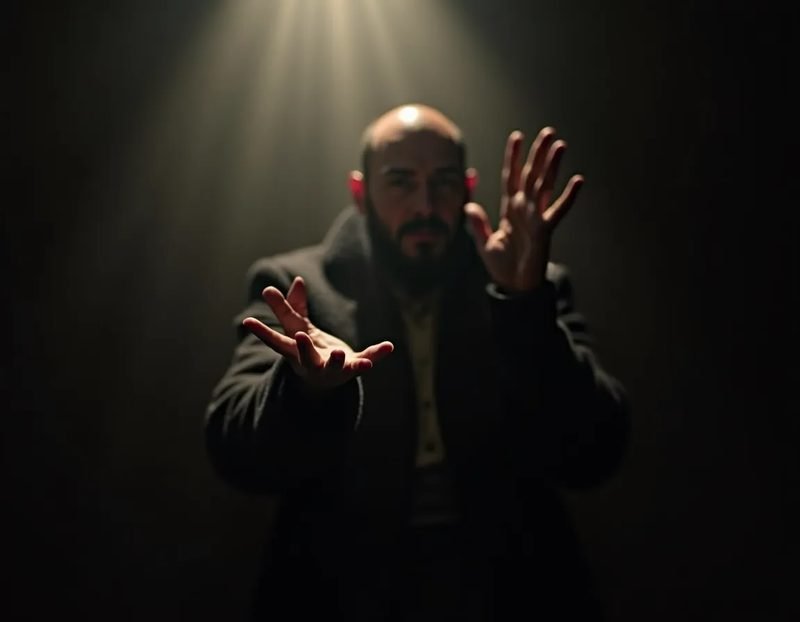
a magician mid-gesture, hand raised toward a spectator, commanding the room

Here’s the part that stings if you’ve built your act around technical precision. A hedge doesn’t just weaken a wrong guess, it actively damages a correct one. Say “I’m getting something… it could be a J, maybe a G…” and land on the right initial, and half the room will remember the fumbling more than the hit. You gave them permission to grade you on the process instead of the result.

Compare that to a flat, declarative statement. “Your father’s name starts with a hard consonant. A G.” Said once, said certain, and moved past. If you’re right, it reads as impossible. If you’re wrong, most rooms will let it go, sometimes they’ll even talk themselves into being closer than they were. I’ve watched spectators argue themselves into a near miss because the delivery gave them nothing to push against.

That’s not a trick of language, it’s a trick of nervous systems. A confident statement doesn’t invite scrutiny, it invites comparison. Your spectator checks it against what they know and moves on. A hedged statement invites analysis, and analysis is where cold reading dies.

A Wrong Guess Delivered Right

I tested a blunt version of this at a private event near Louisville a while back. Book test, standard four pillar force, nothing exotic. Except this time I deliberately missed on the first pass, on purpose, just to watch what confidence alone would do to the room.

I said the word with total certainty. Wrong word. The spectator paused, then said “close, actually,” and started explaining how the real word connected to what I’d said. She built the bridge herself. I hadn’t asked her to. My hands stayed still, my face didn’t move, and the room leaned in rather than pulling back.

That’s the whole mechanism, laid bare in one room on one night.

A wrong answer delivered with zero doubt gets rationalized. A right answer delivered with visible doubt gets audited. If you only remember one sentence from this piece, remember that one.

Confidence Is a Technique, Not a Personality Trait

Here’s where most guides on this topic go soft, they tell you to “just be more confident,” as if that’s a switch. It isn’t. Confidence in a read is built from specific, learnable choices, and you can start applying them tonight.

  • Drop the qualifier stack. “I feel like it might possibly be” is four hedges in one clause. Cut to “It’s.”
  • Statement, not question. Your inflection should fall at the end of the sentence, not rise. A rising tone reads as asking permission to be right.
  • Commit before you speak. Decide the word, name, or number in silence, then deliver it. The pause before is where certainty gets built, the sentence itself should have none.
  • Never repair mid-sentence. If you start correcting yourself out loud, “It’s a G, well, could be a J,” you’ve handed the room the wobble. Finish the thought you started, even if you suspect it’s wrong.
  • Match the body to the words. Stillness reads as certainty, fidgeting reads as doubt, and audiences read your hands before they finish parsing your sentence.

None of this requires you to guess more. It requires you to stop signaling the guessing you already do.

The Ethical Line, and Why It Matters More Here

I need to say this plainly, because this technique is powerful enough that it’s worth pausing on. Confident delivery is a performance tool for creating wonder in a room that knows it’s watching a show. It is not license to convince someone something is real when they’ve come to you believing your claims are literal.

There’s a real difference between a paying audience enjoying a mentalism act and a grieving person hoping you’re actually reaching someone they lost. The confidence heuristic works on both audiences equally well, that’s exactly the problem. The technique doesn’t care about your intentions, only your delivery. You have to be the one who cares.

I’ve turned down bookings over this line before. I’ll keep doing it.

Building It Into a Working Act

The uncomfortable truth in all this is that most mentalists over-prepare for accuracy and under-prepare for delivery. They’ll drill a force fifty times and never once rehearse how flat and certain their voice sounds saying the wrong word on purpose. That’s backwards. Your technical method gets you close, your delivery decides whether the room believes you got there.

Try this in rehearsal, it’s worked for me for years. Record yourself doing a cold read cold, no prep on the line itself, and force yourself to guess wrong on the first three attempts, saying each one with total conviction. Listen back. If you can’t tell from your voice alone which guesses were wrong, you’ve built the skill. If you flinch, if your pitch rises, if you rush the delivery, that’s the tell your audience has been catching for years without you knowing it.

Most performers won’t do this drill. It feels wrong to practice sounding certain about something false.

Do it anyway.

The room was never grading your accuracy. It was grading your certainty, and it always will be. That’s not a flaw in your audience, it’s how belief gets built in every reading room, every courtroom, every séance that ever felt real to the people sitting in it. Learn to wield it deliberately and you stop hoping for a hit. You start engineering the feeling of one, every single time you open your mouth.

For tools built to earn that kind of certainty in the room, visit Arcane Relics.

Reading the Body Before the Mind: What Interrogation Trained Microexpression Work Actually Offers a Mentalist

Reading the Body Before the Mind: What Interrogation Trained Microexpression Work Actually Offers a Mentalist

A polygraph examiner and a bizarre magic performer both watch faces for a living. That’s about where the resemblance ends. I’ve spent years reading books on interrogation technique, the Reid method, statement analysis, the whole shelf, and I keep running into the same problem. The room is wrong. The stakes are wrong. The subject is wrong. Everything that makes those techniques work depends on conditions a mentalist almost never has.

I’m not dismissing the material. Some of it transfers beautifully, once you strip away the cop-show language and look at what’s actually being measured.

Most performers borrow the vocabulary anyway because it sounds authoritative. “Tells.” “Leakage.” “Baseline.” Words lifted from a world of locked rooms and criminal stakes, then pasted onto a volunteer who’s had two drinks and just wants to see something impossible happen. That mismatch is worth taking apart piece by piece.

The Interrogation Room Assumes a Liar Under Threat

Paul Ekman’s original microexpression research, and most of what came after it, was built around a specific scenario. Someone has done something, they know it, and they’re being asked direct questions with consequences attached to a wrong answer. The fear of being caught produces a measurable physiological signature. A flash of contempt at the corner of the mouth. A flinch around the eyes lasting less than half a second. These are real. I don’t dispute the data.

But notice what has to be true for that signal to appear at all. The person has to be concealing something specific. They have to believe getting caught carries a cost. And they have to be suppressing a genuine emotional response in real time.

Your volunteer at the table has none of that.

She isn’t hiding a crime. She’s holding a playing card, or thinking of a childhood memory, or gripping a sealed envelope you asked her to focus on. There’s no threat, no guilt, no suppressed emotion fighting its way to the surface. Applying interrogation-grade reading to that moment is like bringing a stethoscope to listen for an engine that was never running.

What Actually Transfers: Baseline, Not Betrayal

close-up of two hands resting calmly on a table, contrasted with hands lightly gripping an envelope

Here’s the part worth keeping. Baselining is real, and it’s useful, just not for the reason interrogators use it.

In a police interview, baseline means establishing how someone behaves when telling the truth about something low-stakes, “what’s your name,” “where do you live”, so you can later notice deviation when the real questions start. In a séance or a sealed prediction routine, I use it for something quieter. I want to know what this particular person looks like at rest, before anything charged has been said, so I can notice the smallest shift once it has.

That shift is rarely dramatic. It’s a change in breathing rhythm. A hand that stops moving instead of one that starts. Weight transferring off one hip. These aren’t tells in the interrogation sense, evidence of concealment, they’re evidence of attention. Something just got heavier in the room, and the body register it before the person consciously decides to hide or reveal anything.

I tested a version of this at a private event near Louisville a while back, watching a small group of volunteers as I named locations on a hand-drawn map, waiting to see which name made someone’s shoulders drop half an inch. Nobody told me anything. Nobody needed to.

My hands stay still while I’m watching for this. Moving draws the eye away from theirs, and the whole read depends on nobody knowing they’re being read.

The Seven Universal Expressions Are the Wrong Tool for This Job

Ekman’s seven universal expressions, anger, disgust, fear, happiness, sadness, surprise, contempt, get quoted in mentalism circles like scripture. Learn to spot a flash of disgust and you’ll know when someone’s lying, or so the pitch goes.

This is where I get skeptical, and I stay skeptical.

Those seven categories were built to classify emotion, not to detect deception. Ekman himself has said as much in his later writing, the presence of an emotion tells you nothing about its cause. A flash of fear on your volunteer’s face might mean she’s thinking about something painful. It might mean she’s afraid of looking foolish in front of her husband. It might mean absolutely nothing, a random neural firing that has nothing to do with the number she’s thinking of.

Trying to read specific content, which card, which name, which memory, off a universal emotion category is a category error. Emotions don’t carry that kind of resolution. It’s the equivalent of using a thermometer to find out what someone’s thinking about. You’ll get a real number. It won’t tell you what you want to know.

This is the point where most guides get it backwards.

They teach you to hunt for named emotions when you should be hunting for change.

What Bizarre Magic Actually Needs From the Body

Strip the interrogation framework down to its actually useful parts and you get three things worth building a technique around.

  • Timing over content. You don’t need to know what emotion someone’s body is showing. You need to know when it changed, relative to what you just said or did.
  • Asymmetry as a flag, not a verdict. A one-sided mouth movement, one shoulder rising higher than the other, these are worth noting because they’re rarer than symmetric movement, not because they mean deception. Rarity earns attention. It doesn’t earn a conclusion.
  • Suppression, not expression. Interrogators look for a flashed emotion. I look for a stopped one. Someone catching themselves mid-reaction, a laugh cut short, a breath held instead of released, tells me more than any named expression ever has. That’s a person managing themselves in front of an audience, and a bizarre magic performer’s whole job is noticing what people manage.

None of this requires the framework of guilt and concealment. It requires patience, and a willingness to watch instead of narrate.

I don’t necessarily believe you can read a specific number off a stranger’s face with anything close to reliability. I do have a strong conviction that you can read the moment a stranger stops thinking about nothing and starts thinking about something.

That gap, between nothing and something, is where the whole performance lives.

Cold Reading Fills the Space Interrogation Leaves Empty

If microexpression work only tells you when, cold reading is what tells you toward what. This is the piece most performers skip because it feels less scientific, less “trained by the FBI,” more like an old carnival trick. That instinct is exactly backwards.

Cold reading, done properly, is a feedback loop. You make a statement broad enough to likely land, watch the body’s timing response to it, then narrow based on what you saw. The microexpression training tells you the volunteer’s shoulders dropped when you mentioned a body of water. Cold reading is what lets you follow that thread, “near water, but not on it, somewhere you could hear it,” and keep narrowing until the room goes quiet in the specific way rooms go quiet when you’ve actually landed somewhere true.

Used together, body reading gives you the signal and cold reading gives you the vocabulary to act on it out loud, in real time, without ever naming what you’re doing.

Where This Gets Genuinely Unnerving

The part I still haven’t fully made peace with, after years of using this stuff on stage, isn’t the technique. It’s how little the volunteer knows they’re transmitting.

People believe their faces are private property, that a poker face is achievable with enough will. My experience says otherwise. The body leaks intention constantly, not through some elaborate deception signature, but through simple biological economy, suppression takes more effort than expression, and effort shows.

I’ve watched a grown man’s jaw tighten over a name he hadn’t said out loud in years.

He never confirmed it. He didn’t have to.

Whether that’s a “tell” in the interrogation sense or just a nervous system doing what nervous systems do under quiet pressure, I genuinely don’t know. I’m not sure it matters. What matters is that the reading was true, the room felt it, and nobody in that room could explain afterward exactly how I knew.

That unexplainable residue is the whole business we’re in.

Building This Into Your Own Work

If you’re going to take anything from this into your own act, take it in this order. Learn to baseline a stranger in under thirty seconds of small talk, before any charged question gets asked. Practice noticing timing rather than naming emotion, when did the shift happen, not what was the shift. Then pair that timing data with cold reading language so you have somewhere to put what you noticed.

Skip the parts borrowed wholesale from interrogation rooms. Your volunteer isn’t a suspect, and treating her like one, hunting for guilt signatures on a face that has nothing to hide, will make your reads worse, not better. You’ll see things that aren’t there because you’re looking for the wrong category of thing entirely.

So yes, the vocabulary is worth knowing. Just don’t mistake borrowed vocabulary for borrowed truth.

If you want the physical pieces that make this kind of work land at the table, the sealed items, the props built for exactly this quiet style of reading, take a look through what we carry.

Visit the Arcane Relics shop

Forcing Belief: The Neuroscience Behind Why Mentalism Hits Harder Than Conjuring

Forcing Belief: The Neuroscience Behind Why Mentalism Hits Harder Than Conjuring

Forcing Belief: The Neuroscience Behind Why Mentalism Hits Harder Than Conjuring

The Difference Nobody Talks About

Show someone a card trick and they applaud. Read their mind and they go quiet. That silence is not politeness. It is a different cognitive process entirely, and understanding it separates performers who consistently destroy audiences from those who consistently impress them.

Visual magic and mentalism do not hit the brain the same way. The research is specific enough now that it has direct implications for how you construct a routine, what you say before the effect begins, and how long you wait after it ends. This post is not about the history of either discipline. It is about the machinery underneath both, and why one machine has more torque.

Cognitive Dissonance Is Your Best Prop

Cognitive Dissonance Is Your Best Prop

Leon Festinger’s dissonance research from the 1950s still holds. When a person holds two contradictory beliefs simultaneously, the brain works to resolve the tension. It does not sit comfortably with contradiction. It needs a winner.

In a card trick, the contradiction is simple: “I saw the card go into the middle, but now it is on top.” The brain resolves this quickly. It files it under “trick.” Clever, yes, but categorized. The mystery has a container.

Mentalism presents a different problem. The spectator knows, rationally, that you cannot read their mind. That is belief one. But you just described their mother’s name, the number they were thinking of, and the specific memory they chose. That is belief two. The brain cannot resolve this cleanly. There is no “trick” category that feels satisfying. The contradiction lingers.

Festinger found that unresolved dissonance intensifies when the person is publicly committed to one of the beliefs. If your spectator said out loud, in front of a group, “I’m thinking of a number,” and you name it, their discomfort is not just cognitive. It is social. That combination locks the experience in far more deeply than any visual surprise can.

Banachek understood this. Read Psychosomatic again with Festinger in mind. The script work is not just atmosphere. It is systematic commitment-extraction before the reveal.

The Compliance Window

Social compliance research, particularly Milgram’s obedience studies and Cialdini’s work on influence, outlines a consistent pattern: people follow authority signals, especially in ambiguous situations. A mentalism performance is an ambiguous situation by design.

The spectator does not know the rules. They do not know what is possible. In that uncertainty, they look for social cues. You are the person who has done this before. You are confident. You are not surprised by what is happening. Those signals read, neurologically, as evidence of legitimacy.

Visual magic undercuts this. The moment you produce a deck of cards or a silk, the spectator places you in a category: conjurer, entertainer, trickster. Useful categories, all of them, but they trigger skepticism as a reflex. The compliance window narrows before you have said a word.

Mentalism, framed correctly, delays categorization. The spectator cannot immediately file what you do. They stay in that open state longer. The compliance window stays wider longer. This is not theory. It is directly observable in how audiences behave during a cold reading versus a color-change sequence.

Corinda addressed this obliquely in Thirteen Steps. His notes on “creating the right atmosphere” are not decoration. They are instructions for managing the compliance window. The candles, the quiet room, the unhurried pace: all of it keeps the spectator in evaluative suspension, where social compliance sits at its highest.

The Pattern-Seeking Problem

The Pattern-Seeking Problem

The human brain is a prediction machine. That is not metaphor. Predictive processing is one of the more durable models in current cognitive neuroscience. The brain constantly generates predictions about incoming sensory data and updates when those predictions fail.

Visual magic produces prediction failures, but bounded ones. The coin disappears. The prediction fails. The brain flags the failure, notes it as entertainment, and moves on. The failure is in the external world, not in the self.

Mentalism attacks the prediction machine from inside. When you name what someone is thinking, the prediction failure is not “something outside me behaved unexpectedly.” It is “something inside me was accessed without my permission.” That is a categorically different disruption. The brain does not have a clean protocol for handling it.

Apophenia, the tendency to perceive meaningful connections in unrelated events, activates strongly in this state. After a successful mentalism piece, spectators regularly report noticing “signs” in the days that follow. They connect unrelated events to the experience. The effect propagates outward. A well-executed card trick does not do this.

Annemann built his entire performance persona around this gap. The dark suit, the direct gaze, the economy of movement: none of it was designed to entertain. It was designed to occupy the space left by a disrupted prediction machine. He left nothing cheerful to grab onto. The discomfort had nowhere to go except inward.

Verbal Structures That Activate Belief

Specific language patterns activate pattern-seeking more reliably than others. These are not “patter” in the old sense. They are structural tools, and treating them as such changes how you write material.

  • Present-tense framing. “You are thinking of something right now” is more disorienting than “Think of something.” The present tense implies access already in progress. The spectator is behind before they start.
  • Partial revelation with a pause. State part of the information, stop, let the spectator fill the gap mentally before you complete it. The brain’s completion reflex creates a sense of co-authorship. They feel like you pulled it from inside them, not from a system.
  • Specificity over generality. “A woman” lands differently than “someone close to you.” The Barnum effect works, but it works best as a warm-up, not a closer. Specific details that land produce the dissonance spike. Generalities produce mild assent. Mild assent is not what you are after.
  • Presuppositions over questions. “Is it the one on the left, or the other one?” assumes there is a “one.” It presupposes rather than asks. Presuppositions bypass the critical filter more cleanly than direct statements because the brain processes the assumed content before it evaluates the question.
  • Silence after the reveal. This is the most ignored tool in the set. The moment of impact is not the reveal. It is the three to five seconds after. Do not fill that silence. Let the brain work. What it does in those seconds is the actual effect.

These are drawn from the same compliance and cognitive literature that underlies NLP, therapeutic suggestion, and structured interviewing. They work in those fields because they are accurate descriptions of how language interfaces with belief formation. They work here for the same reason.

Framing and Pacing: Where the Real Work Is

Pacing in mentalism is not about timing in the comedic sense. It is about managing the spectator’s cognitive load.

When you move too quickly through a piece, the spectator’s brain is still processing the previous beat when you deliver the next. The compounding effect is lost. Each moment lands independently, which weakens the overall architecture. The effect becomes a series of small surprises rather than a single escalating disruption.

Slow down at the moments of commitment, not the moments of revelation. Ask your spectator to concentrate, to hold the thought, to confirm it silently. Give them time to reinforce their internal belief before you break it. The revelation hits harder because the belief it challenges is more firmly in place. You are not speeding toward the payoff. You are building the wall you are about to walk through.

On framing: the pre-frame determines how much cognitive resistance you face. “I want to try something” generates more resistance than “Something I’ve noticed is.” The first positions you as a performer attempting a trick. The second positions you as an observer reporting a discovery. One triggers the skepticism reflex. The other invites the spectator into a shared observation, which is an entirely different relationship to what follows.

Max Maven’s scripting consistently does this. The effect often begins before the spectator knows it has begun. By the time they realize they are a participant, they have already committed to the frame. Reversal at that point requires more social courage than most people have in front of a group.

What This Changes About How You Build Material

None of this replaces a strong method. Cognitive science does not make a weak effect strong. What it does is show you where the real gain is once the method is solid.

The suspension you are after is not achieved by the effect alone. It is achieved by the total architecture: the framing before, the language during, the silence after, and the pacing throughout. Get any one of those wrong and the effect underperforms regardless of how clean the method is.

Mentalism is not harder to perform than visual magic. It is harder to perform well, because the psychological scaffolding is visible in a way that a sleight is not. The psychology is the method. You cannot hide a weak pre-frame behind technical skill. There is nothing to hide it behind.

Learn the cognitive structure. Build your routines around it deliberately, not as an afterthought to the method. The audiences who go quiet in that particular way will confirm when the architecture is working.

For manuscripts, props, and tools built specifically for this kind of work, the Arcane Relics shop stocks material selected for performers who take the psychology as seriously as the method.