Part 2: The Hidden Object Hunt, Building a Contact Mind Reading Routine That Plays to a Full Theatre

In Part 1: Hellstromism: The Lost Art of Contact Mind Reading and the Performers Who Nearly Buried It, we covered where this craft came from and why it nearly vanished. Now the harder question. How do you make a form built for a drawing room read clearly to four hundred people, some of them forty rows back?
I don’t think contact mind reading is telepathy. I never have. But I’ve watched a blindfolded performer walk a stranger’s thoughts across a stage in near silence, and the room behaved as though something impossible had happened.
That reaction is the product. Your job is to protect it.
Why the Parlor Version Dies on a Big Stage
The classic hunt was built around intimacy. A dozen guests, a hidden pin or a ring, and a performer moving through furniture with a spectator’s hand clamped to his wrist. Everyone could see everything, so nobody needed help understanding what they were watching.
On a stage, the same effect fails for three boring reasons. The walk is slow. The action is small. And the back row can’t tell whether the performer is searching, guessing or succeeding.
Slow is fatal in a big room. Small is invisible. Confusing is worse than both, because a confused audience decides the volunteer is a plant before you’ve found anything.
So you don’t shrink the parlor version onto a stage. You rebuild it around what a large audience needs to see, hear and believe. That’s a different piece.
Staging the Hide So Everyone Owns It
The hide is where the audience decides whether the piece is fair. Get it wrong and nothing you do afterward can repair it.
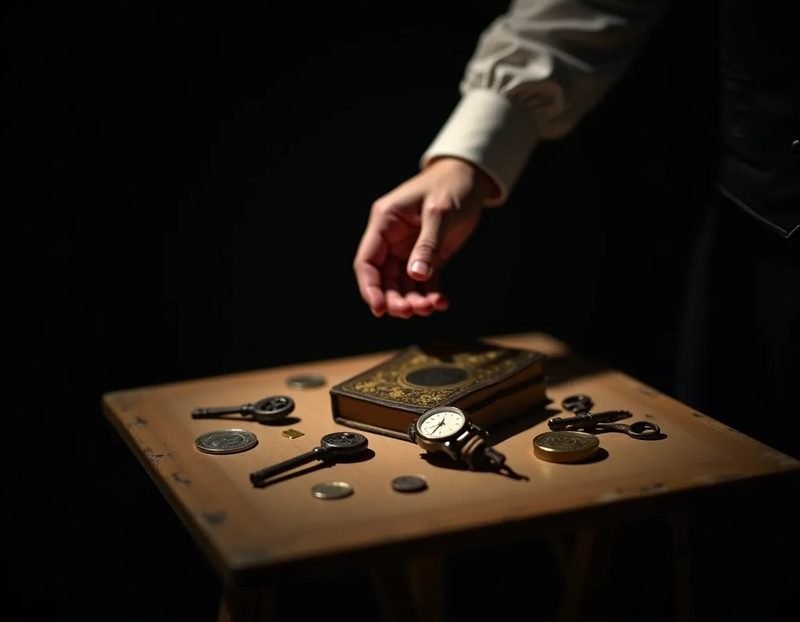
Don’t ask the group to hide something while you wait in the wings. That’s a parlor habit, and it turns your absence into a question mark. Instead, keep the process public and fast. Put a small pool of borrowed objects on a table downstage, let the audience call out which one, and have a second volunteer choose the location while you stand with your back to the house, hands visible, blindfold still in your pocket.
Then the key move. The hider whispers the location to the subject, and only the subject. The room never learns it either. That matters more than it sounds like it should, because a large audience that doesn’t know the answer can’t watch you fumble toward it. They can only watch you arrive.
Keep the hiding places physical and distinct. A jacket pocket in row three. Under a specific chair is too vague. Try inside the closed lid of the grand piano, taped beneath the edge of the lectern, or in the hand of a volunteer seated at the aisle. Places the back row can picture the moment you name them.
Choosing the Subject Who Will Carry the Piece
Nothing in this routine matters as much as your subject. The reading depends on tiny, involuntary pressure changes, and a nervous person is a noisy person. A jittery volunteer gives you static. A calm one gives you a signal.
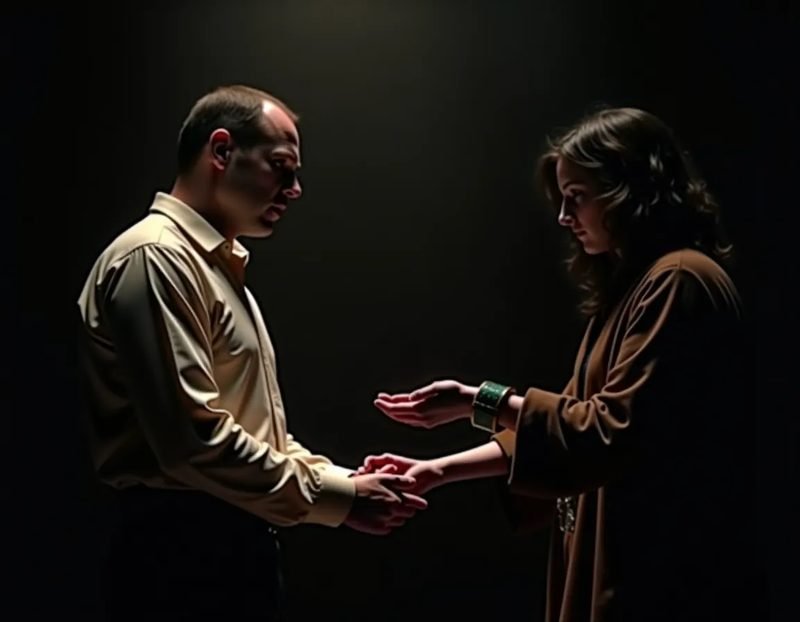
Spend thirty seconds finding out which you’ve got. Before you ever mention the hunt, take the volunteer’s hand, ask them to press gently against yours while you shift your weight left, then right. You’re not testing them for the audience. You’re testing the channel. If the pressure is soft and consistent, proceed. If they grip like they’re dangling off a cliff, thank them warmly and choose again.
I’ve had better luck with people who are a little bored than with the eager ones. Eager volunteers push. They try to help, and helping is the enemy of good contact work.
Give them one instruction, and give it in plain words. Think of the place. Don’t steer me. That’s the whole briefing.
Making the Walk Readable From the Back Row
Now the visual problem. A two-person walk across an empty stage looks like a slow dance unless you give the eye something to track.
First, light it. A tight follow spot on the pair, with the house dimmed low, turns them into a moving picture frame. Without that, the back row loses the contact point, the actual hand on the wrist, and that hand is the whole story.
Second, use a lavalier on you and a handheld or a second lav on the subject. When they breathe and you hesitate, the room should hear it! A hush with a live microphone in it is one of the most tense sounds in theatre, and most performers never give it to their audience.
Third, and this is the piece people skip, build stops into the walk. Twenty steps of continuous motion tells the audience nothing. Stop dead, pivot, back up, correct. A hunt with visible hesitation reads as genuine effort, and genuine effort is what sells contact reading in a hall. If you’ve been following the pressure honestly, you’ll do this naturally anyway.
If the venue has a camera feed to a screen, put it on the joined hands during the stops. A close shot of a wrist gripped by a stranger says more than any patter line.
The Blindfold Question and the Talking Question
Do you blindfold? I lean yes for a stage. It removes the objection that you spotted the subject’s glance, and it makes the audience lean forward. But use a proper one. Something padded, dark and slightly theatrical, not a scrap of cloth that leaves the volunteer wondering what they signed up for.
Whatever you choose, let a spectator tie it, and let the front row see the knot. That’s thirty seconds well spent.
Then decide how much you’ll talk. Most performers over-narrate. They describe every step, every flicker of feeling, every supposed impression, and the nuance drains out of it. I keep my patter thin during the walk. A few words at a turn, a sentence at a stop. When I tested this shape at a private event in Clarksville, Indiana, the quietest stretch got the loudest silence, and I felt the whole room lean with me. My hands went still. So did theirs.
Silence is a prop. Treat it like one.
Scripting the Moment the Object Turns Up
Here’s the part that separates a competent hunt from a memorable one. The last three steps.
Don’t rush toward the location. Slow down as you approach, let the pressure guide you into a near stop, and make the final move look like something the subject did, not something you did. Have them lift the piano lid. Have them reach into the pocket. Let the discovery pass through their hands, not yours.
Why? Because a mind reader who grabs the object looks like he knew all along. A mind reader who stands back while a stranger finds the object looks like he was led there. That difference is the entire illusion.
Then script the aftermath, and keep it short. Remove the blindfold slowly. Thank your subject by name. Ask them one question: Were you thinking of anything besides that place? If they say no, leave it alone. If they say something odd, keep it for the second show.
Never explain how it worked. Not even in a joking way.
Then walk off. That’s the whole game, honestly.
Rehearsing It Until It Stops Feeling Like a Trick
You cannot learn this from a description. You learn it by practicing with real people, in real rooms, until you can feel the difference between confident pressure and hopeful pressure in your own wrist.
Run the walk with ten different volunteers before you put it on a bill. Friends, relatives, the neighbor who owes you a favor. Note who gives you a clean signal and who doesn’t, and what you said to each before starting. Record two of the sessions on video so you can watch your own hesitation and see how it reads from a distance.
Watch for the moments you look like you’re guessing. Cut them, or restage them, or turn them into deliberate stops.
Contact mind reading isn’t dead. It was set down by people who stopped asking what a bigger room needs, and that’s a solvable problem, if you’re willing to be a little more theatrical than the old parlor men ever needed to be.
If you’re building a stage piece like this, you’ll want the right supporting cast of props, blindfolds and borrowed-object presentations. You’ll find the pieces we stand behind at arcanerelics.com/shop.
Equivoque Without the Tell: Making the Magician’s Choice Survive a Thinking Audience

A man in a Okolona living room folded his arms on the second “or.” I saw it happen. He’d let the first two choices go by, but when I offered him a third split of the same pile, his jaw set and his weight shifted back into the cushion. He was replaying it in real time. He didn’t say a word, and he didn’t have to.
I don’t think equivoque is a cheat. I do, however, have a firm conviction that most performers use it like one, and that sharp audiences smell it every time.
That’s the problem worth solving.
Why Sharp Audiences Catch It
The magician’s choice works because a spectator hears a series of free decisions, while the performer hears a single funnel that ends where he needs it to end. The gap between those two experiences is the whole trick, and it’s also the tell, because a thinking person eventually notices that your words changed shape depending on what they said.
Watch what the skeptic does. He doesn’t object in the moment. He nods, he plays along, and he files it away. Then somewhere on the drive home he runs the transcript back and finds the seam, “you kept saying eliminate when I picked the wrong one.”
Your real audience isn’t the room. It’s that replay.
So the standard isn’t “does it fool them now.” The standard is “does the memory still read as a free choice at eleven at night, alone, with a suspicious mind.” Those are very different tests, and most scripts fail the second one.
The Wording Is the Prop
Here’s the part most guides get wrong. They hand you a formula, “if they pick X, say this, if they pick Y, say that,” and treat the phrasing as a lookup table. But a lookup table has a visible rhythm, and rhythm is what a suspicious listener catches first.
Your job is to make every branch sound like the same sentence. Not similar. The same. If the spectator picks the left item and you say “we’ll keep that one,” then when they pick the right item you can’t suddenly say “and we’ll set that one aside.” The verbs have to be interchangeable in your mouth before they’re interchangeable in the procedure.
Three habits that help:
- Use one verb family. Pick “we’ll use” or “we’ll leave,” and never switch mid-routine. Verb changes are the loudest tell there is.
- Keep the tone flat on every branch. If you sound relieved after the useful choice, you’ve told them which one was useful.
- Record yourself running all the branches back to back. Listen for where your pitch, your pace, or your hands change. You won’t hear it live. The recording will hear it for you.
I run my branches into a phone at my kitchen counter, then listen with my eyes closed. It’s humbling. My voice drops half a step on the branch I like best, every single time.
What Daniels Puts in Choices

I have the lecture notes for Choices by Joseph Daniels on the site, and they’re worth your time if you take this subject seriously. The notes don’t treat equivoque as a single move. They treat it as one tool inside a larger question, how do you build a choice that survives being examined?
The material moves through multiple outs, envelopes, vanishing ink, and equivoque itself. Read in that order, it makes a quiet argument. Equivoque shouldn’t be the only thing holding your ending up. It should be one layer, and the other layers exist so that if a spectator’s memory attacks the wording, there’s nothing underneath for the attack to find.
That’s a different philosophy than “learn the formula.” It’s closer to defense in depth.
And there’s one recommendation in the notes I’d repeat without qualification. Daniels points to Darrell King’s script as a must read. If you only take one action from this post, read it. A script that has been worked out word by word by someone who cared about the replay teaches more than ten pages of theory, because you can see where each phrase is doing its job and where it’s deliberately doing nothing.
Read it with a pencil. Mark every word you’d have changed, then ask yourself why King didn’t.
Multiple Outs: Never Marry One Ending
Equivoque under pressure is fragile because it usually has one job, get to one result. When the spectator does something unexpected, the script has nowhere to go, so the performer improvises, and improvised wording is exactly what a skeptic remembers.
Multiple outs change that. If you can land the effect from more than one direction, then you never need the wording to bend. The choice can simply be a choice. You aren’t steering, so there’s nothing to hear.
This is the most counterintuitive point in the whole discussion: the more outs you carry, the less you need to use equivoque at all. Its best use becomes the rare moment when the spectator drifts off your primary path and you need a gentle correction. One clean sentence, delivered once, and never repeated.
Repetition is what makes the pattern visible. A single, confident use looks like conversation. Three in a row looks like a system.
So build your routine backwards. Start with the outs. Ask how many different final positions you can honor without changing your patter. Then let equivoque fill the gaps rather than carry the weight.
Envelopes and Vanishing Ink: Hiding the Procedure
A choice feels freest when the physical objects appear to have no stake in it. This is where the envelopes and vanishing ink in Daniels’ material earn their place. Sealed envelopes give the spectator something solid to hold while the important decision happens in their head, not yours. Their attention goes to the paper, the flap, the weight of it.
Vanishing ink solves a different problem. It gives the moment of decision a reason to feel unrepeatable. Writing that disappears can’t be re-examined, and a choice that can’t be re-examined is one the audience is less tempted to audit later. There’s an honesty to it, oddly. The spectator is being told, in effect, that this moment only happens once, and they believe it because the ink agrees.
I’m careful about leaning on props for that reason, though. A prop should raise the stakes of the choice, not disguise a weak one. If your wording is shaky, an envelope won’t save it. It’ll just make the failure more elegant.
Use the objects to slow the room down. Use your script to keep it honest.
Pacing and the Drive Home
Speed is the enemy of a believable choice. A rushed selection feels rehearsed on both sides of the table. So slow down where it counts, at the moment they decide, and give them silence they can hear.
My hands go still when I ask. My breath lengthens. I let the pause sit for a full beat longer than feels polite, because the discomfort belongs to me, not them, and the calm on my face is what tells the room the decision is theirs.
Then move on fast. That’s the second half of the rule. Once they choose, don’t linger on the choice, don’t recap it, and never explain it. A performer who says “and remember, you could have picked anything” has just told a jury exactly what he’s worried about.
Ask yourself what the replay sounds like. It should be short. “I picked one, I picked again, it was mine.” No detail to snag on. No phrase to rewind. Simplicity in memory is the goal, and you engineer it by keeping the live moment as clean as you can.
That’s the whole game, honestly.
Build It This Week
Here’s a practical order of work if you want to harden your own choices.
- Read the Daniels notes on the site, then read Darrell King’s script with a pencil.
- Write down every branch of your current routine as full sentences, not shorthand.
- Rewrite each branch until the verbs match and the rhythm is identical.
- Add at least one additional out so equivoque is a backup, not the engine.
- Record all the branches, listen with your eyes closed, and fix what your voice gives away.
- Perform it for the most suspicious person you know, and ask them to describe it to you the next day.
That last step is the one people skip. Do it anyway! What a suspicious friend remembers is the only honest review your script will ever get, and it’s worth more than any amount of solo rehearsal.
The choice was never supposed to be free. It was supposed to be remembered as free.
If you’re building routines around that idea, start with the props and materials that make it easier to carry: https://arcanerelics.com/shop/
Two Truths in One Room: Dual Reality and the Ethics of What Your Volunteer Knows

I don’t believe a volunteer is ever a neutral instrument. I’ve stopped pretending otherwise. The person you pull from row two is a witness, a participant, and a future storyteller, all at once, and what they carry out of the room matters more than anything you carried in.
Dual reality is the structure that makes this impossible to ignore. One person on stage lives through a version of the effect that differs from what the audience sees. Done well, it’s devastating. Done carelessly, it’s a slow leak that shows up three days later at a kitchen table.
Why the Split Works
An audience doesn’t judge a mentalism effect by the method it can’t see. It judges by the face of the person who’s inside it. When your volunteer’s breath catches, when their eyes go to the middle distance and stay there, the crowd reads that as evidence. Nobody can fake it convincingly, and the room knows that.
That’s the engine. In a dual reality, the volunteer’s reaction is honest because their experience is honest. They aren’t performing astonishment. They’re having it, inside a frame you built around what they were allowed to perceive.
This is why the structure outperforms so many cleaner-looking methods. A well-briefed confederate is acting. A volunteer living a different version of the same minute is simply reacting, and reactions can’t be rehearsed.
Most performers treat that as a technical advantage. It’s a moral one too, and that’s where the trouble starts.
What the Volunteer Actually Owns
Here’s the counterintuitive part. In a dual reality, your volunteer usually knows more than the audience about some things and less about others. They know what they thought, what they wrote, what they felt in their hands. They don’t know what the room saw. That gap is the whole trick, and it’s also what they’ll spend the next week trying to close.
Think about what happens in a person’s head after they step off. They replay it. Everyone does. They rebuild the sequence from memory, and they test it against what their friends tell them, because that’s what people do with a strange experience. They compare notes.
Your two realities will meet in that conversation whether you’ve planned for it or not. The only choice you get is whether they meet gently or badly.
I learned this at a private event in New Albany, Indiana. A woman I’d worked with for six minutes left the stage visibly shaken, in the good way. Twenty minutes later I overheard her telling her husband what she’d seen me do. His version was different. Not wrong, just different, and her face changed as she listened. My mouth went dry.
Nothing collapsed. But I watched a wonderful memory get a hairline crack, and I’ve never forgotten how quiet it was.
Keeping the Stories From Colliding
The practical rule is simple to say and hard to build. The outcome has to be identical in both realities, even when the path isn’t. What the volunteer would report, and what the audience would report, should end at the same place. The middle can differ. The ending can’t.
Here’s how I check a routine for this:
- The one-sentence test. Can the volunteer summarize their experience in a single sentence that an audience member would also endorse? “He knew the word I was thinking of” survives every comparison. “He did something with the cards while I concentrated” doesn’t.
- The hallway test. Imagine the volunteer and their spouse in the car afterward. What’s the first thing each says? If those two sentences contradict, you’ve built a landmine.
- The missing-detail test. Remove every detail only the volunteer could verify. If the effect still plays for the audience, you don’t need to lean on those details, and you shouldn’t.
- The retelling test. Ask a trusted friend to watch, then describe it to someone who wasn’t there. Whatever they drop or mangle is what a real audience will drop and mangle too.
The fourth one hurts, because it’s the one where you learn what your routine actually sounds like once it leaves your control.
Keep the shared facts loud and the divergent facts quiet. Volunteers don’t remember the process. They remember the peaks, so build your peaks where the two realities agree.
Complicity Versus Burden
Now the harder question. Sometimes the volunteer is told something. A small secret, a private instruction, a role. Performers call this complicity, and the word sounds friendly. It suggests a partnership, a wink across the table.
Sometimes it is exactly that. A confederate who signed up knowing what they were part of, who enjoys the game, who can hold it lightly? That’s a collaborator, and good ones are worth a great deal.
But I’ve watched performers hand a secret to a stranger in the middle of a live show, with no warning and no way out, and call it complicity. It isn’t. The volunteer has been drafted. They’re now responsible for a lie they didn’t choose, told to people they might love, in a room where the cost of failing is being seen to fail.
That’s a burden. And burdens don’t announce themselves. They show up later as a tight smile when someone asks, “So how did he do it?”
A Working Ethic for the Secret
I don’t hand out rules easily, but here are the ones I hold myself to. You can disagree with them. I’d ask that you at least have your own.
- The secret should be small. If it takes effort to carry, it’s too big. A private word, a private choice, a moment of silence. Not a story.
- It should never require them to lie to someone they know. A stranger in the audience is one thing. Their sister in the third row is another.
- They shouldn’t be the one who looks foolish if it goes sideways. Build the routine so that any failure lands on you.
- They can walk away from it. If the secret is real, there must be a graceful exit, and they must know it exists.
- It should expire. A secret that has to be kept forever isn’t a secret, it’s a debt.
None of this makes the effect weaker. If anything, volunteers who feel safe give you better reactions, because they aren’t guarding themselves.
A frightened volunteer performs. A trusted one experiences. You want the second.
What You’re Actually Leaving Behind
There’s a line I think about often. Every effect leaves a residue, and the residue lives in one person’s memory more than in anyone else’s. It’s the volunteer who takes the night home. It’s the volunteer who tells it at Thanksgiving, in year two, in year ten, with details smoothed and sharpened by time.
That’s your real legacy as a performer. Not the applause. The story, told without you, in someone else’s voice.
So build your dual realities with that person in mind. Give them an experience they can carry without flinching, a secret they can set down, and an ending that matches what everyone else saw. Do that, and the two truths in your room will hold together for years.
Skip it, and you’ll get one great night and a quiet, permanent flaw.
If you build for the volunteer who tells it back, you my friend, are doing the work right. Find the tools worth carrying into that room at arcanerelics.com/shop.
Part 2: Pacing the Valleys, Designing the Quiet Moments That Let a Miracle Land

In Part 1: Impossibility Fatigue: Why the Third Miracle in a Row Lands Softer Than the First, I laid out the problem. Stack enough miracles together and the audience stops gasping and starts waiting. I don’t claim to have a cure. I do have a conviction, built over a lot of rooms, that the cure isn’t another miracle. It’s what you put between them.
This is the build sheet. Where to place the valleys, what to fill them with, and how to tell when you’ve dug one too deep.
A Valley Is Not a Filler Bit
Most performers hear “add a low point” and reach for comedy. A quick gag, a funny prop, a line that gets a laugh and buys thirty seconds. That’s not a valley. That’s a speed bump with a joke painted on it.
A real valley lowers the emotional temperature on purpose. Laughter is high-energy, and it keeps the audience in the same alert, braced state that made the third miracle feel soft in the first place. What you want is recovery. Shoulders drop, breathing slows, people lean back in their chairs and then, without noticing, lean forward again.
Think of it as resetting a scale. Your audience’s sense of “impossible” has been stretched by the last effect, and you need the needle back at zero before you ask it to move again.
Comedy can live inside a valley. It just can’t be the whole valley.
Three Materials for Building Low Ground
I work with three materials, and I rotate them so no two valleys in a set feel alike.
Story. Not a patter theme. A short, true, unhurried account with no trick hiding inside it. Ninety seconds about where an object came from, or about the person who owned it, with no hook at the end. The audience keeps waiting for the turn, and when it doesn’t come, they relax into the telling. That relaxation is exactly what you’re buying.
Silence. Real silence, planned, with a number attached. Four seconds of nothing, eyes on the object, no throat-clearing. Beginners fill silence because it feels like failure. It’s the opposite. A room that goes quiet together is a room that’s paying attention, and it resets faster than any line you could deliver.
Human contact. A question with no trick behind it. Asking a spectator how long they’ve lived in their house, or who taught them to play cards. You listen to the answer, and I mean actually listen, because a stalling performer is obvious and a curious one isn’t.
Each material drops the pulse in a different way. Story slows it, silence stills it, contact warms it.
Where the Valleys Go
Here’s the part most routining advice gets wrong. People say to put the strongest effect last and the second strongest first, then fill the middle. That’s a ranking of peaks. It says nothing about the ground between them.
Map your set as terrain. Draw it on an index card if you have to. Peaks are your impossible moments, and valleys are the recoveries. Then check the spacing, because the mistake I see most is valleys placed by convenience. A prop reset becomes the pause, a costume change becomes the pause, and the audience gets a break exactly where you needed one, not where they did.
Put the deepest valley right before your largest effect, not after it. After a big moment, the audience needs to applaud, react, and talk to the person next to them. Give them that. Let the applause land and let it die on its own. The quiet you’re designing goes in front of the next peak, when they’ve just started to relax and don’t yet know what’s coming.
A short valley after every effect and one long valley before the closer. That’s the skeleton I return to.
A Room in St. Matthews
I learned the cost of skipping this at a private event in St. Matthews. Small room, maybe twenty people, good crowd. I’d built a tight run of three effects with almost no air in it, because the material was strong and I trusted it.
The first got a real reaction. The second got a good one. The third, which I’d have told you was my best, got polite nodding. A woman near the back checked her drink.
My jaw tightened. I knew what had happened, and I’d written half of Part 1 about it.
So I did something I hadn’t planned. I set my props down, sat on the arm of a chair, and told them about the first deck of cards I ever owned, a soft, water-stained thing from a thrift bin with the two of clubs missing. I told it plainly, no punchline. Then I asked a man near me what his first deck looked like. He laughed and told me about his grandfather.
Maybe two minutes total. When I picked up the next prop, the room had changed. Faces were open again. That final effect hit the way the first one had, and I hadn’t changed a single move in it.
The material was never the problem.
Keeping the Valley From Turning Into a Hole
Valleys fail in two directions. Too shallow and they don’t reset anything. Too deep and you lose the room, because a story that runs past its welcome is just a delay, and delays feel like stalling.
A few rules I hold myself to:
- Keep stories under two minutes. If it needs longer, it’s a different piece of your show, and it should earn its own spot in your running order.
- Silence gets four to six seconds. Past that, someone laughs nervously and you’ve spent the tension instead of banking it.
- Never explain the valley. No “let me take a moment here.” Just do it. Announcing a pause kills it.
- Tie it to the next effect loosely. A thread, not a rope. If the story obviously sets up the trick, the audience sees the mechanism and the calm evaporates.
- Watch hands and shoulders. If people are still gripping drinks and sitting upright, your valley hasn’t worked yet. Give it another breath.
That last one matters most. The room tells you when it’s ready. Your job is to be quiet enough to notice.
Matching the Valley to the Effect Behind It
Here’s the counterintuitive piece. The valley shouldn’t be neutral. It should be the emotional opposite of the effect before it, and a quiet cousin of the effect after it.
If you’ve just done something loud and physical, an object moving on its own, say, follow it with something interior. A memory, a personal question. If you’ve just done something cerebral, a precise prediction with numbers in it, follow it with something tactile, like handing an object to a spectator and letting them hold its weight for a moment without instruction.
This contrast matters because the audience isn’t just tired of miracles. They’re tired of one kind of attention. Switch the kind and you refresh them without stopping the show. A mentalist who moves from a cold, clinical reading to a warm, personal one feels like two performers sharing a stage, and both get more credit for it.
Then the next peak arrives, and it doesn’t feel like the fourth impossible thing. It feels like the first.
Build Your Own Terrain
Take your current set and lay it out on the table in order. Between each pair of effects, write down what actually happens. Not what you intend, what happens. If the answer is “I pick up the next prop,” you’ve found your first project.
Start with one valley. Just one, placed before your strongest effect. Make it a story or a silence, and run it for a week of performances. Watch what happens to that final moment. I’d bet money on the result, and I’m not a betting man!
Then add a second, and vary the material. Keep the ones that work, cut the ones that feel like filler, and remember that the goal isn’t more content. It’s more contrast.
The strongest sets I’ve seen weren’t the ones packed with the most impossible things. They were built by performers who understood that a miracle needs somewhere to land. If you’re building that kind of show, the props worth carrying are the ones with weight, history, and a reason to be held quietly in the dark. You’ll find them here: https://arcanerelics.com/shop/
Casting Before the Curtain: How Mentalists Choose a Volunteer Before the Room Notices

Every working mentalist has stood at the edge of a room and felt it before understanding it, a pull toward one face in the crowd and away from another. Most performers think volunteer selection happens when they say “how about you, sir.” It doesn’t. It happens sixty seconds earlier, while you’re still setting your table, still adjusting a lav mic, still pretending you haven’t already made your choice. The room reveals itself before you ever ask it to participate. Most performers don’t watch for that. Most performers are wrong to skip it.
The Sixty Seconds Before You Ever Speak
I don’t necessarily believe casting is instinct in the mystical sense. I do, however, have a strong conviction that it’s pattern recognition dressed up as instinct, the kind you build after watching a few hundred audiences behave in a few hundred rooms.
Before I say a word to a crowd, I’m already watching who leans forward when I walk in, who checks their phone, who talks to the person next to them versus who sits quietly and studies me. That quiet study matters more than almost anything else. A person who watches you closely before you’ve asked anything of them has already decided, somewhere under the surface, that they’re willing to be watched back.
I worked a private event in the Louisville area a while back where I clocked my volunteer before I’d finished my opening line, a man in a rumpled blazer who hadn’t touched his drink and hadn’t looked away from me once. He wasn’t the loudest person in the room. He wasn’t trying to be noticed at all.
He turned out to be exactly right.
Where They’re Sitting Tells You Who They Are
Seating position is not random, it’s confession. People choose where to sit based on how visible they want to be, and that choice happens before you’ve even entered the room.
Center-front seats attract two very different personalities: the genuinely eager and the performatively eager. Learn to tell them apart. The genuinely eager lean in with their whole torso. The performatively eager lean in with their chin, chasing attention rather than experience, and they’ll fight you for control of the moment once you bring them up. That’s a bad casting decision waiting to happen.
The aisle seats are worth watching too. Someone who picks an aisle seat at a show wants an exit route, physically or socially. That’s not a rule against them, plenty of wonderful volunteers sit on the aisle, but it’s data. Combine it with everything else you’re seeing.
Back-of-room sitters get dismissed by performers who haven’t done this long enough. Don’t make that mistake. Some of the sharpest, most emotionally present volunteers I’ve ever worked with were sitting in the back because they wanted to observe the whole room before committing to anything, including you.
Reading the Body Before the Mouth Opens
Arms crossed doesn’t automatically mean closed off, I know that’s the tired advice everyone repeats, and it’s not always true. Context is everything. A person with crossed arms who’s also nodding along, whose eyes track your every move, is engaged. A person with crossed arms who’s glancing at the exit is not.
What I actually watch for is mirroring. If someone in the crowd starts unconsciously matching your posture, leaning when you lean, going still when you go still, they’ve already synced with your rhythm. That synchronization is the real tell, it happens below conscious thought, and it’s a far more reliable signal than a raised hand or an eager smile.
Eye contact duration matters too. A volunteer who holds eye contact a beat longer than is socially comfortable is telling you something real. They’re not performing interest for the people around them, they’re actually present with you.
My hands go still sometimes when I spot it, that half-second where I know I’ve found my person before I’ve said a word to them.
The Loud One Is Rarely the Right One
This is the part most guides get wrong, and it costs performers clean effects more often than any technical fumble ever will.
The person waving their hand, calling out “pick me,” standing halfway out of their chair, they want the spotlight. That’s fine for some formats. It is disastrous for most mentalism, where the entire illusion depends on the room believing this ordinary person had no idea what was coming and no reason to perform for you.
An audience reads a volunteer’s motives the same way they read yours. If your volunteer is visibly hungry for attention, the room quietly discounts everything that happens next, they assume some collusion, some eagerness to play along, even when there’s none. You’ve done nothing wrong and you’ll still lose credibility you never should have had to defend.
Social proof is a trap here, it fools performers who mistake enthusiasm for suitability. The volunteer who raises their hand is voting for themselves. The volunteer you actually want rarely votes at all, you have to go find them.
When the Read Goes Wrong
I’ve misread a room. Every performer who tells you they haven’t is either lying or hasn’t worked enough rooms yet to know what a bad read feels like.
The most common misread isn’t picking a bad person, it’s picking a guarded person and mistaking their guardedness for cooperation. You bring them up, and thirty seconds in you feel the temperature drop. Their answers get short. Their body angles away from you toward their seat, toward the exit, toward anywhere that isn’t this stage.
My jaw tightens the moment I feel that shift, because I know I have maybe ten seconds to recover the moment before the whole room feels the friction too.
Recovery starts with giving them an easy win immediately, something low stakes that lets them relax into the role rather than perform under scrutiny. Ask a simple question. Make a small joke at your own expense, never theirs. A guarded volunteer who feels mocked will shut down completely, and once that happens, no technique in the world saves the effect.
The deeper lesson here is that casting isn’t a one-time decision made at the moment of selection. It continues for the entire length of the interaction, you’re reading and adjusting the whole time, not just in that first sixty seconds.
Building the Instinct
You build this the same way you build any skill worth having, through repetition and honest review afterward. After every show, ask yourself who you almost picked and why you didn’t. That near miss teaches you as much as the choice you actually made.
Watch rooms even when you’re not performing. Restaurants, waiting rooms, family gatherings, they’re all free practice. Notice who’s mirroring whom, who’s holding eye contact a beat too long, who chose the seat closest to the door and why. This kind of observation becomes second nature faster than most performers expect.
Trust builds slowly and then all at once.
By the time you’re standing at the edge of your own room, scanning faces before your opening line, you won’t be guessing anymore. You’ll already know.
If you’re the kind of performer who studies a room the way I do, who wants your tools to carry the same weight as your read, take a look through what we’ve built at Arcane Relics: https://arcanerelics.com/shop/.
Protected: DeConstructed – [#28663]
Protected: Talos – [#28537]
Part 2: The Center Tear in a Phone-First World, Adapting Mentalism’s Most Important Move for Volunteers Who Don’t Carry Paper

In Part 1: The Center Tear: A Design History of Mentalism’s Most Important Move, I traced where this move came from and why it still sits at the center of serious written-word work. That piece was about lineage. This one is about survival. Because the center tear, in its purest classic form, assumes something that is no longer true of the person standing in front of you: that they are carrying paper.
The Volunteer Doesn’t Carry a Pen Anymore
Ask a room full of people to write something down and watch what happens. Half of them pat their pockets out of habit, find nothing, and look at you like you’ve asked them to churn butter. The wallet is gone too, or it’s a phone case with two cards wedged in the back. This isn’t a generational quirk you can route around. It’s the new baseline, and every written-word method built before 2010 has to answer for it.
Here’s what most performers get wrong when they try to fix this. They treat the phone as an inconvenience, a paper substitute to be tolerated. That’s backwards. The phone is a better prop than paper ever was, it has a lock screen, a notification tray, a camera roll, and a dozen built-in misdirection points that a torn sheet of paper never had. You just have to stop thinking like a paper mentalist and start thinking like someone who understands what a phone actually does in a stranger’s hand.
What the Center Tear Actually Requires
Strip the center tear down to its skeleton and you get three requirements, none of which mention paper by name. You need the spectator to commit something privately. You need a moment where your attention appears to be elsewhere while it is not. And you need a clean, natural reason to be holding or looking at the object that contains the information.
Paper satisfied all three because tearing is a familiar, disposable gesture, nobody questions why a torn scrap gets handled. The digital equivalent has to find its own disposable gesture, its own reason for you to be looking at a screen that isn’t yours. Get that part wrong and the whole structure collapses into “why is he looking at my phone.”
That question, my friend, is the one thing a center tear can never allow.
The Notes App Billet
The most direct adaptation asks the spectator to open their own Notes app and type a single word, a name, a childhood memory. You never touch their phone while it’s unlocked. That’s the line. Cross it and you’ve turned a piece of mentalism into a privacy incident, and volunteers remember that longer than they remember the trick.
Instead, you route the glimpse through something they do naturally. Ask them to lock the phone once they’ve typed the word. Most lock screens still show a notification preview for a few seconds, or the last-used app thumbnail in the app switcher. Ask them to hand you the phone “so I don’t influence what I say next,” face down, screen off. You’re not unlocking it. You’re catching the preview during the natural handoff, before the screen fully sleeps. It’s a glimpse window measured in a second and a half, not a hack.
Some performers prefer the safer route: have them screenshot the note, then show you the screenshot in their gallery for a beat, no unlock required on your end because they’re the one holding and driving the phone the entire time. Slower, but it removes any question of you touching a stranger’s device. For a first-time digital center tear, I’d start there.
Texting the Thought
A second approach skips their phone screen altogether. You give the spectator a number, sometimes framed as “text this to my assistant,” sometimes just “text this to me,” and they type their word into a message. You never need their device at all, which solves the privacy problem outright.
The information arrives on your end instead, on a phone in your pocket or, better, on a smartwatch where a glance reads as checking the time. That’s the misdirection beat the classic center tear built around a table crumb or a lit match. A glance at a watch is one of the most socially invisible gestures a person can make in public. Nobody clocks it as suspicious, they clock it as habit.
The tradeoff is timing. Texts don’t arrive instantly, carrier delay is real, and you need a routine that tolerates a five to fifteen second gap between the send and your glance. Build that gap into your patter rather than fighting it. A pause that feels like “tuning in” plays better than a pause that feels like waiting for a bar of signal.
When the Old Handling Still Wins
None of this means paper is dead as a prop, it means paper now has to be supplied, not assumed. I keep a small stack of blank cards and a decent pen in my kit for exactly this reason, because when I hand someone a nice card and a pen that actually writes well, the object itself does some of the framing work a phone can’t. It signals ceremony. A phone signals errands.
I’ve run both versions back to back at private events around Louisville, close-up sets where the room shifts between six people at a table and it matters which prop matches which mood. The card version reads as more intimate, almost old-world, and it’s what I reach for when the piece is about a name that matters to someone, a lost relative, a decision they’re sitting with. The phone version reads as sharper, more “how is this even possible,” and it’s what I reach for when the piece needs to feel contemporary, unnerving in a modern way rather than a gothic one.
Choose the object for the emotional register you want, not because one is easier to carry.
Where Digital Billets Break Down
I’d be lying if I said the phone methods were flawless, and a skeptic who’s been surprised by plenty still has to be honest about what fails. Dead batteries kill the bit before it starts. Face ID lockouts happen when a volunteer’s hands are cold or shaking, which, ironically, tends to happen most during the emotionally loaded readings where the trick matters most. Notification previews get disabled by privacy-conscious users, more of them every year, which quietly removes your glimpse window without warning.
Build a paper-based backup into every phone-based routine you run. Not as an apology, as a second weapon. If the digital glimpse doesn’t present itself, you fall to the card and pen without the audience ever knowing you had a contingency at all. That’s not a compromise. That’s just how working professionals build a piece that has to fire every single time, not just on the nights the technology cooperates.
Building Your Own Handling
The center tear survived a century of format changes because the principle underneath it never depended on the material. Wax tablets gave way to slates, slates gave way to paper, paper is now giving way to glass and silicon. What hasn’t changed is the requirement for a natural reason to be looking where the secret lives.
Don’t chase a single “correct” digital method. Build two or three handlings, one for phones, one for paper, maybe one for a borrowed object entirely, and let the room tell you which one to run. A volunteer who flinches at handing over their phone has just told you something useful. Listen to it.
If you’re serious about rebuilding your written-word work for the world your volunteers actually live in, we keep a working selection of billet pads, impression devices, and the kind of pens that make paper feel like ceremony again. Take a look at the Arcane Relics shop and build the version of this move that fits your hands.
The Major Arcana on Stage: Building Tarot Mentalism Without Becoming a Fortune Teller

I don’t think tarot works. I’ve never felt a card do anything a deck of paper couldn’t. But I’ve sat across from a man in his sixties who turned over The Tower at the exact moment his voice cracked on his brother’s name, and I’m not going to pretend the room didn’t change. Cards don’t carry power. Audiences do. And the Major Arcana is the most efficient device ever invented for handing that power to a performer.
That’s the trap, too.
Why Twenty-Two Cards Beat Fifty-Two
A playing card is a number and a suit. Nobody has ever gasped at the seven of clubs. The Major Arcana gives you twenty-two images that carry meaning before you say a word, Death, The Lovers, The Devil, The Hanged Man, and even a spectator who has never touched a tarot deck knows roughly what they’re looking at.
That pre-loaded weight is your advantage. A selection of The Star feels different from a selection of the queen of hearts, even when the method is identical. The audience supplies the drama. You only have to stay out of its way.
There’s a practical bonus most performers miss. Twenty-two is a small, clean field. A spectator can hold the whole deck in their head, which means a free choice feels vast while remaining tightly manageable for you. Fifty-two cards makes people suspicious. Twenty-two makes them feel like they’re choosing among characters.
The Force Problem, and Why Majors Help
Tarot forces get better treatment when you stop thinking of them as card tricks. The classic riffle force, the cross-cut force, and the simple equivoque all work with an oversized deck, but the oversized deck changes the handling. Tarot cards are around 4.75 by 2.75 inches, so a dribble force that feels casual with poker cards looks clumsy and slow.
Equivoque is where tarot shines. Lay out the Majors, ask for two to be pushed aside, and you can steer toward your target through the language of “keep” and “discard” with almost no mechanical work. The images help you here. It’s easy to justify why The Fool goes to one side and Justice to the other. Every card has a story you can lean on to make the elimination feel like philosophy rather than procedure.
Here’s a point that will save you months. Force one card, then let the audience believe they’ve chosen among all twenty-two. Don’t announce a number. If you say “any of the twenty-two cards,” you’ve committed to a claim you can’t back up with a bare table. Say “a card from the Major Arcana” and let them count if they want to.
Choose the Card Before You Choose the Method
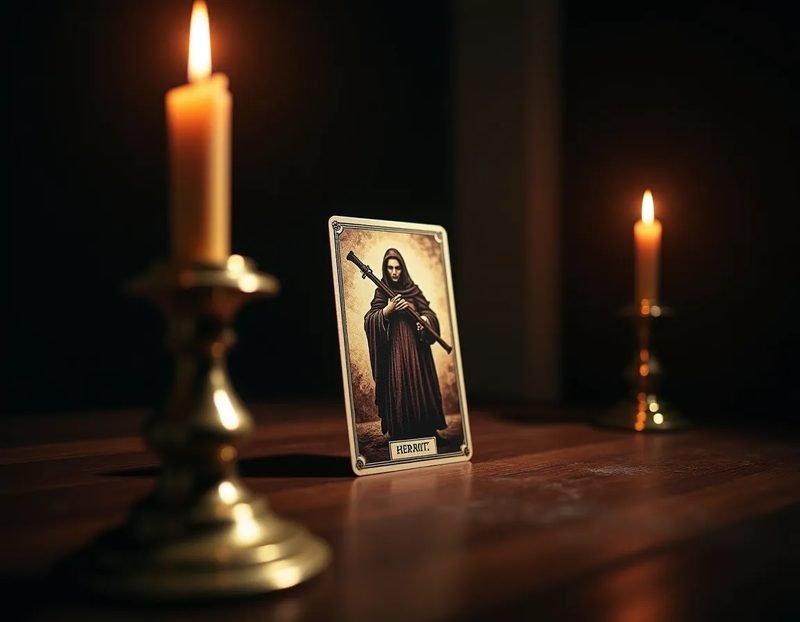
Most performers pick a force and then find out what card they ended up with. Reverse that. Decide which card you want to be the centerpiece of your effect, then pick the method that lands there.
- The Hermit suits a quiet, one-on-one piece. It reads as introspection, and spectators tend to lean in.
- Death is the crowd favorite and the most dangerous. It gets a laugh or a flinch, and you don’t control which one.
- The Moon pairs beautifully with impressions, dreams, and anything with a lunar or nocturnal theme.
- The Wheel of Fortune is underrated for predictions, since the imagery already suggests fate and chance colliding.
- The Fool is a great closer for a skeptical audience, because it lets you finish with a smile instead of a shiver.
I’ve watched a perfectly good prediction die because the forced card was Judgement, and the performer had nothing to say about it. Dead air on a loaded image is worse than dead air on a plain one. Know what your card will make the room think.
The Fortune Teller Line
Here’s where it gets slippery. Put a tarot card in front of a spectator and they’ll ask what it means. Answer, and you’ve crossed into reading. Refuse, and you’ve broken the spell you just cast.
I’ve been asked at private events in Anchorage to tell someone about their marriage, their job, a pregnancy that hasn’t been announced yet. I don’t do it. Not because I’m squeamish, but because a mentalist who gives sincere readings has quietly changed jobs. Now you’re responsible for what you say, and people remember advice far longer than they remember effects.
The move that works for me is to keep the interpretation in the historical or symbolic register. “Traditionally, this card speaks of sudden upheaval, the collapse of something built on false footing.” That’s true. It’s about the card, not about them. Let the spectator do the personal translation. They will, every time, and they’ll credit you with an insight you never claimed.
My hands go still when someone leans across the table and says, “No, but really, what do you see?” That’s the moment. Smile. Say the card only tells you what it has always told people. Then move on.
Three Structures That Hold Up
The prediction structure. A card is sealed in an envelope or a small wooden box before the show starts. A spectator selects, the envelope is opened, the images match. Simple, old, and it works because tarot art is distinctive enough that the match feels undeniable. Nobody wonders whether a card “counts” as close. It’s either The Empress or it isn’t.
The divination structure. The spectator shuffles the Majors privately, chooses one, and you name it. The trick is in the build. Don’t jump to the name. Start with the mood of the card, the color, a single object in the illustration, then arrive at the title. Three or four beats of narrowing feel like a mind at work. A single flat announcement feels like a stunt.
The imagery structure. The spectator thinks of a card and you draw or describe its dominant symbol, the tower struck by lightning, the figure hung by one foot, the lantern held aloft. This one demands the most from you as a storyteller and rewards you the most. It’s also the closest to reading, so guard the frame carefully.
All three structures gain from a physical anchor. A linen bag, a tarnished spoon used as a pointer, a single stub of candle. Give the spectator’s eye something to rest on besides your face.
Presentation That Keeps You on Your Side of the Line
Your persona decides whether tarot elevates you or trips you. Three habits keep me steady.
- Frame yourself as a collector, not a channel. “This deck has been through a lot of hands” carries mystery without claiming access to anything.
- Talk about the cards, never about the future. Symbolism and history are safe ground. Prophecy is not.
- Let the effect end on the effect. Once the impossible thing has happened, stop. Every extra sentence is a chance to drift into a reading.
The prop itself matters more than performers admit. A cheap, glossy deck signals a party trick. An aged, matte-finish deck with soft corners tells the room you take this seriously, and they’ll respond by taking it seriously too! Cards that look handled and old give you credibility before you speak.
I don’t claim the cards know anything. I do have a firm conviction that a room full of adults will treat an old tarot deck as if it might, and that’s a gift you can use honestly.
Where to Start
Pick one card. Just one. Build a three-minute piece around The Magician, or The High Priestess, or The Hanged Man, and learn everything about its imagery, its history, and how a room reacts when it appears. Then build a second. Twenty-two cards is a lot of ground, and the performers who try to cover it all end up with a show that sounds like a lecture.
Depth beats breadth here. Always has.
If you’re building a tarot routine and want props with real character, decks, boxes, and pieces that look like they’ve earned their age, you my friend, are home. Browse the current collection at https://arcanerelics.com/shop/.